
Quick Answer: Why Do Bilingual Children Stop Speaking Their Home Language?
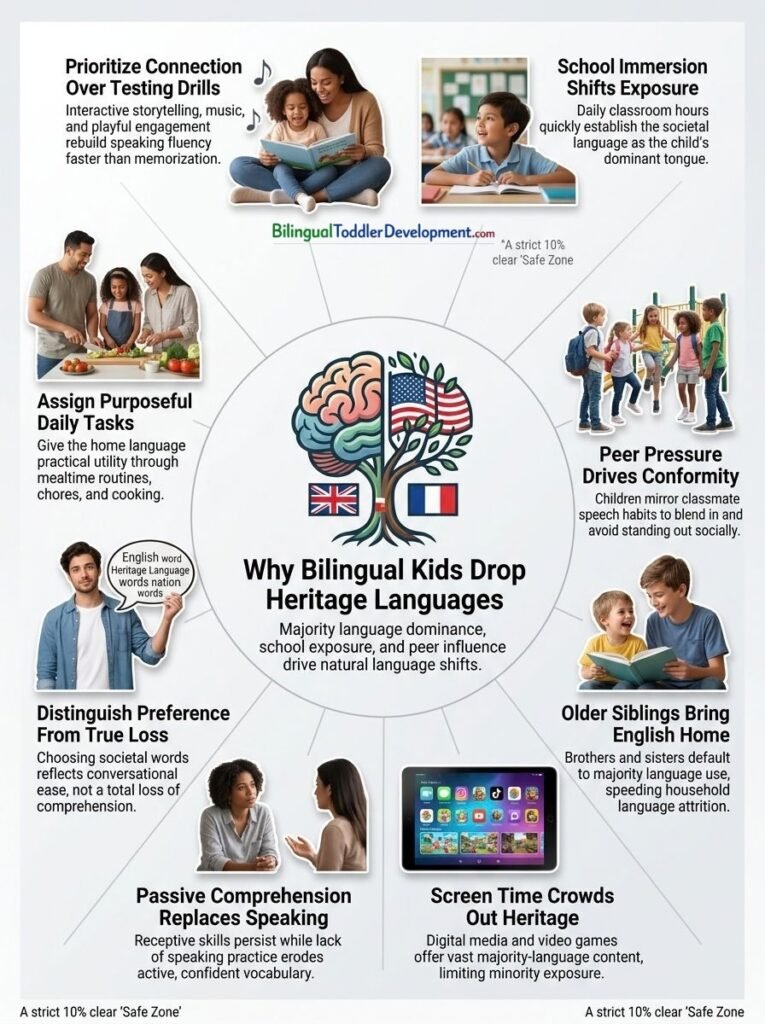
A bilingual child may stop speaking their home language when another language becomes easier, more useful, or more socially important in daily life. This often happens after a child starts daycare or school and begins spending much more time using English with teachers, friends, siblings, and media.
Your child may still understand the home language even if they answer almost entirely in English. In some children, this develops into receptive bilingualism, where understanding remains stronger than speaking.
This shift does not necessarily mean your child has rejected the home language, your culture, or your family. But if opportunities to use the language continue to decrease, speaking skills and eventually some understanding can weaken.
The good news is that a home language does not have to disappear. Regular exposure, meaningful conversations, family relationships, and positive cultural experiences can help keep it an active part of your child’s life.
Is It Normal for a Bilingual Child to Stop Speaking Their Home Language?
It is common for bilingual children to begin using the majority language more often as their language environment changes.
A young child may spend most of the day at home hearing Spanish, Mandarin, Arabic, Polish, or another family language. Then preschool or kindergarten begins.
Suddenly, English may fill much of the child’s day.
It becomes the language of teachers, classmates, playground games, books, schoolwork, television, and conversations with friends. With so much practice, English may become easier to retrieve and more natural to use.
This can also change a child’s language dominance. The language that once seemed strongest does not necessarily remain the strongest language as a child’s environment changes.
A child may therefore understand a parent perfectly well in the home language and still respond in English.
That is different from completely losing the language.
A useful way to think about the difference is:
Language preference means your child tends to choose one language because it is easier, more familiar, or more useful in a particular situation.
Receptive bilingualism means your child can understand a language better than they can speak it.
Language loss or attrition occurs when skills in a language weaken because the child has fewer opportunities or reasons to use it.
These patterns can overlap, and they can change over time.
Why a Bilingual Child May Start Using the Majority Language More
Children do not use their languages equally simply because they are bilingual.
They use the languages that are part of their lives.
If English becomes the language your child needs for school, friendships, entertainment, and most activities outside the home, it may gradually become the language they use automatically.
School and Daycare Can Change the Language Balance
Starting daycare, preschool, or elementary school can dramatically change how much time a child spends hearing and speaking each language.
A child who previously spent much of the day hearing the home language may suddenly spend six or more hours in an English-speaking environment.
That adds up quickly.
English is no longer simply another language the child knows. It becomes the language they need to follow directions, learn new concepts, play with classmates, ask for help, and participate in school.
This does not mean parents need to compete with school. It means the home language may need continued opportunities to remain active once the child’s language environment changes.
Friends and Peers Influence Which Language a Child Uses
Language is also social.
Children use it to make friends, tell jokes, join games, share secrets, and feel that they belong.
If most of your child’s friends speak English, English may become closely associated with fun and friendship. Your child may even use English with another bilingual child who speaks the same home language.
That does not necessarily reflect a negative attitude toward the home language. It may simply be the language both children are accustomed to using together.
Peer influence can become stronger as children get older and become increasingly aware of how they fit into their social world.
Siblings Can Bring the Majority Language Home
Parents may speak the home language consistently and still notice English gradually taking over conversations between their children.
An older child who attends school may bring English expressions, jokes, games, and vocabulary home. Younger siblings often copy them.
Before long, English can become the language the children naturally use with each other, even when both understand the family language.
This is one reason language exposure is not simply about counting how many hours a child hears each language. Who uses the language, when they use it, and what the child does with it also matter.
Media Can Add to the Shift
Television, streaming video, games, music, and other media can add many more hours of exposure to the majority language.
If school is in English, friends speak English, and most entertainment is also in English, the home language may occupy a relatively small part of the child’s waking day.
Home-language media can help rebalance that exposure, particularly when it leads to conversation.
Watching a show together and talking about what happened, singing a song together, or listening to an audiobook and discussing the story gives the language a social purpose.
The goal is not simply to surround a child with sound. Children also need meaningful interaction.
The Majority Language May Simply Become Easier
Children often choose the language that requires the least effort in the moment.
If your child spends most of the day speaking English, English words may come to mind faster. They may know how to describe school, games, friends, science, sports, and other parts of their lives more easily in English.
Answering in English may therefore have little to do with rejecting the home language.
It may simply be easier.
Why Does My Child Understand the Home Language but Not Speak It?
Understanding and speaking are related, but they are not identical skills.
A child may hear the home language every day and understand almost everything a parent says while getting relatively little practice speaking it.
Over time, the gap can become noticeable.
Your child understands:
“Go get your shoes because we’re leaving in five minutes.”
But when you ask what happened at school, the answer comes back in English.
This pattern is particularly common when parents continue using the home language but children discover that their parents also understand English.
Why struggle to find a word in the home language when the English word works immediately?
Your child may eventually become much stronger at understanding the language than producing it.
If this describes your child, see Why Does My Child Understand a Language but Not Speak It? for a closer look at the difference between receptive and expressive language.
How Language Dominance Can Change as Children Grow
Being bilingual does not mean both languages remain equally strong.
One language may be stronger for certain people, activities, or subjects. Those patterns can also change.
A child might speak Spanish most easily with grandparents but prefer English when discussing school. Another child might understand a home language extremely well but have a larger speaking vocabulary in English.
A move, a new school, more time with relatives, a bilingual program, or changes in family routines can shift that balance again.
This is why a preference for English today does not necessarily predict permanent loss of the home language.
However, a language that is rarely used can become harder to speak.
Your child may begin giving shorter answers, substituting English words, or struggling to tell a detailed story in the home language. The knowledge may not be gone, but accessing it can become more difficult.
How Culture and Identity Affect a Child’s Language Choice
A home language is more than a collection of vocabulary words.
It may carry family stories, humor, traditions, songs, food, memories, relationships, and ways of expressing affection.
That makes maintaining a home language partly a language-development issue and partly an identity issue.
Children Learn Where Each Language Belongs
Bilingual children quickly notice that different languages may dominate different parts of their lives.
English may belong to school and friends.
The home language may belong to parents and grandparents.
There is nothing inherently wrong with using languages in different settings. Bilingual people commonly use their languages differently depending on where they are and whom they are talking to.
The challenge comes when the home language becomes restricted to only a few situations, particularly commands and routine questions.
- “Put on your shoes.”
- “Eat your dinner.”
- “Time for bed.”
Those exchanges keep a language present, but they do not give children much opportunity to use it for imagination, humor, opinions, emotions, storytelling, or problem-solving.
Try to let the home language participate in the interesting parts of family life too.
Wanting to Fit In Can Affect Language Choice
As children become more socially aware, they may notice that speaking another language makes their family different from some of their friends’ families.
Some children enjoy that difference.
Others may become self-conscious about it, particularly in public or around peers.
A child who happily speaks the home language with Grandma may suddenly answer a parent in English when friends are nearby.
Avoid treating this as a betrayal.
Belonging is important to children, and attitudes toward language and identity can change considerably as they grow.
A child who resists a heritage language at one age may become curious about it later when they begin thinking more deeply about family history, culture, travel, or their own identity.
Make the Home Language Part of Family Connection
Children have more reason to value a language when it connects them to people and experiences that matter.
A conversation with a grandparent gives the language a purpose.
So does learning a family recipe, hearing a story about a parent’s childhood, singing a traditional song, celebrating a holiday, or talking with cousins.
These experiences teach something a vocabulary worksheet cannot:
This language is part of who we are and how we connect with one another.
That connection can become increasingly meaningful as a child grows.
Is My Child Losing Their Home Language?
Speaking less does not automatically mean a child is losing the language.
Look at what is changing over time.
A child who answers in English but still understands family conversations, follows directions, enjoys stories, and laughs at jokes in the home language retains meaningful knowledge of that language.
More noticeable language loss may involve a broader decline.
You might see:
- difficulty finding home-language words that were once familiar
- increasingly short or simple responses
- more difficulty understanding detailed stories or conversations
- frequent reliance on English words because home-language vocabulary is harder to retrieve
- difficulty following home-language conversations that were previously understood
The important distinction is between choosing not to use a language and having increasing difficulty using or understanding it.
Continued understanding matters even when speaking has declined. A child who retains strong comprehension has maintained an important connection to the language and may have an easier foundation for strengthening speaking skills later.
What Should Parents Do When a Child Stops Speaking the Home Language?
The goal does not have to be forcing your child to speak the home language in every conversation.
A better goal is to keep giving the language a meaningful place in your child’s life.
Keep Speaking the Home Language
If the home language is the language you naturally use with your child, continue using it.
Your child may answer in English. You can acknowledge the answer and continue the conversation in the home language without turning the exchange into a confrontation.
If your child gets stuck, supply the word naturally.
Mixed-language answers can also be part of bilingual communication. You do not need to correct every sentence before continuing the conversation.
Warm, frequent interaction gives children something far more important than perfect performance: a reason to keep participating.
Give the Language a Real Purpose
Children are more likely to use a language when they need it to do something meaningful.
That might mean:
- talking with a grandparent or relative
- helping prepare a family recipe
- playing with other children who speak the language
- choosing music or a movie
- playing a game
- telling a family story
- participating in a cultural or community activity
The language should do something in your child’s life.
For more practical strategies, see How to Encourage a Bilingual Toddler to Speak the Home Language.
Strengthen the Cultural Connection
Books, songs, celebrations, food, family photographs, stories, and visits with relatives can make the home language part of something larger than language practice.
As children grow, explain why the language matters to your family.
Perhaps it allows your child to speak with grandparents.
Perhaps it connects them with relatives in another country.
Perhaps it gives them access to family stories, music, humor, traditions, or a part of their heritage they might otherwise experience only indirectly.
The goal is not to make a child feel guilty about losing the language. It is to give them positive reasons to want to keep it.
For a broader maintenance strategy, see How to Help Your Child Maintain a Heritage Language.
Avoid Turning the Language Into a Test
“What is this called?”
“Say it in Spanish.”
“No, don’t answer in English.”
Repeated demands can make ordinary family conversation feel like a language lesson.
There may be times when encouraging a child to try again is perfectly reasonable, but constant correction can make a hesitant speaker even more reluctant to participate.
Conversation should still feel like conversation.
Listen to what your child is trying to tell you. Respond to the message first. Model words and grammar naturally when needed.
Connection is more important than catching every mistake.
Can a Child Start Speaking the Home Language Again?
Yes. Reduced speaking does not mean the door has closed.
Children can strengthen a home language when opportunities to hear and use it increase again. Older children, teenagers, and adults can also reconnect with heritage languages.
A child who already understands much of the language has something valuable to build on.
Start with the language your child has now rather than the language you think they should have.
A child who understands well but gives one-word answers may gradually begin producing longer responses. A child who mixes languages may begin finding more home-language words as speaking becomes easier.
Progress does not have to be immediate or perfectly linear.
A family visit might produce a burst of home-language speaking. A busy month at school might shift the balance back toward English.
Look at the pattern over time rather than judging success conversation by conversation.
When Should Parents Be Concerned About Their Child’s Language Development?
A child preferring English over the home language is not, by itself, evidence of a language disorder.
Multilingual children can have different strengths across their languages, and their stronger language can change as their exposure and communication needs change.
What deserves closer attention is a broader or unexpected difficulty with communication.
For example, talk with your child’s pediatrician or a speech-language pathologist if you are concerned that your child is losing previously acquired communication skills, has persistent difficulty understanding language, or struggles to communicate effectively beyond what you would expect from their opportunities to learn and use each language.
Bilingualism itself does not cause a speech or language disorder.
Because bilingual children’s knowledge is distributed across their languages, an evaluation should consider the child’s complete language background rather than judging their abilities from English alone.
If you are wondering whether your child’s development warrants professional assessment, see When Does a Bilingual Child Need a Speech-Language Evaluation?.
Frequently Asked Questions About Children Stopping Their Home Language
Why Does My Child Answer Me in English When I Speak the Home Language?
Your child may understand the home language perfectly well but find English faster and easier to speak, particularly if English dominates school, friendships, and entertainment.
Continue using the home language naturally and create situations where it has a meaningful purpose rather than treating every English response as a problem.
Should I Make My Child Speak the Home Language?
Parents can set reasonable expectations about language use, but pressure and constant correction can make some children more reluctant to speak.
Regular exposure, patient modeling, meaningful conversation, and genuine reasons to use the language are generally more helpful than turning ordinary conversation into a test.
Will My Child Forget the Home Language If They Stop Speaking It?
Skills can weaken when a language is rarely used. Speaking vocabulary may become harder to retrieve first, while understanding remains stronger.
Continued conversation, reading, family interaction, and other meaningful exposure can help maintain the language and provide opportunities to strengthen speaking again.
Can a Child Understand a Language but Not Speak It?
Yes. Some bilingual children understand a language much better than they speak it. This is often described as receptive bilingualism.
A child may understand everyday conversation but answer in the language that is easier to produce.
Can a Child Learn Their Home Language Again Later?
Yes. Children and adults can strengthen or relearn a heritage language later.
Existing comprehension, family relationships, community involvement, classes, books, music, travel, and regular conversations can all provide ways back into the language.
Maintaining some connection to the language now can make that path easier later.
Final Thoughts: Keeping the Home Language Part of Your Child’s Life
When a bilingual child starts speaking the majority language more and the home language less, it can be difficult for parents not to take the change personally.
But a child’s language choice is shaped by exposure, practice, school, friendships, convenience, culture, and the desire to belong.
Your child answering in English does not necessarily mean they are rejecting their family or heritage.
Keep the home language present in the parts of life that matter: meals, stories, jokes, music, games, celebrations, conversations with relatives, and family traditions.
Most importantly, give your child reasons to experience the home language as more than something they are supposed to practice.
Make it a language of relationships, belonging, and family life.
That gives your child something worth holding on to.