
You notice your bilingual toddler says fewer words in one language than other children.
They mix languages in the same sentence.
They understand much more than they say.
It can look like something is wrong — even when it isn’t.
Bilingual language development doesn’t always follow the same visible pattern as monolingual development. When you count words in just one language, progress can look slow. When you step back and look across both languages, the picture often changes.
In the U.S., more than 1 in 5 children grow up hearing a language other than English at home. Yet many families still receive outdated advice about confusion, delay, or needing to “pick one language.”
Before you make changes based on fear, it helps to understand what typical bilingual milestones really look like — what’s normal, what’s truly late, and what’s simply a myth.
Key Takeaways
- Bilingual children are not confused. Code mixing and code switching are normal parts of learning two languages.
- Count vocabulary across both languages. A child may know fewer words in each language, but their combined vocabulary can be right on track.
- Uneven skills are expected. One language often grows faster, especially the majority language from childcare or school.
- True delays show up in both languages. A real language delay affects overall communication, not just the minority language.
- Don’t ignore stacked red flags. Early evaluation is usually easier than waiting and worrying.
- Consistency matters more than perfection. Daily exposure and playful interaction support stronger long-term outcomes.
Before you can decide whether something is typical or concerning, you need a clear picture of how bilingual language development actually unfolds. Milestones still matter, but they need to be interpreted through the lens of exposure, timing, and growth across both languages.
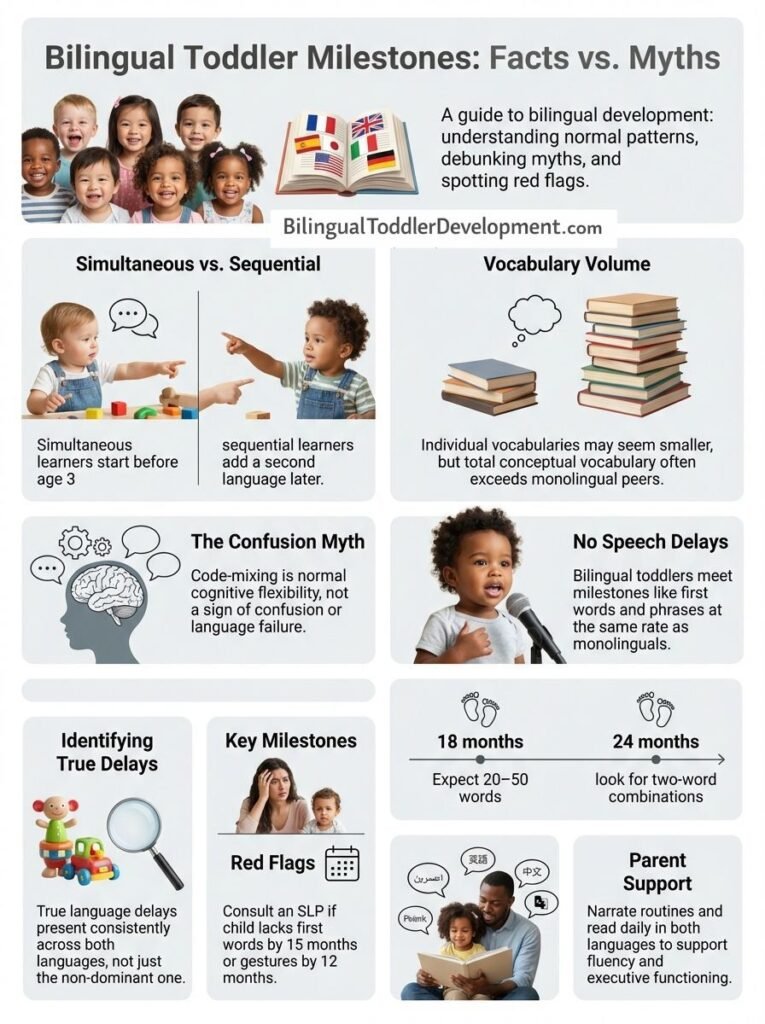
Understanding Bilingual Language Development Milestones
Bilingual toddlers can reach language milestones through more than one path. Some learn two languages from the start, and others add a second language after the first is underway.
Your job is not to “force balance.” Your job is to look for steady progress in language development, across both languages, and to spot patterns that point to a real language delay.
- Progress: new words, more attempts to communicate, longer phrases over time
- Clarity: speech becomes easier to understand as they grow
- Connection: gestures, joint attention, and back-and-forth interaction
- Consistency: skills show up in both languages, even if one is stronger
Simultaneous vs. Sequential Bilingualism
A simultaneous bilingual is exposed to two or more languages early, typically before age 3. A sequential bilingual adds a second language after age 3, once some proficiency is established in the first language (these are the timing definitions used by the American Speech-Language-Hearing Association).
One practical difference is what you see day to day. Sequential bilinguals may go through a short phase where they listen a lot and talk less in the new language. ASHA describes this as a possible “silent period” in early second-language learning, and it usually reflects listening and comprehension growing faster than speaking.
| Type | What it often looks like at home | What to do |
|---|---|---|
| Simultaneous bilingualism | Words appear in both languages, with plenty of mixing early on | Keep using both languages naturally, keep routines predictable |
| Sequential bilingualism | One language dominates, the newer language may start slowly | Give low-pressure chances to use the second language, keep the first language strong |
Typical Language Development Patterns
A common pattern is the “distributed” bilingual vocabulary. Your toddler may know food words in one language and play words in the other, because that’s where those topics show up in daily life.
A helpful way to track vocabulary development is to count what your child can say across both languages, and avoid double-counting exact translation equivalents. A 2024 JAMA Pediatrics article aimed at parents describes this approach as a more accurate way to judge early language acquisition in multilingual kids.
If you want a simple system that stays consistent week to week, try this:
- Make a two-column list (Language A and Language B).
- Circle words your child knows in both languages (translation equivalents).
- Track growth monthly, not daily, so you see the trend.
- Write down new phrases, not just single words, because phrases show real language processing.
If you’re working with a speech-language pathologist, ask whether they use parent-report tools such as the MacArthur-Bates Communicative Development Inventories (MB-CDIs), and whether they can interpret results in a bilingual or multilingual context.
Debunking Common Myths
The fastest way to reduce anxiety is to separate what’s normal bilingual language learning from what’s truly concerning. Many families hear “Pick one language,” or “Mixing means confusion,” and it pushes them to drop the home language.
Hearing multiple languages does not cause a speech or language disorder. The real question is whether your child is progressing, and whether concerns show up across both languages.
Myth 1: Learning Two Languages Causes Confusion
Young children can tell languages apart, and they adjust based on who they are talking to. Mixing languages is not proof of confusion. It’s usually a sign that the child has two active systems and is using whatever words come fastest in that moment.
If you want to test this at home, watch what happens when the context changes:
- Does your toddler choose different words with different people?
- Do they understand simple directions in both languages, even if they answer in only one?
- Do they switch languages more when tired, excited, or rushed?
Those patterns point to flexible language learning, not a breakdown in development of language.
Myth 2: Bilingualism Causes Speech Delays
Being bilingual or multilingual is not the cause of speech delays. A true delay has other drivers, such as hearing loss, autism spectrum disorders, broader developmental delays, or limited access to meaningful interaction in either language.
An evidence-based checkpoint is the “late talker” profile. A 2023 clinical review in American Family Physician notes that watchful waiting is not recommended when a child is 24 months or older with fewer than 50 words, or with no two-word combinations, and that referral criteria are the same for bilingual and monolingual children.
Also, don’t skip the basics. If speech feels stalled or unclear, ask your pediatrician about hearing testing and an audiology referral, because hearing loss can look like a language processing problem.
Myth 3: Mixing Languages Indicates Failure
Code mixing is expected, especially while vocabulary size is growing and while the child is learning which words “belong” to which listener and setting.
In a longitudinal study of Spanish-English bilingual toddlers published in 2019, children who code-switched did so in a meaningful, patterned way, and code-switching showed up in a measurable portion of their utterances during play, rather than being random noise.
What helps most is how you respond in the moment:
- Stay responsive: answer the message, not the language choice.
- Model, don’t correct: repeat the idea back in the target language as a full sentence.
- Keep conversations moving: long pauses for “say it right” can reduce communication skills.
- Use clear routines: predictable contexts make word learning easier.
What’s Normal for Bilingual Toddlers?
“Normal” in bilingual toddlers usually means: steady progress, even if it’s uneven across the minority language and majority language. You might see strong understanding in both languages while speaking is stronger in only one.
To keep your expectations grounded, use milestones as a range, then focus on momentum: is your child adding new ways to communicate every few weeks?
Code-Mixing as a Natural Stage
Many bilingual toddlers code-mix because their vocabulary is still under construction. They may have the concept in mind but only have the word in one language, or they may borrow a word because it comes faster.
If you want a simple “normal vs. needs-help” filter, use this rule:
- Usually normal: mixing increases during excitement, new settings, or fast play.
- Worth a closer look: your child rarely attempts words in either language, and frustration or withdrawal is rising.
- Concerning: you see a long plateau in both languages, with fewer attempts to communicate over time.
Grammar and Vocabulary Development
For bilingual toddlers, vocabulary development is best judged across both languages, and then paired with functional milestones like gestures, imitation, and combining words.
The CDC’s updated developmental milestones (2022) include “says at least two words together” as a typical language/communication milestone by age 2, and that’s a useful anchor even for bilingual children.
| Age range | What you often see | What to do next |
|---|---|---|
| 12-18 months | First meaningful words may appear in either language, gestures should be growing | Increase face-to-face talk during routines, keep it playful and frequent |
| 18-24 months | Fast word learning, more attempts to label and request, early two-word combinations may start | Track combined words and new phrase attempts across both languages |
| 24-36 months | Two-word phrases become more common, speech clarity improves, mixing often starts to drop | Model short sentences in the target language, then pause so your child can take a turn |
| 3-4 years | Longer sentences, storytelling begins, strangers understand much more | If speech is still hard to understand in both languages, ask for a speech-language pathologist evaluation |
For speech clarity, many clinicians use a simple intelligibility rule of thumb (often called “age divided by four”): unfamiliar listeners understand about 50% of a 2-year-old’s speech and about 75% of a 3-year-old’s speech. Use it as a trend check, not a pass-fail test.
When to Be Concerned
It’s time to pay closer attention when you see a pattern, not a one-off “bad week.” Look for persistent difficulty with language processing, limited growth in communication skills, or reduced social understanding, across settings and across both languages.
If you’re unsure, you can start with three steps: talk to your pediatrician, request a speech-language pathologist evaluation, and ask whether a hearing check is needed.
Signs of a True Language Delay
These signs matter more than whether your child prefers the majority language or minority language right now. They point to possible language delays that deserve a closer look.
- Limited gestures by about 12 months: little pointing, showing, waving, or shared attention.
- No clear first words by about 15 months: very few meaningful word attempts in either language.
- Slow vocabulary growth across both languages: you see a long plateau rather than steady additions.
- No word combinations by about 24 months: no consistent two-word phrases in either language.
- Speech stays hard to understand after age 3: unfamiliar listeners struggle in both languages.
- Loss of skills at any age: fewer words, fewer gestures, or less social connection than before.
If several items fit your child, schedule an evaluation rather than waiting for the next “jump.”
Importance of Consistent Delays Across Both Languages
A core bilingual assessment principle is this: a difference in just one language often reflects exposure patterns, but a delay across both languages can reflect a real disorder.
That’s also why bilingual evaluations matter. A valid assessment looks at your child’s skills in both languages, and it may use trained interpreters when the clinician does not speak the family’s languages (this approach is outlined in ASHA guidance on multilingual service delivery).
In the U.S., you also have a public option for support. Under IDEA Part C, states must complete the initial evaluation and the first planning meeting within 45 days of referral, and evaluations and assessments cannot be withheld just because a family cannot pay.
Supporting Bilingual Language Development
The best support is simple and consistent: warm interaction, lots of meaningful talk, and daily chances to hear and use each language. You do not need a perfect system to support language learning.
If you suspect a language delay, keep both languages going while you seek help. Bilingual children can make excellent progress with therapy that respects the child’s full language environment.
Engaging in Rich Conversations
Talk with your child throughout the day, in both languages. Let them choose the language they want for the message, then you model a clear version back.
- Use “serve and return” turns: your child vocalizes or gestures, you respond, then you pause.
- Narrate routines: meals, bath, and getting dressed create repeated word learning opportunities.
- Expand their message: if they say “milk,” you say “More milk, please” in the target language.
- Ask simple choices: “Apple or banana?” reduces pressure and increases successful talking.
- Share the plan with caregivers: align with childcare staff and family members so language exposure stays steady.
- Get help early if progress stalls: an SLP can separate normal bilingual patterns from language delays.
Reading in Both Languages
Shared reading is one of the easiest ways to boost vocabulary development, grammar, and attention. Keep it short, enjoyable, and repeat favorite books.
Reach Out and Read reports distributing millions of books at well-child visits each year in the U.S., and their model includes guidance to families on reading aloud from birth through age 5, which is a strong reminder that small daily habits compound.
- Keep it realistic: aim for 10 minutes a day, then build up if your child enjoys it.
- Reread favorites: repetition supports language processing and new word learning.
- Make it interactive: point, label, and ask “Where is it?” questions in both languages.
- Use wordless books: you can tell the story in any language, which supports dual language learning.
- Sing and rhyme: rhythm supports memory for sounds and phrases.
- If reading feels hard: try audiobooks paired with the print book, then talk about pictures together.
Conclusion
Bilingual toddlers reach language milestones in more than one valid way.
Code mixing, uneven vocabulary, and temporary dominance in one language are usually signs of active language learning — not confusion or delay.
What matters most is steady progress across both languages: growing vocabulary, emerging word combinations, clearer speech over time, and strong back-and-forth interaction.
If concerns appear in both languages, or progress stalls rather than fluctuates, seek a speech-language pathologist for a bilingual-informed evaluation. Early guidance provides clarity and support — not a label.
With consistent exposure, meaningful interaction, and realistic expectations, most bilingual children develop strong communication skills in both languages.