
If you’ve ever hesitated before speaking your home language to your baby, you’re not alone.
Many parents quietly wonder: Will two languages confuse my child? Will they talk later? Am I making this harder than it needs to be? The fear is understandable. The early years feel fragile, and language feels foundational.
But here’s what brain science shows: your baby’s brain is not fragile when it comes to language. It is astonishingly prepared.
In the first three years of life, the brain is running one of the most powerful pattern-recognition systems it will ever have. It listens for rhythms, sorts sound contrasts, predicts word boundaries, and builds separate, efficient maps for the languages it hears most. It doesn’t “mix them up.” It organizes them.
What looks like confusion from the outside — language mixing, uneven vocabulary, preference shifts — is usually the brain doing exactly what it was designed to do: adapt to input.
This article walks you through what actually happens inside the bilingual brain from birth to age three, why code mixing is normal for both simultaneous and sequential bilingual children, and what you can do at home and in childcare to support strong vocabulary development and long-term language proficiency.
Key Takeaways
- Dual-language exposure does not confuse babies. From birth, infants can sort languages by rhythm, and by about four months they can distinguish even similar-sounding languages.
- Exposure drives strength. The more consistently a child hears and uses a language, the stronger their vocabulary and grammar will be in that language — especially for speaking.
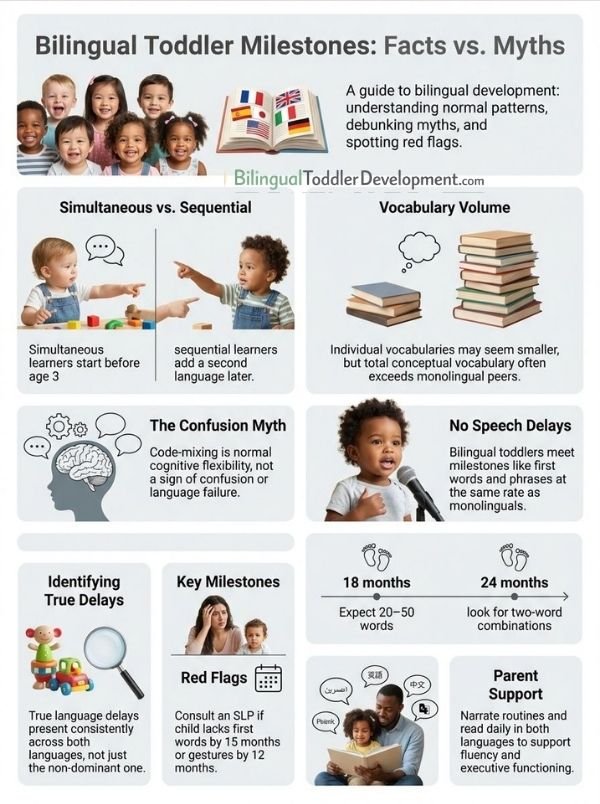
- Code mixing is normal and rule-governed. When toddlers combine languages, they are communicating efficiently, not showing signs of delay.
- Vocabulary is distributed across languages. A bilingual child’s total conceptual vocabulary often matches monolingual peers, even if each single-language list looks smaller.
- Interactive talk beats passive input. Live, back-and-forth conversation builds the strongest language pathways in the first three years.
- Evaluation should include both languages. Monolingual-only assessments can overidentify delays in bilingual children.
The Science of Early Bilingual Brain Development
From birth to age three, the brain is highly plastic. It rapidly builds networks for sound, meaning, and grammar, and it can do that for multiple languages at the same time.
When researchers talk about the “language network,” they often mean regions such as Broca’s area (planning speech and grammar) and Wernicke’s area (supporting word meaning), along with auditory cortex regions that tune to the sounds your child hears most.
Because babies cannot sit still in a scanner for long, scientists often use a mix of tools. Functional magnetic resonance imaging (fMRI) and near infrared spectroscopy (NIRS or fNIRS) both track changes linked to brain activity, and fNIRS is especially practical with infants because it is quiet and movement-tolerant.
- What brain imaging can tell you: which networks light up during language processing, and how quickly infants adapt to frequent sound patterns.
- What it cannot prove: that one specific parenting strategy “causes” better outcomes on its own, because home input, childcare, and community language all change together.
- The practical takeaway: consistency and interactive talk drive the strongest learning signals, especially in the first three years.
Brain plasticity in the first three years
Plasticity means your child’s brain is constantly updating its predictions about speech. It listens for patterns, then uses those patterns to decide what counts as a meaningful sound and what can be ignored.
This is why early input matters for accent and phoneme learning. If one language is rarely heard, the brain has less reason to keep fine-grained sensitivity to that language’s sound contrasts.
| Age window | What’s developing | What helps most at home |
|---|---|---|
| 0 to 6 months | Sound discrimination and early sound mapping | Short, frequent “face-to-face” talk in each language, with clear articulation and warm attention |
| 6 to 18 months | Word learning, gesture use, and early comprehension | Label what your child is focused on, repeat key nouns and verbs, and link words to real actions |
| 18 to 36 months | Sentence processing, grammar growth, and rapid vocabulary expansion | Back-and-forth play, story talk, and predictable routines that reliably happen in each language |
If you want one simple principle, treat each language like a “daily diet.” Your child does best when both languages show up often, in meaningful interactions, not just in background noise.
Dual language exposure and neural pathways
In research, “bilingual exposure” is usually defined by the percentage of time a child hears each language, and studies use different cutoffs. A large multi-lab infant study described prior work using minimum exposure criteria ranging from about 10% up to 40% for the non-dominant language, which is one reason families hear conflicting advice.
For vocabulary development in a specific language, the proportion matters. A National Academies review summarizing dual language learner research notes that exposure predicts vocabulary and grammar in each language, and one study (Thordardottir, 2011) reported children often needed about 40% to 60% exposure to score in the monolingual range for receptive vocabulary, and higher exposure for expressive vocabulary.
- Track hours, not vibes: If your toddler is awake about 12 hours a day, five hours a week in a second language is less than an hour a day. That is usually enough to recognize some words, but it is often not enough to “speak a language fluently.”
- Expect some switching: Recent work reports that, even in bilingual homes, only a minority of child-directed input includes switching, often estimated around 5% to 15%. That means your child gets plenty of clean, single-language runs too.
- Use more than one speaker when you can: Studies on bilingual toddlers have found that hearing a language from multiple speakers and contexts supports stronger word learning and comprehension.
A good reality check is this: children do not need perfect separation, but they do need enough high-quality exposure for each language to “pay rent” in the brain.
Stages of Bilingual Development in the First Three Years
Most bilingual children hit the same big milestones as monolinguals. The difference is where the words “live,” since vocabulary can be split across languages.
If you only count one language, you can miss how much your child already knows.
- Birth to 12 months: sound mapping, phoneme tuning, and social learning.
- 1 to 2 years: first words, fast word learning, and early code mixing.
- 2 to 3 years: vocabulary expansion, early grammar, and language preference shifts shaped by childcare and peers.
Birth to 12 months: Phoneme recognition and sound mapping
Newborns can discriminate languages that differ in rhythm, and by about four months, bilingual infants can also tell apart languages that are rhythmically similar. That early “sorting” is a feature of language processing, not a sign of confusion.
Babies also learn best through social interaction. Classic studies comparing live interaction to video show that infants pick up more from responsive, real-time communication than from passive viewing.
- Use “parentese” in both languages: a warmer tone, shorter sentences, and clear pauses help babies find word boundaries.
- Make it responsive: comment on what your baby is looking at, then wait for a sound, gesture, or glance back.
- Keep screens in their place: guidance updated June 2025 recommends screens for under 18 months be limited to video chat with an adult, since babies learn language best from people.
- Build sound maps with routines: diaper changes, meals, and bath time work because the same words recur with the same actions.
If your baby gets one language mainly through overheard adult conversation, shift some of that language into direct baby talk. The “serve and return” loop is where the learning happens.
1 to 2 years: Emergence of first words and language mixing
Between one and two, bilingual children begin producing words, and many start code mixing. This is usually driven by limited vocabulary in each language plus a smart instinct to keep the conversation moving.
Researchers have found that toddlers can understand code-mixed sentences by around 20 months, and they can learn which language “goes with” which person by about age two.
Code mixing is often a sign of efficiency: your child is using the word that comes fastest, not failing to separate languages.
- Model the word you want, without shutting them down: if they say “agua,” you can respond, “Yes, water, you want water.”
- Repeat labels in meaningful moments: snacks, getting dressed, and play are where verbs and nouns stick.
- Count conceptual vocabulary: “dog” and “perro” are one concept. Tools like the MacArthur-Bates Communicative Development Inventories include English and Spanish forms, and they can be scored in a way that merges concepts across the two languages.
If you are tracking progress, use totals across both languages first. Then look at each language separately to see which one needs more exposure.
2 to 3 years: Vocabulary expansion and preference shifts
Ages two to three bring rapid word learning and longer sentences. Many bilingual children’s total conceptual vocabulary looks similar to monolingual peers, even if each single-language list looks smaller.
This is also the stage where childcare and community language can tip the balance. If your child starts spending more hours in the majority language, you may see a clear language preference shift within months.
| Common shift | What you may notice | What to do this week |
|---|---|---|
| Majority language dominates after daycare starts | Minority language becomes quieter, with more “yes/no” answers | Create two daily minority-language anchors (for example, breakfast and bedtime story) that never switch |
| Minority language only used with one parent | Child understands but answers in the majority language | Keep speaking the minority language, and build “need to use” moments like games with turn-taking phrases |
| Child prefers peers’ language | More majority-language requests and pretend play | Add peer exposure in the minority language through playdates, caregivers, or weekend community programs |
In my experience working with families, the most overlooked step is creating predictable minority-language moments that your child can count on, even during busy weeks.
Myths About Early Bilingualism
Most myths about bilingual children come from one blind spot: people count the child’s words in only one language, then compare that number to monolingual norms.
Once you measure both languages and consider exposure, the “confusion” story does not hold up.
| Myth | What research supports | What you should do |
|---|---|---|
| “They’ll get confused.” | Infants discriminate their languages early, and toddlers adjust language use by conversation partner. | Keep both languages present daily, and treat switching as normal communication. |
| “Bilingualism causes language delay.” | Bilingual status alone is not linked to a higher risk of language delay, but bilingual children can score lower on single-language tests because their vocabulary is distributed. | Ask for bilingual-appropriate assessment and consider conceptual vocabulary. |
| “Never mix languages.” | Code mixing is common in bilingual families and tends to follow grammar-like patterns. | Choose a family strategy you can sustain, then increase consistent exposure where needed. |
Are bilingual children confused?
No. A practical way to think about it is that bilingual children run a fast “context filter.” They use cues like the speaker, the setting, and the topic to predict which words will work.
Even when toddlers hear a switch, research using eye-tracking and physiological measures suggests they handle it as a normal processing event, not as a breakdown in comprehension.
- Typical: mixing a noun from one language into the other, then continuing the sentence smoothly.
- Typical: answering in the dominant language even when you speak the minority language.
- Worth a closer look: losing words in both languages for weeks, or showing frustration and not understanding simple requests in either language.
If something feels off, trust your instincts. Just make sure you evaluate both languages before you label it “confusion.”
Does bilingualism cause delays in language development?
Evidence reviews in U.S. family medicine guidance note that bilingual status is not associated with an increased risk of speech and language delays. The more common issue is measurement, because standardized tests often reflect monolingual expectations.
That is why the best clinical question is not “How many English words?” It is “How many concepts does your child understand and say across their first language and second language?”
- Ask for a bilingual plan: evaluation should include parent interview about exposure, observation, and, when possible, testing in both languages.
- Check hearing early: hearing problems can look like a language delay, and they affect learning in every language.
- Support both languages in therapy: speech-language work is often most effective when families can practice skills in all spoken languages at home.
Should parents avoid mixing languages?
You do not need to avoid mixing languages to raise bilingual children. Many families mix for practical reasons, and children still develop two strong systems.
That said, if you are worried about vocabulary development in the minority language, you can tighten your routines so your child gets longer stretches of that language each day.
- One Person, One Language (OPOL): one caregiver consistently uses one language.
- Minority Language at Home: home stays in the minority language, with the majority language happening in childcare and the community.
- Time and Place: for example, one language at meals, another at bath time and bedtime.
- Repair technique: if your child mixes, reply with a correct model, then move on. Keep the conversation warm and fast.
The strategy that works is the one you can sustain on tired days, because consistent exposure beats perfect rules.
Cognitive Advantages of Early Bilingualism
Bilingual experience is often linked to executive functioning skills like shifting attention and managing interference. Some studies find advantages, and others find small or inconsistent effects once factors like socio-economic status and publication bias are considered.
So I frame this benefit carefully: bilingualism is a clear advantage for communication, family connection, and linguistic diversity. Any executive function boost is a possible bonus, and it depends on the child’s daily language demands.
Meta-analyses in 2020 and a Bayesian meta-analysis published in early 2026 suggest bilingual adults may experience dementia symptoms about 3 to 5 years later on average, while not showing a clear reduction in dementia incidence.
Enhanced problem-solving and multitasking skills
Bilingual children get practice selecting a target language and inhibiting the non-target language, especially when both languages are actively used in daily life.
Still, a 2021 meta-analysis of children’s executive functioning found the average “bilingual advantage” was small and could disappear after adjusting for publication bias, which is a good reminder not to oversell this point.
- Use language as a game: do quick “switch” rounds, like naming foods in one language, then animals in the other.
- Teach repair skills: “Try that again in Spanish,” or “Tell Grandma in English,” keeps switching purposeful.
- Protect depth, not just breadth: rich vocabulary in each language comes from stories, pretend play, and real conversation, not drills.
Improved attention and memory
Studies in infancy suggest bilingual and monolingual babies both respond strongly to infant-directed speech, and babies pay more attention when the language matches what they hear at home.
If you want to support working memory and attention during language learning, the most reliable tool is still interactive talk that follows your child’s focus.
- Narrate what they are doing: “You’re stacking, up, up, it fell.”
- Build translation equivalents: teach the same concept in both languages, because “double-labeling” helps children connect meaning across systems.
- Keep sentences short, then expand: child says “truck,” you say, “Big truck. The big truck is fast.”
Tips for Supporting a Bilingual Brain
The goal is simple: give your child enough meaningful exposure to each language that their brain keeps investing in it.
In the U.S., this often means planning around childcare hours, the community’s dominant language, and how much minority language time is left at home.
Create a consistent bilingual environment
Start by mapping a normal week. Write down where each language happens, with which people, and for how long.
Then choose one strategy that increases minority language exposure without creating stress.
| If your week looks like this | Try this adjustment |
|---|---|
| Most waking hours in majority language childcare | Reserve two daily routines for the minority language, and keep them stable (for example, breakfast and bedtime story) |
| Minority language only on weekends | Add a short weekday “language block” tied to a habit, like the walk to the park or bath time |
| Only one fluent minority-language speaker at home | Add input from other speakers through playdates, caregivers, or community groups, so your child hears varied accents and vocabulary |
Also, pick the language you can speak with confidence. Clear, natural speech supports better language processing than hesitant, simplified talk.
Encourage back-and-forth interactions
Conversational turns are your best “metric,” because they force comprehension and response. That is where language acquisition accelerates.
Programs used in some U.S. libraries have even used wearable audio tools to help families notice when talk drops off during the day, then build new routines that increase conversation.
- Follow your child’s lead: comment on what they choose, then pause for a response.
- Ask choice questions: “Apple or banana?” is easier than “What do you want?”
- Repeat with a small upgrade: child says “more,” you say “more milk” or “more bubbles.”
- Invite storytelling: at age two to three, ask “What happened?” with toys, pictures, or bedtime recap.
If you are getting pushback, keep your request small. One extra two-minute conversation per routine adds up fast over a week.
Expose children to diverse language contexts
Children learn the languages that consistently show up in their environment. If the minority language lives only inside your home, it is easier for the majority language to become the default.
In the latest state-level profiles based on U.S. Census survey data, there are about 7.1 million dual language learner children under age five, with many living in states like California, Texas, New York, Florida, and New Jersey. Those communities often have more options for bilingual childcare and early childhood education.
- Use local early childhood spaces: library story time, community centers, and playgroups can add real peer input.
- Choose childcare intentionally: ask whether caregivers use the minority language during play, routines, and conflict repair, not just songs.
- Protect the minority language socially: regular time with relatives or family friends creates a real reason to use the language.
- Keep the content age-real: toddlers need words for feelings, requests, and play scripts, not just colors and animals.
Conclusion
The first three years shape a bilingual brain, because plasticity and steady exposure build durable pathways for language acquisition.
Infants map sounds early, toddlers use code mixing as a normal strategy, and many children shift language use depending on people and settings by around age two.
If you want the best outcome, focus on consistent, interactive input in both the first language and second language, and use childcare and community time to protect the minority language before it gets crowded out by the dominant language.
FAQs
1. Will speaking two languages confuse my baby?
No. Infants can distinguish languages early in life and build separate sound systems for each one. Mixing words or preferring one language at times is a normal part of bilingual development — not confusion.
2. How much exposure does a child need to become bilingual?
There is no single magic percentage, but consistent daily exposure matters. Children typically need substantial, repeated interaction in a language to develop strong speaking skills. Recognition requires less exposure than fluent production.
3. Why does my toddler mix languages in one sentence?
Code mixing is common and usually reflects efficiency. Toddlers use the word that comes fastest or is strongest in that moment. It is not a sign of delay and often decreases as vocabulary grows.
4. Should I stop mixing languages when I speak?
You don’t need perfect separation. Many families naturally mix languages and still raise strong bilingual children. What matters most is that each language gets meaningful, interactive use.
5. What if my child prefers one language over the other?
Language preference often shifts based on childcare, peers, and community exposure. You can support the less-used language by creating predictable daily routines where it is consistently spoken.
6. When should I worry about a delay?
Consider seeking an evaluation if your child has very few words across both languages, does not combine words by around age two, or struggles to understand simple directions in either language. Make sure any evaluation considers both languages.