
How Speech Therapists Identify Language Disorders in Bilingual Children
Your bilingual child receives a low score on an English language test. Does that mean your child has a language disorder, or could the result reflect the fact that they’re still learning English?
It’s a question many parents face, especially when their child seems to communicate comfortably at home but struggles to express themselves at preschool or school.
The answer isn’t always obvious. A child who is learning two languages may show patterns that resemble a language delay, even when their development is progressing normally.
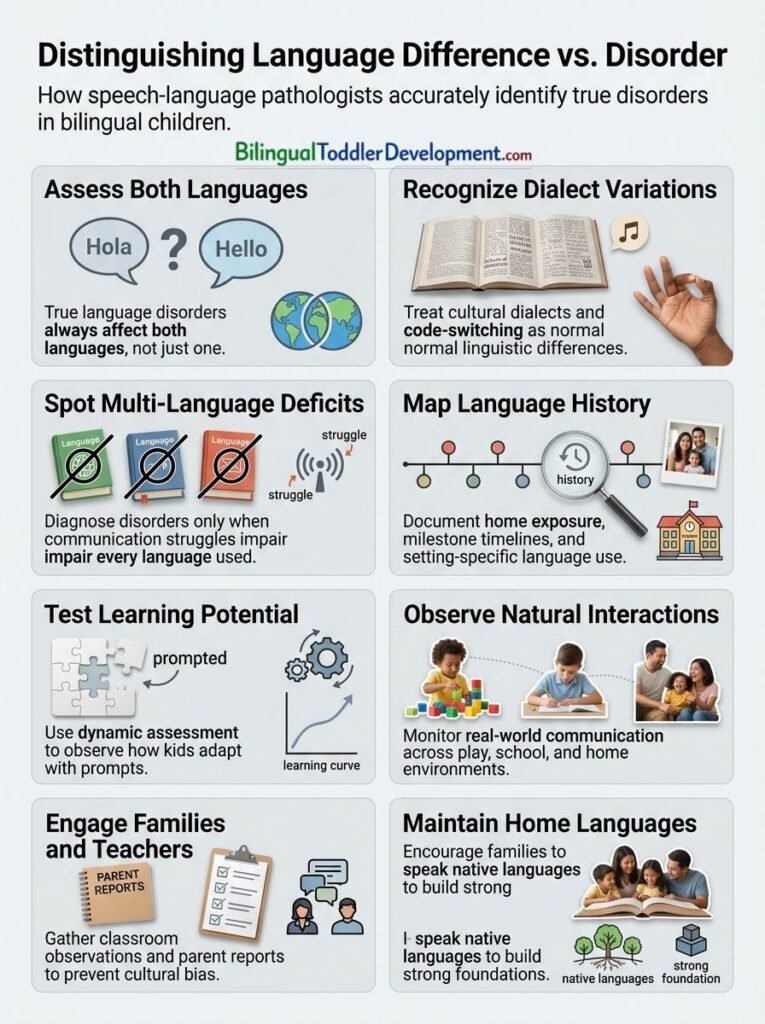
That’s why speech-language pathologists (SLPs) look beyond individual test scores. They examine how children communicate in their different languages, how they respond to teaching, and whether their difficulties affect everyday communication.
Understanding this process can help you make sense of an evaluation and feel more confident about the decisions that follow.
Quick Answer
Speech-language pathologists distinguish a language difference from a language disorder by examining a child’s abilities across their languages, their language-learning history, their response to teaching, and their communication in everyday situations.
A language difference reflects a child’s linguistic background and experiences. A language disorder involves persistent difficulties learning, understanding, or using language that cannot be adequately explained by language exposure or cultural differences.
No single test can reliably make this distinction for every bilingual child. SLPs combine several sources of information to reach a well-supported conclusion.
What Is the Difference Between a Language Difference and a Language Disorder?
The distinction comes down to whether a child’s communication patterns reflect their language-learning experiences or suggest an underlying difficulty with language development.
A language difference is not a disability. It describes communication patterns that are expected because of the languages or dialects a child uses.
For example, a Spanish-speaking child who recently started learning English might use Spanish sentence patterns when speaking English. The child may also know certain words in Spanish but not yet know their English equivalents.
These patterns can be normal parts of learning another language.
A language disorder, on the other hand, involves difficulties understanding or using language that interfere with communication and are not adequately explained by limited exposure, cultural differences, or typical language development.
A child with a language disorder might have trouble learning new words, understanding familiar instructions, or putting ideas into sentences, even when communicating in a language they know well.
Importantly, bilingualism does not cause language disorders.
Children who speak two languages can develop language disorders, just as children who speak one language can. Learning another language does not create the underlying difficulty.
If you’re still trying to determine whether your child’s development falls within the expected range, our guide to language delay vs. bilingual development explains some of the patterns parents commonly notice.
How Speech-Language Pathologists Evaluate the Evidence
A good bilingual language evaluation is more than a series of questions or a standardized test.
The SLP’s goal is to understand how the child learns and uses language, taking into account the child’s age, experiences, cultural background, and opportunities to hear and speak each language.
Several types of evidence help build that picture.
1. Understanding the Child’s Language History
Before interpreting test results, an SLP needs to know which languages the child has been exposed to and how those languages are used.
Two children who speak Spanish and English may have very different language experiences.
One might hear Spanish throughout the day at home and English only during preschool. Another might hear both languages regularly from birth.
Those differences matter when evaluating vocabulary, grammar, and comprehension.
An SLP may ask:
- Which languages does your child hear at home?
- When did your child begin hearing each language?
- Who speaks each language with your child?
- Which language does your child usually choose when speaking?
- Has your child’s language use changed since starting daycare or school?
- In which language does your child seem most comfortable?
- Have family members noticed communication difficulties in either language?
The answers help explain why a child might perform differently in different settings.
For example, a child who has heard English for only a few months should not automatically be expected to demonstrate the same English vocabulary as a child who has used English since birth.
The important question is whether the child’s abilities make sense given their language-learning experiences.
2. Looking at Communication Across Both Languages
A bilingual child may be stronger in one language than the other. That alone does not indicate a disorder.
An SLP looks for evidence of how well the child understands and communicates in each language, while recognizing that the languages may be developing at different rates.
Suppose a four-year-old speaks Spanish fluently at home but struggles to answer questions in English at preschool.
If the child understands age-appropriate Spanish, tells simple stories, and communicates effectively with family members, those strengths may suggest that the English difficulties reflect limited experience with English rather than a language disorder.
Now consider a child who has persistent difficulty understanding familiar instructions and expressing ideas in both Spanish and English.
That pattern may raise greater concern, particularly if the difficulties are not explained by the child’s exposure to each language.
However, a language disorder does not have to look identical in both languages. The signs may differ because languages have different grammatical structures and children have different levels of experience with them.
The SLP considers the entire language profile rather than looking for exactly the same errors in both languages.
Our article on why bilingual children should be evaluated in both languages explains why this broader approach matters.
3. Observing How the Child Communicates Naturally
Children do not always demonstrate their abilities during formal testing.
Some become quiet around unfamiliar adults. Others have difficulty answering direct questions but communicate much more comfortably during play.
For this reason, SLPs often collect language samples.
A language sample is a recording or observation of how a child communicates during an activity such as playing, talking with a caregiver, describing pictures, or telling a story.
For toddlers, the SLP might observe how the child requests a toy, responds to a parent, uses gestures, or combines words during play.
For older children, the SLP may ask them to describe an event or retell a short story.
The clinician looks at several aspects of communication, including:
- Vocabulary: Does the child use a variety of meaningful words?
- Sentence structure: How does the child combine words and express relationships between ideas?
- Comprehension: Does the child understand what others are saying?
- Social communication: Can the child participate in interactions and communicate their needs?
- Storytelling: Can the child organize and explain events in a developmentally appropriate way?
These observations can reveal abilities that a standardized test might miss.
For example, a child who gives few answers during testing may use longer, more meaningful sentences when playing with a familiar caregiver.
That difference provides useful information about the child’s communication abilities and the conditions under which they communicate best.
For a closer look at this method, see our guide to language sampling for bilingual children.
4. Measuring How the Child Responds to Teaching
One of the most useful questions in a bilingual evaluation is not simply what a child knows today.
It’s how the child learns when given appropriate support.
Speech-language pathologists can explore this through a method called dynamic assessment.
Dynamic assessment often follows a test-teach-retest approach.
First, the clinician observes how the child performs a language task.
Next, the clinician provides instruction, examples, or guided practice.
Finally, the child tries the task again.
The SLP looks at how much help the child needs, whether their performance improves, and whether they can apply what they’ve learned.
Consider a child who has trouble retelling a short story.
After the clinician demonstrates how to describe the beginning, middle, and end, the child may begin organizing the story more clearly.
That improvement can suggest the child has the capacity to learn the skill but has not yet had sufficient experience with it.
Another child may continue to struggle despite carefully structured teaching.
That response may raise concern about an underlying language-learning difficulty.
Neither result establishes a diagnosis on its own. Children respond differently to teaching for many reasons, including attention, familiarity with the task, and previous learning experiences.
Dynamic assessment is most useful when interpreted alongside the other evaluation findings.
You can learn more about the process in our article on dynamic assessment for bilingual children.
5. Interpreting Standardized Test Results Carefully
Standardized language tests can provide valuable information, but their scores require careful interpretation.
Many commonly used English language tests were developed using children whose language backgrounds differ from those of bilingual children.
If a test’s comparison group does not adequately represent a child’s linguistic background, its standard scores may not provide a valid measure of that child’s abilities.
For example, a bilingual child might score poorly on an English vocabulary test because many of the words are unfamiliar in English.
That result does not necessarily mean the child has difficulty learning vocabulary.
The child may know the same concepts in another language.
SLPs therefore consider whether a test is appropriate for the child, whether its scores can be interpreted meaningfully, and how the findings compare with other evidence.
Sometimes standardized scores are useful. In other situations, descriptive observations and alternative assessment methods provide more meaningful information.
A low score can identify an area worth investigating. It should not automatically be treated as proof of a language disorder.
How SLPs Put the Evidence Together to Reach a Diagnosis
This is where the different parts of an evaluation become especially important.
Rather than making a decision based on one result, the SLP looks for patterns across the information collected.
The clinician considers which findings agree, which appear inconsistent, and whether there are reasonable explanations for those differences.
When the Evidence Suggests a Language Difference
Imagine a four-year-old named Sofia who speaks Spanish at home and has attended an English-speaking preschool for six months.
Her teacher is concerned because Sofia rarely answers questions in English and has difficulty following some classroom instructions.
An English language test also produces a low score.
At first, those findings might suggest a language delay.
But the rest of the evaluation reveals something different.
Sofia’s parents report that she understands Spanish well, tells stories about her day, and regularly asks questions at home.
A Spanish language sample demonstrates age-appropriate communication skills.
During dynamic assessment, Sofia also learns new English vocabulary quickly when the clinician provides examples and practice.
Taken together, these findings suggest that Sofia’s English difficulties may be related primarily to her limited experience with English.
The SLP may conclude that the available evidence supports a language difference rather than a disorder.
The appropriate response might involve continued English-language support and monitoring rather than speech-language therapy for a disorder.
When the Evidence Suggests a Language Disorder
Now consider another four-year-old, Mateo.
Mateo has heard Spanish at home since birth and has also had regular exposure to English.
His parents report that he struggles to understand familiar instructions in Spanish. He also has difficulty explaining what he wants, even when speaking with family members who know him well.
His preschool teacher notices similar communication difficulties in English.
During the evaluation, the SLP observes limited sentence development and difficulty learning new words in tasks appropriate to Mateo’s language experiences.
Dynamic assessment shows that Mateo needs substantial support and continues to have difficulty applying newly taught language skills.
These findings raise greater concern about a possible language disorder.
The concern is not simply that Mateo has a small English vocabulary.
It is that several sources of evidence suggest persistent difficulties learning and using language, including in his familiar home language.
The SLP would also consider hearing, developmental history, and other relevant factors before reaching a diagnosis.
Why These Examples Matter
Sofia and Mateo are fictional examples, and real evaluations are often less straightforward.
Some children demonstrate a combination of typical bilingual language patterns and genuine communication difficulties.
Others show strengths in certain language skills but struggle in specific areas.
A child might understand language well but have difficulty expressing ideas. Another might speak in complete sentences but struggle to understand complex directions.
There is no single pattern that identifies every language disorder.
The SLP’s responsibility is to determine whether the child’s difficulties are consistent with their language experiences or whether the combined evidence points toward an underlying disorder.
| Evaluation finding | May support a language difference | May raise concern about a disorder |
|---|---|---|
| Language history | Difficulties fit limited exposure to a language | Difficulties are not adequately explained by exposure |
| Communication across languages | Stronger skills in a familiar language | Persistent difficulties evident across the child’s language profile |
| Natural communication | Effective communication in familiar situations | Ongoing difficulties communicating even with familiar people |
| Dynamic assessment | Meaningful improvement with appropriate teaching | Continued difficulty despite appropriate support |
| Everyday functioning | Communication meets developmental expectations in familiar contexts | Difficulties interfere with daily communication and participation |
These are clues, not diagnostic rules. No single row determines whether a child has a disorder.
What Happens When the Evaluation Results Are Unclear?
Not every bilingual evaluation produces an immediate, definite answer.
Sometimes a child performs poorly on standardized testing but communicates effectively during play.
Another child may show limited skills in both languages, but the clinician may not have enough information about their language exposure to interpret those findings confidently.
In these situations, the SLP may need additional evidence.
That might involve collecting more language samples, observing the child in another setting, consulting with a trained interpreter, or gathering information from caregivers and teachers.
The clinician may also monitor the child’s progress over time or recommend additional assessment.
The goal is not to delay needed services. It is to make a decision that accurately reflects the child’s abilities and needs.
If a child has significant communication difficulties, appropriate support should not be withheld simply because the diagnostic picture is complicated.
Parents can ask what information is still missing, what the next steps will be, and when the child’s progress or evaluation findings will be reviewed.
Other Factors That Can Affect an Evaluation
Language development does not happen independently of a child’s overall development and environment.
Speech-language pathologists consider other factors that might influence communication.
Hearing and Medical History
A child who has difficulty hearing certain sounds may also have difficulty understanding spoken language or learning new words.
For this reason, hearing screening or an audiology evaluation may be recommended as part of the assessment process.
Parents should mention frequent ear infections, known hearing concerns, and relevant medical history.
Hearing difficulties and language disorders can also occur together, so identifying one does not automatically rule out the other.
Developmental History
The SLP considers how the child’s communication has developed over time.
This includes early milestones, changes in language use, and whether the child continues to acquire new skills.
Developmental expectations must be interpreted in light of the child’s age and linguistic experiences.
A loss of previously acquired language or communication skills deserves prompt professional attention rather than waiting to see whether bilingual development explains it.
Cultural and Family Communication Patterns
Families differ in how adults and children interact.
Some children are encouraged to speak frequently with adults. Others may be expected to listen more and speak when invited.
Storytelling, eye contact, turn-taking, and other communication behaviors can also vary across cultures.
These differences should not automatically be interpreted as evidence of a disorder.
An SLP needs to understand the child’s cultural and family context before deciding whether a communication pattern is unusual or concerning.
What Parents Can Do to Help Ensure an Accurate Evaluation
Parents have an important role in helping clinicians understand how their children communicate.
You know what your child sounds like during ordinary family life, which may be very different from how they communicate in an unfamiliar testing environment.
The most useful information is often specific and practical.
Share Examples From Both Languages
Rather than saying only that your child struggles with language, describe what happens.
For example:
- “She understands Spanish directions at home but often seems confused by English instructions at preschool.”
- “He can name objects in both languages but has trouble explaining what happened during the day.”
- “She uses longer sentences with her grandmother than she does with her teacher.”
- “He becomes frustrated when we cannot understand what he is trying to tell us.”
Examples like these help the SLP understand the circumstances in which communication succeeds or breaks down.
If possible, share observations from family members who regularly speak your child’s other language.
Describe How Your Child Uses Each Language
Tell the clinician which languages your child hears, who speaks them, and how often they are used.
You do not need a perfectly accurate record of every hour.
A reasonable description of your family’s daily routines can be useful.
Also mention any major changes, such as starting an English-speaking preschool or spending more time with relatives who use the home language.
These changes may help explain shifts in your child’s language abilities.
Ask How the Evaluation Will Account for Bilingualism
You have every reason to ask how the clinician plans to assess your child’s full language abilities.
Useful questions include:
- How will you evaluate my child’s skills in both languages?
- What information will you collect if you do not speak our home language?
- How will you distinguish limited language exposure from a possible disorder?
- Will you observe how my child communicates during play or other natural activities?
- How will you interpret standardized test scores?
- What findings would support a diagnosis, and what findings would suggest typical bilingual development?
A qualified clinician should be able to explain the assessment process and the reasoning behind the conclusions in language you can understand.
Keep Using Your Home Language
Parents sometimes wonder whether they should stop speaking their home language when a child experiences communication difficulties.
In general, there is no reason to abandon a family’s language because of concerns about speech or language development.
Children benefit from meaningful communication with the people around them.
If Spanish, Mandarin, Arabic, or another language is the one you speak most comfortably, continuing to use it allows you to provide rich conversations, stories, and everyday interactions.
Your child’s SLP can help you identify ways to support communication that respect your family’s languages.
What If You Disagree With the Evaluation Results?
You may leave an evaluation feeling that the report does not describe the child you know.
Perhaps your child barely spoke during testing but talks constantly at home.
Or the clinician may have focused primarily on English even though your child communicates much more comfortably in another language.
If the findings do not seem consistent with your observations, ask the SLP to explain how the different sources of information were considered.
You can also ask whether additional home-language assessment, language samples, or observations would help clarify the results.
If important concerns remain unresolved, seeking another evaluation from a clinician experienced in bilingual language development may be appropriate.
The goal is not to obtain a particular diagnosis. It is to make sure the decision reflects your child’s actual communication abilities and needs.
What Happens After the SLP Makes a Decision?
An evaluation should provide more than a label.
It should help parents understand their child’s communication strengths, areas of difficulty, and appropriate next steps.
If the findings suggest a language difference rather than a disorder, the clinician may recommend language-learning support, family strategies, or monitoring.
If the child is diagnosed with a language disorder, the SLP may recommend speech-language therapy and develop goals based on the child’s specific needs.
Those goals should consider the languages that matter in the child’s everyday life.
In some cases, the evaluation may identify concerns that require further investigation before a diagnosis can be established.
Whatever the outcome, parents should understand what the findings mean and what they can do next.
Our guide to what happens after a bilingual speech evaluation explains the possible next steps in greater detail.
Final Thoughts
Distinguishing a language difference from a language disorder is not always simple, particularly when a child is developing skills in two languages.
A low English test score, uneven vocabulary, or a preference for one language does not automatically indicate a disorder.
At the same time, genuine language difficulties should not be dismissed simply because a child is bilingual.
The most useful evaluations look at the whole child. They consider language history, communication across languages, learning potential, and the child’s ability to communicate in everyday situations.
As a parent, you do not need to determine whether your child has a language disorder on your own.
Your role is to share what you observe, ask questions, and work with professionals who understand bilingual language development.
A thoughtful evaluation can help you move beyond uncertainty and identify the support your child actually needs.
Frequently Asked Questions
Can a bilingual child have a language disorder in only one language?
An underlying developmental language disorder generally affects language learning across the child’s languages, although the difficulties may look different in each one.
A child may struggle more noticeably in one language because of differences in exposure, language structure, or the demands of a particular setting.
An SLP examines the full language profile rather than expecting identical difficulties in both languages.
Can an English-only language test incorrectly identify a bilingual child as having a disorder?
Yes. An English-only test may underestimate a bilingual child’s abilities when the test’s norms do not adequately represent the child’s language background.
This is one reason SLPs consider language history, home-language abilities, natural communication, and other assessment methods before making a diagnosis.
What if the speech-language pathologist does not speak my child’s home language?
An SLP does not necessarily need to speak every language the child uses, but the evaluation still needs to account for those languages.
The clinician may collaborate with trained interpreters, obtain language samples, interview family members, and use assessment methods appropriate to the child’s linguistic background.
Ask how home-language information will be collected and interpreted.
Does improving quickly during dynamic assessment mean my child does not have a language disorder?
Not necessarily.
Improvement with teaching can provide evidence about a child’s learning abilities, but it does not automatically rule out a disorder.
Likewise, limited improvement during one activity does not prove that a disorder exists.
The SLP interprets the response alongside the child’s language history, other assessment results, and everyday communication.
Should I wait until my child is fluent in English before requesting an evaluation?
No. If you have concerns about your child’s language development, you do not need to wait for English fluency before seeking professional advice.
An appropriately conducted evaluation can consider your child’s current language abilities and experiences.
If you’re uncertain whether an evaluation is appropriate, our article on when a bilingual child needs a speech-language evaluation can help you understand when to seek additional guidance.