
Quick Answer: How Does Growing Up Bilingual Affect a Child’s Identity?
Growing up bilingual can influence how a child thinks about family, culture, community, and belonging. Language may become part of how children connect with their heritage and understand where they fit in the world.
But bilingual identity does not look the same for every child.
Some children feel strongly connected to both languages and cultures. Others identify more closely with one culture while still valuing both languages. A child’s sense of identity can also change as school, friendships, language abilities, family relationships, and life experiences change.
Most importantly, being bilingual does not require a child to choose between two identities or to speak both languages equally well.
Parents can support a positive bilingual identity by treating both languages with respect, connecting them to meaningful relationships and experiences, and giving children room to decide what their languages and cultures mean to them.
Key Takeaways
- Language can be part of identity. It can connect children with family, culture, community, and a sense of belonging.
- Bilingual identity is not one-size-fits-all. Children can relate to their languages and cultures in very different ways.
- Identity can change over time. School, friends, family relationships, language ability, and life experiences can all influence how children see themselves.
- Heritage-language fluency is not a requirement for cultural belonging. Children can identify strongly with their heritage even if another language becomes dominant.
- Parents can support identity without defining it for their child. Positive experiences with language and culture matter more than demanding perfect fluency.
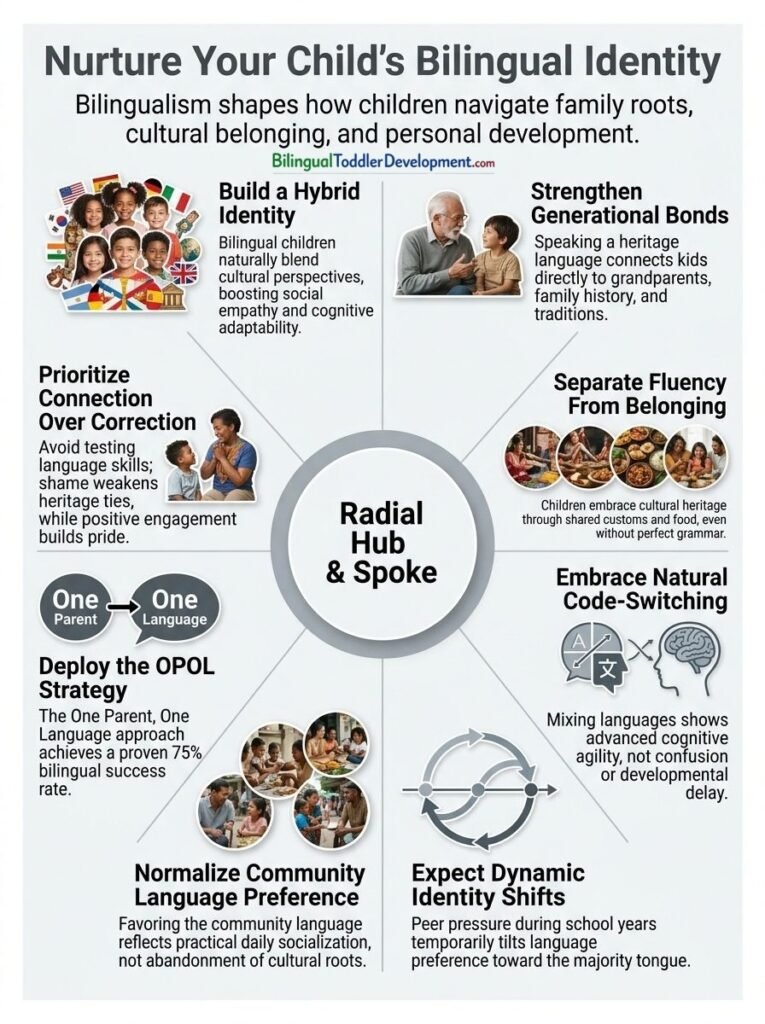
What Is Bilingual Identity?
Bilingual identity is the way a person understands and experiences themselves in relation to their languages and the people, cultures, and communities connected with those languages.
It is about more than simply being able to speak two languages.
For a child growing up with English and Spanish, for example, Spanish might be associated with grandparents, family celebrations, food, stories, and home life. English might be associated with school, friends, sports, and the larger community.
Both can become meaningful parts of the child’s life.
That does not mean every bilingual child develops the same identity. One child may strongly identify with two cultures. Another may feel primarily connected to one culture while still valuing the other. Some children may describe themselves differently depending on the situation.
If you want a broader explanation of what counts as bilingualism, see What Does It Mean to Be Bilingual?.
Bilingual Identity Is More Than Speaking Two Languages
Language ability is only one part of identity.
A child can speak a heritage language fluently without feeling especially connected to the culture associated with it. Another child may have limited speaking ability but feel deeply connected to that culture through family, traditions, community, food, music, religion, or family history.
That distinction matters because parents sometimes unintentionally treat language proficiency as proof of cultural belonging.
But identity is more complicated than that.
How children see themselves develops through relationships and experiences as well as language.
Bilingual and Bicultural Identity Are Not Always the Same
Being bilingual and being bicultural are related ideas, but they are not identical.
Bilingual generally describes the ability to understand or use more than one language.
Bicultural describes a connection with or participation in more than one culture.
A child can be bilingual without identifying equally with two cultures. Likewise, a child can feel deeply connected to a family’s heritage culture without speaking its language fluently.
This is one reason it is helpful to avoid thinking of bilingual identity as a simple equation:
two languages = two equal cultural identities
Children develop their own combinations of language, culture, family connection, and belonging.
How Can Language Shape a Child’s Sense of Identity?
Language can become meaningful because of what happens through it.
A heritage language may be the language a child associates with grandparents. Another language may be the language of school friendships. One language may carry family jokes and childhood nicknames, while another becomes the language the child uses for reading, sports, or schoolwork.
Over time, those associations can become part of how children understand themselves.
Language Connects Children to Family
One of the clearest ways language can influence identity is through relationships.
When children share a language with parents, grandparents, and extended family, they can participate more directly in conversations and family life.
That can become especially important when some relatives do not speak the child’s stronger language.
A shared language may allow children to hear family stories directly, understand humor and expressions, ask grandparents questions, and participate in conversations without relying on someone else to translate.
The value is not simply that the child knows more words.
The language belongs to a relationship.
For many families, that is one of the strongest reasons for maintaining a heritage language as children grow.
Language Connects Children to Culture
Language can also give children access to parts of a culture that are difficult to reproduce completely in translation.
These might include:
- family stories
- songs and music
- books and folktales
- humor and expressions
- celebrations
- religious traditions
- cultural media
- conversations with members of the wider community
Not every child needs the heritage language to feel connected to these things. Culture can be passed from one generation to another in many ways.
But language can provide an additional route into that culture.
Language Can Create a Sense of Belonging
Children gradually learn that languages are connected with groups of people.
A child may discover that Spanish helps them participate more fully in conversations at a family gathering, while English helps them connect with classmates at school.
Rather than belonging to only one world, some bilingual children learn that they can belong in several.
Their behavior may also change naturally with the setting. A child might speak one language with Grandma, another with classmates, and mix both with a bilingual sibling or friend.
That flexibility does not mean the child is confused about who they are.
It reflects the fact that language and identity are social. Different parts of a child’s life can bring different parts of their bilingual experience to the foreground.
Do Bilingual Children Feel Caught Between Two Cultures?
Some do, but it should not be treated as an inevitable consequence of bilingualism.
Many children are comfortable having more than one cultural influence in their lives. Others may go through periods when belonging feels more complicated.
This can become more noticeable as children get older and become increasingly aware of how their family differs from friends and classmates.
Feeling Different at School or Around Friends
Young children gradually become aware of which languages other people speak and which language dominates their school and community.
A child may notice that friends speak only English while their family speaks Spanish, Mandarin, Polish, Arabic, or another language at home.
For some children, that difference is a source of pride. For others, it may occasionally make them self-conscious, particularly if classmates react negatively or if the child feels pressure to fit in.
Some children may become reluctant to use the home language around friends even though they continue using it comfortably with family.
Parents can help by treating bilingualism as a normal and valued part of family life without requiring children to display it publicly.
Feeling “Not Enough” in Either Language or Culture
As children get older, some may begin comparing their language ability with other people’s.
A child might wonder:
“Am I really bilingual if my English is much better than my Spanish?”
Or:
“Do I still belong to my family’s culture if I don’t speak the language very well?”
These questions can become especially important during adolescence, when young people are thinking more deliberately about identity and belonging.
Parents can make those questions easier by separating language proficiency from belonging.
A child does not have to earn membership in a family or culture by passing a language test.
And being stronger in one language does not make someone less bilingual. As explained in Will My Child Become Fluent in Both Languages?, bilingual children commonly have different levels of ability in their two languages.
Why Bilingual Identity Can Change With Context
Identity is not necessarily fixed.
A child may feel particularly connected to the family’s heritage while visiting grandparents, then feel more identified with the surrounding community while at school.
A move, new school, trip abroad, friendship, heritage-language program, or closer relationship with extended family can also change how meaningful a language or culture feels.
These changes do not necessarily signal confusion.
They can simply reflect a child’s expanding experiences and growing understanding of themselves.
How Does a Heritage Language Affect Cultural Identity?
A heritage language can be an important part of cultural identity, but the relationship is not automatic.
For some children, speaking the heritage language becomes an important way of expressing cultural belonging. For others, cultural identity may depend more heavily on family relationships, traditions, values, community, or ancestry.
Research also suggests that the relationship between heritage-language proficiency and ethnic identity can differ among communities and generations.
That means parents should be careful about assuming that stronger language skills automatically create a stronger cultural identity.
Heritage Language Can Strengthen Family Connections
The practical value of a shared family language is easy to see.
If grandparents or other relatives are most comfortable in the heritage language, maintaining that language allows children to communicate with them more directly.
That can mean more than exchanging basic information.
It can allow children to understand family stories, jokes, memories, opinions, and emotions in the language relatives naturally use to express them.
Those relationships can then become part of the child’s sense of family and heritage.
Language Provides Access to Culture and Family History
A heritage language can also provide direct access to cultural material.
As children grow, that might include books, films, music, family documents, community events, religious traditions, historical materials, or conversations with people in a family’s country of origin.
Knowing the language is not the only way to access those things.
But it can provide another layer of connection.
Cultural Identity Does Not Require Perfect Fluency
This point deserves emphasis:
A child does not have to speak a heritage language fluently to have a meaningful cultural identity.
Language can contribute to identity without determining it.
A child who speaks only basic Spanish may still feel strongly Mexican American. A child with limited Korean may still feel deeply connected to Korean family traditions. Another child may speak a heritage language fluently yet identify primarily with the culture in which they are growing up.
There is no contradiction in any of those possibilities.
Language ability and cultural identity can develop along different paths.
What Happens to Identity When a Child Prefers One Language?
Language preference often changes as a child’s environment changes.
In the United States, English frequently becomes stronger once children spend much of their day at school and with English-speaking peers.
That change can worry parents, especially when a child who once readily spoke the home language begins answering in English.
But preference for English does not automatically mean rejection of the family’s culture.
Why the Community Language Often Becomes Stronger
Children tend to become most comfortable in the language they use most.
Once school begins, the community language may dominate:
- classroom instruction
- friendships
- sports and activities
- books and homework
- entertainment
- online communication
The result can be a shift in language dominance.
The community language becomes faster and easier because the child gets so much practice using it.
That is a language-development pattern, not necessarily a statement about identity.
Language Preference Does Not Necessarily Mean Cultural Rejection
A child who answers you in English after you speak Spanish may simply find English easier.
The same child may still love family traditions, feel close to grandparents, enjoy cultural celebrations, and strongly identify with the family’s heritage.
Parents should therefore be cautious about interpreting:
“I want to speak English.”
as:
“I don’t want to be part of our culture.”
Those are very different statements.
If a child begins using the home language much less after school starts, Why Bilingual Children Stop Speaking Their Home Language looks more closely at why that shift happens.
How Does Bilingual Identity Change as Children Grow?
A toddler does not think about identity in the same way a teenager does.
The role of bilingualism can therefore change substantially as children develop.
Toddler and Preschool Years
For young children, language is closely tied to people and routines.
One language may mean Mom. Another may mean Dad. A heritage language may be connected with Grandma, bedtime stories, particular foods, songs, or family gatherings.
Toddlers are not usually analyzing whether they are bicultural.
They are experiencing language through relationships.
Parents can support this foundation by making both languages ordinary, positive parts of family life.
School-Age Years
School expands a child’s social world.
Children become more aware of how they compare with classmates and may begin noticing differences in language, food, names, family traditions, holidays, and cultural practices.
This is also a period when the community language often becomes dominant.
Children may start choosing languages based on who they are talking to and where they are. Some become proud of being able to speak another language. Others may temporarily avoid the heritage language around peers because they do not want to stand out.
Parents can provide stability by continuing to value the home language while listening to how their child feels about using it.
Adolescence
Identity becomes more deliberate during adolescence.
Teenagers may begin asking what their ancestry, culture, nationality, family history, and languages mean to them personally.
Some become more interested in their heritage during these years. Others distance themselves from it temporarily. Still others combine different cultural influences into an identity that does not fit neatly into one category.
Language may be important to that process, but it is only one part of it.
The parent’s role also changes.
Rather than defining the teenager’s identity for them, parents can provide access to family, language, history, and culture while allowing the teenager to decide how those pieces fit together.
How Can Parents Support a Positive Bilingual Identity?
Supporting bilingual identity is less about creating strict language rules and more about creating an environment in which both languages and cultures are treated with respect.
Treat Both Languages as Valuable
Children notice how adults talk about languages.
They notice whether one language is associated with success and education while another is treated as less important. They notice embarrassment about accents. They also notice when parents proudly use the family language.
Try to avoid describing one language as the “good,” “proper,” or “important” language.
Instead, let children see that different languages can be useful and meaningful in different parts of life.
Connect Language With Relationships
Language becomes much more meaningful when it connects a child with someone they care about.
Grandparents, cousins, family friends, caregivers, and bilingual peers can give the heritage language a purpose that vocabulary exercises cannot.
Instead of making the message:
“You need to practice Spanish.”
the experience becomes:
“Spanish is how I talk with Grandma.”
That shift from performance to connection can make a major difference in how children experience the language.
Make Culture Part of Everyday Family Life
Culture does not have to be taught as a formal lesson.
It can simply be part of life.
Cook family recipes. Tell family stories. Listen to music. Read books. Celebrate holidays and traditions. Attend community events. Talk about where relatives came from and what their lives were like.
When possible, let children experience the culture rather than simply being told that it is important.
The goal is not to manufacture cultural pride.
It is to give children meaningful experiences from which their own connection can grow.
Let Your Child Define Their Own Identity
Two siblings raised in the same bilingual home may eventually describe themselves differently.
That is not necessarily evidence that one family’s bilingual approach worked and the other failed.
Identity is personal.
As children grow, listen to how they describe themselves rather than insisting on a particular label.
A child may identify strongly with both cultures, more strongly with one, or with a blended identity that reflects their particular experience.
Those feelings may change over time.
Parents can provide the roots without deciding exactly how the branches must grow.
Avoid Making Language Ability a Test of Belonging
Avoid messages such as:
“If you can’t speak Spanish, you’re not really Mexican.”
or:
“You should know this. You’re Chinese.”
Even when said jokingly, messages like these can turn language into a test the child can fail.
Instead, separate language learning from acceptance.
Encourage children to use the heritage language. Help them improve when they want to. Give them opportunities to hear and speak it.
But make it clear that their place in the family and their right to explore their heritage do not depend on perfect pronunciation, grammar, vocabulary, or fluency.
Does Losing a Heritage Language Affect a Child’s Identity?
It can affect some parts of a child’s experience, particularly communication and access.
A child who no longer speaks the same language as grandparents may find family conversations more difficult. Limited language ability can also make it harder to participate directly in some cultural or community experiences.
But it would be too strong to say that losing a heritage language necessarily causes a child to lose their cultural identity.
Children can maintain strong cultural connections through family relationships, traditions, values, community participation, ancestry, and shared experiences even when heritage-language ability is limited.
At the same time, maintaining or rebuilding the language can open additional ways to connect with those parts of life.
If your child still understands the heritage language but rarely speaks it, Why Does My Child Understand a Language but Not Speak It? explains why receptive skills sometimes remain stronger than speaking skills.
Final Thoughts: Bilingual Identity Is About More Than Speaking Two Languages
Growing up bilingual can give children more than the ability to communicate in two languages.
Those languages may connect them with different people, cultures, traditions, communities, and parts of their family history.
But there is no single bilingual identity that every child is supposed to develop.
One child may feel equally connected to two cultures. Another may identify more strongly with one. A child’s feelings can also change as they grow and have new experiences.
Parents do not need to create the “right” identity for their child.
Instead, keep the doors open.
Treat both languages with respect. Make family and cultural connections available. Give your child meaningful opportunities to use the languages. And make sure language ability never becomes a test of whether they belong.
Then give your child room to decide what being bilingual means to them.
Frequently Asked Questions
Does being bilingual affect a child’s identity?
It can. Languages may become connected with family relationships, culture, school, friendships, and community, all of which can contribute to a child’s developing sense of self. The effect varies from child to child, however, and bilingualism does not produce one particular type of identity.
Can a bilingual child identify with two cultures?
Yes. Some bilingual children feel connected to two or more cultures and develop an identity that incorporates different parts of each. Others identify more strongly with one culture. Both experiences can occur in bilingual families.
Do bilingual children ever feel caught between two cultures?
Some children do, particularly as they become more aware of differences between home, school, and peer groups. Others are comfortable moving between cultures and do not experience them as competing identities. Family support and acceptance can give children room to explore what each culture means to them.
Can a child have a strong cultural identity without speaking the heritage language fluently?
Yes. Heritage-language ability can be an important part of cultural identity for some people, but it is not a requirement for cultural belonging. Family relationships, traditions, community, values, ancestry, and personal experiences can all contribute to cultural identity.
What if my child prefers English to our home language?
Preferring English is common for children who attend English-speaking schools and spend much of their time with English-speaking peers. It usually reflects which language is easiest and most useful in daily life, not necessarily rejection of the family’s heritage or culture.
Continue providing positive opportunities to use the home language, particularly through relationships and activities the child enjoys, without turning language choice into a loyalty test.
How can parents encourage a positive bilingual identity?
Treat both languages and cultures with respect, connect them with meaningful relationships and experiences, and avoid judging your child’s cultural belonging by their language proficiency. As children grow, listen to how they describe their own identity and give them room for that identity to change.