
Your toddler understands everything you say in one language but barely responds in the other.
Or maybe they speak in full little phrases with one parent, then switch to single words or silence when the second language is used.
It can feel confusing. Sometimes it even feels a little worrying.
Are they falling behind in one language?
Are you doing something wrong?
Should both languages be developing at the same pace?
What you are seeing is extremely common.
In fact, many bilingual toddlers appear ahead in one language and behind in the other, even when they hear both every day. This pattern has a name. It is called language dominance, and it is a normal part of bilingual development.
The key thing to understand is this. Your child is not building one language system. They are building two at the same time, and those systems are shaped by how often each language is heard, used, and needed in real life.
Once you understand why one language moves faster, everything becomes clearer. You can see what is driving the difference, what is completely normal, and what you can gently adjust at home if you want more balance.
In this guide, you will learn what language dominance really means, why it happens, how to tell it apart from a delay, and simple ways to support both languages without turning your day into a constant lesson.
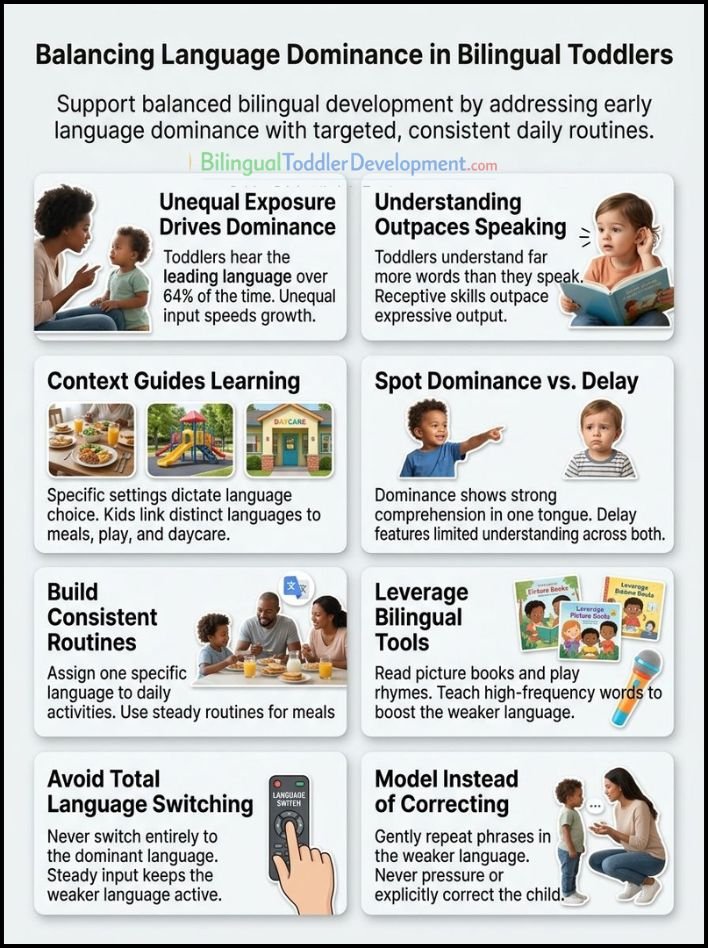
What Is Language Dominance in Toddlers?
Quick answer: Language dominance means one language is stronger than the other because a child hears and uses it more often.
Language dominance in toddlers means that one language is developing faster or is stronger than the other at a given time.
This can show up in several ways. Your child may:
- Know more words in one language
- Use longer sentences in one language
- Understand directions faster in one language
- Respond more quickly in one language
Language dominance is not a problem. It is a normal and expected part of bilingual development, especially when a child receives more exposure to one language in daily life.
Most bilingual toddlers are not exposed to both languages equally. One language is often used more during routines like meals, play, or childcare. Over time, that language becomes easier to process and use, which is why it appears to develop faster.
It is also important to understand that language dominance can change. A child may be stronger in one language now and shift toward the other later as routines, environments, and social interactions change.
Definition of Language Dominance
Language dominance refers to stronger language skills in one language compared to another, based on how much and how often the child hears and uses each language.
Researchers often measure dominance by looking at:
- Vocabulary size in each language
- How quickly a child understands spoken language
- How easily a child produces words and sentences
In many studies, a language is considered dominant when it makes up more than half of a child’s total language exposure.
Expressive vs Receptive Language Dominance
Language dominance can affect both what a child says and what a child understands.
Expressive language refers to spoken words. This includes naming objects, asking for things, and combining words into phrases.
Receptive language refers to understanding. This includes following directions, pointing to objects, and recognizing familiar words.
Many bilingual toddlers understand more than they can say in both languages. Because of this, a child may seem weaker in one language when they are actually understanding much more than they express.
If you want to check understanding at home, try simple low-pressure activities such as:
- Asking your child to point to a picture
- Giving a short direction like “bring the ball”
- Offering choices between two objects
These can reveal hidden comprehension that is not obvious through speech alone.
Language Dominance vs Language Preference
Language dominance is based on skill. Language preference is based on choice.
A child may prefer one language because it feels easier, gets a faster response, or is used more often in social settings.
A simple way to tell the difference:
- Dominance shows up even during calm activities like reading or routines
- Preference changes depending on the setting or the people involved
Both can exist at the same time, and both can shift as your child’s environment changes.
Why Do Bilingual Toddlers Develop One Language Faster?
Many parents notice the same pattern. One language seems to grow quickly, while the other lags behind.
This happens for a simple reason. Children develop faster in the language they hear, use, and need the most.
In most cases, this difference is not a problem. It is a predictable result of how language exposure works in real life.
Quick answer
Bilingual toddlers develop one language faster because they receive more frequent, meaningful exposure to that language in daily routines, interactions, and social settings.
Unequal Language Exposure
The most common reason one language develops faster is unequal exposure.
Even in bilingual homes, one language is often used more during key parts of the day such as meals, playtime, and childcare. Over time, that language becomes easier for the child to understand and use.
For example:
- Daycare may be mostly in one language
- One parent may speak more than the other
- Books, media, and play may favor one language
When a child hears one language more often, they build vocabulary faster and respond more quickly in that language.
Daily Routines Shape Language Growth
Toddlers do not learn language evenly across the day. They learn it in routines.
This is why daily routines that build toddler vocabulary play such a powerful role in language development.
Words used during meals, bath time, play, and outings are repeated again and again. These repeated moments build stronger language skills.
If one language is used more during these high-interaction routines, it will naturally develop faster.
For example:
- Snack and meal conversations build food and request vocabulary
- Playtime builds action words and imagination
- Bedtime builds listening and storytelling language
The language that “owns” these moments gains an advantage.
Ease of Use and Word Retrieval
Children tend to use the language that feels easiest in the moment.
This usually comes down to practice. The more often a child uses a word, the faster they can retrieve it.
If a toddler can quickly say a word in one language but has to pause in the other, they will naturally choose the easier option.
Over time, this creates a cycle:
- The easier language is used more
- More use leads to faster retrieval
- Faster retrieval strengthens that language even more
Social Environment and Response Patterns
Language grows where it works best.
If a child gets faster responses, more interaction, or more success using one language, they will begin to favor it.
This often happens in:
- Daycare or preschool settings
- Playgrounds and peer interactions
- Conversations with siblings
Children quickly learn which language gets results. That language becomes their default in many situations.
Context-Based Learning
Young children connect language to specific situations.
They may learn certain words and phrases in one language because they always hear them in the same context.
For example:
- “Bath words” may exist in one language
- “Playground words” in another
- “Book language” in one language depending on what is read at home
Because of this, one language may appear stronger overall, even though both languages are developing in different areas.
Personality and Communication Style
Every child approaches language differently.
Some toddlers are eager to try new words, even if they are unsure. Others prefer to stick with what feels safe and familiar.
This can affect which language they use more often.
For example:
- A cautious child may stick to the stronger language
- An expressive child may experiment more with both languages
This does not change their ability. It simply affects how often they practice each language.
What This Means for Parents
If your child is stronger in one language, it does not mean they are falling behind.
It means that language is getting more opportunities to grow.
The good news is that this pattern can shift over time. When you increase meaningful language exposure for bilingual toddlers, you create new opportunities for growth.
Small, consistent changes in daily routines can make a noticeable difference over the course of weeks and months.
Is It Normal for a Child to Prefer One Language?
Yes, it is very normal for a bilingual toddler to prefer one language over the other.
Many children naturally favor the language they hear more often or the one that feels easier to use in daily situations. This preference does not mean something is wrong. It reflects how language exposure and social interaction shape development.
A child may prefer one language because:
- It is used more often at daycare or with peers
- It leads to faster responses from adults
- It feels easier for word retrieval in the moment
- It is tied to familiar routines or activities
Language preference can also change depending on the situation. A child might use one language at home and another in public or with friends.
It is important to understand that preference is not the same as ability. A child can understand and even know many words in a language they do not often choose to speak.
Why Language Preference Happens
Language preference develops because children learn which language works best in each situation.
If one language consistently helps them get what they want faster or communicate more easily, they will begin to rely on it.
Over time, this creates a habit:
- The preferred language is used more often
- More use leads to stronger skills
- Stronger skills reinforce the preference
This pattern is closely connected to language dominance, but it can shift quickly when exposure changes.
What Parents Should Focus On
Instead of trying to force equal use of both languages, focus on creating meaningful opportunities for the weaker language.
You can do this by:
- Using the weaker language during daily routines
- Reading and talking about books in that language
- Creating situations where your child is likely to succeed
The goal is not to eliminate preference. The goal is to keep both languages growing over time.
Preference is about what your child chooses. It is not a measure of what they are capable of.
Language Dominance vs Language Delay: Key Differences
Many parents worry that their child may be falling behind when one language is much stronger than the other.
This is a very common concern. If you want a deeper breakdown, you can read this guide on language delay vs bilingual development.
In most cases, what you are seeing is language dominance, not a delay.
Quick answer
Language dominance means one language is stronger than the other.
Language delay means a child is developing language more slowly than expected across all languages.
The key difference is this. With language dominance, your child is progressing well in at least one language. With a true delay, progress is slow in both languages.
How to Tell the Difference
A simple way to understand this is to look at your child’s overall communication, not just one language.
Signs that point to language dominance:
- Clear progress in at least one language
- Strong understanding of everyday speech
- Use of gestures such as pointing, showing, or waving
- More communication during familiar routines or with familiar people
Signs that may suggest a language delay:
- Very limited vocabulary across both languages
- Difficulty understanding simple directions
- Limited use of gestures or interaction
- Little progress over time
If your child is growing in one language and communicating in meaningful ways, that is usually a sign of typical development.
Why Bilingual Children Can Look “Behind”
Bilingual children often split their vocabulary across two languages.
For example, a child might know the word for “dog” in one language and “ball” in another. If each language is measured separately, it can look like the child knows fewer words.
When you look at both languages together, the total number of words is often similar to monolingual children.
This is why single-language testing can sometimes underestimate what bilingual children actually know.
Real-Life Examples
A child with language dominance might:
- Speak in short phrases in one language and use single words in the other
- Understand both languages but respond mostly in one
- Use different languages in different settings
A child with a possible delay might:
- Use very few words overall
- Struggle to follow simple directions in daily routines
- Show limited interest in communicating
Looking at patterns across both languages gives a clearer picture than focusing on one language alone.
When to Pay Closer Attention
It may be helpful to look more closely if you notice:
- No steady increase in words over several months
- Difficulty understanding everyday speech
- Limited interaction such as pointing, showing, or responding to others
These signs can appear in any child, whether they are learning one language or two.
When to Seek Professional Advice
You do not need to wait if you feel unsure.
Consider reaching out to a pediatrician or speech and language professional if:
- Your child shows little progress over time
- You are concerned about understanding or interaction
- Skills seem to be delayed in both languages
It is important to work with someone who understands bilingual development. A bilingual-aware evaluation looks at both languages together and considers how your child uses language in real-life settings.
What This Means for Parents
If your child is stronger in one language, this is usually a sign of how their environment is shaping their learning.
It does not mean something is wrong.
Focus on:
- Tracking progress over time
- Supporting both languages through daily routines
- Creating opportunities for meaningful interaction
If concerns remain, seeking guidance early can give you clarity and peace of mind.
How to Support Balanced Bilingual Development
If you want to support both languages, the goal is not perfect balance. The goal is steady growth in both languages over time.
Small, consistent changes in daily routines are more effective than trying to control every word your child hears.
Quick answer
To support balanced bilingual development, increase meaningful exposure to the weaker language through daily routines, repeated phrases, and real interaction.
Focus on the Weaker Language
The fastest way to create balance is to give the weaker language more opportunities to be heard and used.
This does not mean reducing the stronger language. It means adding more moments where the weaker language is needed and useful.
Start with one or two daily routines:
- Mealtime conversations
- Bath time
- Bedtime stories
- Playtime with a favorite toy
Consistency matters more than intensity. If you are unsure how to do this consistently, here is a simple guide on how to increase language exposure at home.
Create Simple and Predictable Language Routines
Toddlers learn best through repetition.
When the same phrases are used in the same situations, children begin to understand and use them more easily.
Examples:
- “More snack”
- “All done”
- “Open door”
- “Let’s go”
Using the same phrases every day helps your child recognize patterns and respond more quickly.
If you want practical examples, here are daily routines that help to build toddler vocabulary.
Use High-Frequency Words First
Focus on words your child can use right away.
These include:
- Everyday needs such as more, done, help
- Common actions such as go, stop, open
- Familiar objects such as ball, cup, toy
These words create quick success, which encourages more use of the weaker language.
Model Language Instead of Correcting
When your child speaks, focus on communication, not perfection.
Instead of correcting, model a slightly improved version.
For example:
- Child says “ball”
- You say “Yes, the ball is rolling”
This helps your child learn without feeling pressure.
Create Opportunities for Success
Children use language more when they feel confident.
You can create easy success moments by:
- Offering choices between two items
- Asking simple questions
- Talking about what your child is already focused on
Success builds confidence, and confidence leads to more language use.
Include Other Speakers When Possible
Language grows through interaction with different people.
If the weaker language only comes from one person, it may feel less useful to your child.
You can support growth by:
- Setting up playdates
- Attending community events
- Finding opportunities to hear the language outside the home
What to Remember
You do not need to create perfect balance.
You need:
- Consistent exposure
- Meaningful interaction
- Patience over time
When the weaker language becomes part of everyday life, it will begin to grow.
Tools and Resources to Strengthen the Weaker Language
If you want to strengthen your child’s weaker language, the most effective tools are the ones you will actually use every day.
You do not need dozens of resources. A small set of consistent, high-quality tools can make a noticeable difference over time.
Quick answer
The best tools for supporting a weaker language are simple, repeatable, and interactive. Focus on books, songs, and routines that encourage real communication.
Vocabulary Trackers
Tracking progress helps you see growth and stay motivated.
You can keep a simple list of:
- New words your child understands
- New words your child says
- Words used in each language
Update once a week instead of daily to keep it manageable.
Picture Books
Picture books are one of the most effective ways to build vocabulary.
Look for books with:
- Clear images
- Simple, repetitive language
- Everyday objects and actions
Tip: Read the same book multiple times. Repetition helps your child recognize and use new words more easily.
Songs and Repetition-Based Learning
Songs help children learn rhythm, pronunciation, and common phrases.
Use one or two “anchor songs” for daily routines such as:
- Cleanup time
- Bath time
- Bedtime
Repeating the same songs builds familiarity and encourages participation.
Apps and Digital Tools
Apps can support language development when used together with your child.
To make screen time more effective:
- Sit with your child and talk about what they see
- Repeat key words and phrases
- Pause and give your child a chance to respond
Limit passive viewing. Interaction is what builds language.
Expanding Beyond the Home
Language grows faster when children hear it from different people.
You can strengthen the weaker language by:
- Attending community events
- Setting up playdates
- Finding groups where the language is spoken
Real interaction makes the language feel useful and meaningful.
What to Focus On
You do not need perfect tools. You need consistent use.
Choose a few resources and use them regularly:
- One or two favorite books
- One or two songs
- A few daily routines
Over time, these repeated experiences help the weaker language become more natural for your child.
Common Mistakes Parents Make with Language Dominance
Many parents try to help their child by making changes that seem helpful in the moment but can actually slow progress in the weaker language.
The good news is that these mistakes are easy to fix once you understand what is happening.
Quick answer
Common mistakes include switching fully to the dominant language, expecting equal use of both languages, correcting too often, and providing inconsistent exposure to the weaker language.
Switching Entirely to the Dominant Language
When communication feels difficult, it is natural to switch to the language your child uses most easily.
This can make daily life smoother, but it reduces opportunities for the weaker language to grow.
What to do instead:
Keep one consistent daily routine in the weaker language, such as meals, bath time, or bedtime stories.
Expecting Equal Output in Both Languages
Many parents expect their child to use both languages equally.
This can lead to frustration when one language is clearly stronger.
Language development does not work this way. Each language grows based on exposure and use.
What to do instead:
Focus on steady progress over time, not equal performance. Growth in the weaker language is the goal.
Correcting Too Often
Frequent correction can make a child less willing to speak, especially in the weaker language.
Children learn best when communication feels safe and successful.
What to do instead:
Model the correct phrase in a natural way instead of correcting directly. Keep the interaction positive and low pressure.
Inconsistent Language Exposure
Some mixing is normal, but when the weaker language does not have consistent time to develop, it becomes harder for the child to use it.
Without repetition, progress slows.
What to do instead:
Create predictable routines where the same language is used every day. Repetition helps build confidence and skill.
What to Remember
Most of these mistakes come from trying to make communication easier in the short term.
If you stay consistent and give the weaker language regular opportunities to be used, it will begin to grow.
Simple Action Plan to Balance Language Development
If you want to support both languages, you do not need a complicated system.
You need a small number of consistent habits that fit into your daily routine.
Quick answer
To balance language development, identify where the weaker language is missing, assign it to daily routines, use simple repeated phrases, and track progress over time.
This plan takes less than 10 minutes of intentional effort each day and can fit into routines you already have.
Step 1: Identify Exposure Gaps
Start by noticing when and where each language is used during the day.
Focus on routines such as:
- Meals
- Playtime
- Errands
- Bedtime
Look for moments where the weaker language is rarely used.
Choose one of those moments to change first.
Step 2: Assign One Routine to the Weaker Language
Pick one daily activity and consistently use the weaker language during that time.
Good options include:
- Breakfast conversations
- Bath time
- Bedtime stories
- Play with a favorite toy
Keep this routine the same each day. Consistency builds familiarity.
Step 3: Use Simple, Repeated Phrases
Toddlers learn through repetition.
Use short phrases that repeat every day:
- “More snack”
- “All done”
- “Open door”
- “Let’s go”
Repeating the same phrases helps your child recognize patterns and respond more easily.
Step 4: Encourage Understanding First
Your child may understand more than they can say.
Focus on comprehension by:
- Asking your child to point to objects
- Giving simple directions
- Offering choices
Understanding builds the foundation for speaking.
Step 5: Track Progress Over Time
Progress can be easy to miss if you do not track it.
Once a week, note:
- New words your child understands
- New words your child says
- Any new phrases
Look for gradual improvement, not instant results.
What to Remember
You do not need perfect balance between languages.
You need:
- Consistent exposure
- Repetition
- Meaningful interaction
Small changes, repeated daily, lead to real progress over time.
Conclusion: Supporting Language Growth Without Overthinking It
Language dominance in bilingual toddlers is a normal result of how children experience language in everyday life.
This pattern is widely observed in bilingual children and is considered a normal part of language development.
If one language is stronger right now, it usually means your child has had more chances to hear it, use it, and succeed with it. It does not mean something is wrong.
The most important thing to watch is overall progress. If your child is learning new words, understanding more, and communicating in meaningful ways, they are moving in the right direction.
Small, consistent changes can make a real difference over time. When you increase opportunities to hear and use the weaker language during daily routines, you help it grow naturally.
You do not need perfect balance. You need steady exposure, real interaction, and patience.
If you have concerns about progress across both languages, reaching out to a bilingual-aware professional can give you clarity and peace of mind.
If you would like to go further, you may also find these helpful:
- How to Increase Language Exposure at Home
- Language Delay vs Bilingual Development
- Daily Routines That Build Toddler Vocabulary
Still have questions? Here are quick answers to the most common concerns parents have about language dominance.
Frequently Asked Questions About Language Dominance in Bilingual Toddlers
Is it normal for a bilingual toddler to prefer one language?
Yes, it is very normal. Many bilingual toddlers prefer one language because they hear it more often or use it more in daily routines. This preference usually reflects exposure and environment, not a problem with development.
Why is my bilingual toddler stronger in one language?
A bilingual toddler is usually stronger in one language because they receive more frequent and meaningful exposure to it. The language used more during play, routines, and social interaction tends to develop faster.
Does language dominance mean my child is falling behind?
No, language dominance does not mean your child is falling behind. It means one language is currently stronger. As long as your child is making progress and communicating, this is typically part of normal bilingual development.
How can I tell if my child has a language delay or is just bilingual?
Look at both languages together. If your child is progressing in at least one language and understands everyday speech, it is likely language dominance. If progress is slow in both languages, it may be worth seeking professional advice.
Will my child lose one language over time?
A child can lose a language if they stop hearing and using it regularly. To maintain both languages, provide consistent exposure through conversation, books, and interaction with other speakers.
Should I force my child to speak the weaker language?
No, forcing a child to speak can reduce their willingness to communicate. It is more effective to model the language, create opportunities to use it, and keep interactions natural and low pressure.
How long does language dominance last?
Language dominance can last for months or change over time. It often shifts when a child’s environment changes, such as starting daycare or spending more time with different speakers.
What is the best way to support both languages?
The best approach is consistent exposure and meaningful interaction. Use daily routines, repeated phrases, books, and play to give both languages a clear role in your child’s life.