
Many parents raising bilingual toddlers quietly wonder the same thing:
“Am I giving my child enough exposure to actually become bilingual?”
That question becomes even harder when one language dominates preschool, daycare, friends, TV, and daily life outside the home.
The truth is that bilingual language exposure is both a math problem and a relationship problem at the same time.
Your child needs enough real interaction with each language for it to stick, but they also need emotional connection, routines, and opportunities to actually use it in everyday life.
In this guide, you’ll learn what “enough exposure” really looks like, why consistency matters more than perfection, and how small daily routines can make a surprisingly big difference in your toddler’s bilingual development.
Quick Answer: Language Exposure for Bilingual Toddlers
Bilingual toddlers do not need perfect 50/50 exposure to learn two languages successfully.
What matters most is consistent, meaningful interaction over time.
A language becomes stronger when your child hears it regularly during real conversations, daily routines, play, reading, meals, and other moments where they can actively respond.
Occasional exposure usually builds understanding faster than speaking. That is why many bilingual toddlers understand far more than they can say at first.
For most families, the goal is not perfection. The goal is creating enough regular opportunities for each language to feel useful, familiar, and emotionally connected.
A few short daily routines in the minority language often matter more than long, inconsistent “practice sessions.”
Here are the biggest things to focus on:
- Prioritize back-and-forth conversation over passive listening
- Build language into routines your child already enjoys
- Protect the minority language if English dominates outside the home
- Focus on consistency instead of exact percentages
- Give your child chances to respond, not just listen
The rest of this guide will help you understand:
- how much exposure bilingual toddlers typically need
- what counts as “high-quality” exposure
- why some children become language dominant
- how to strengthen a weaker language naturally
- when uneven language development may be worth discussing with a professional
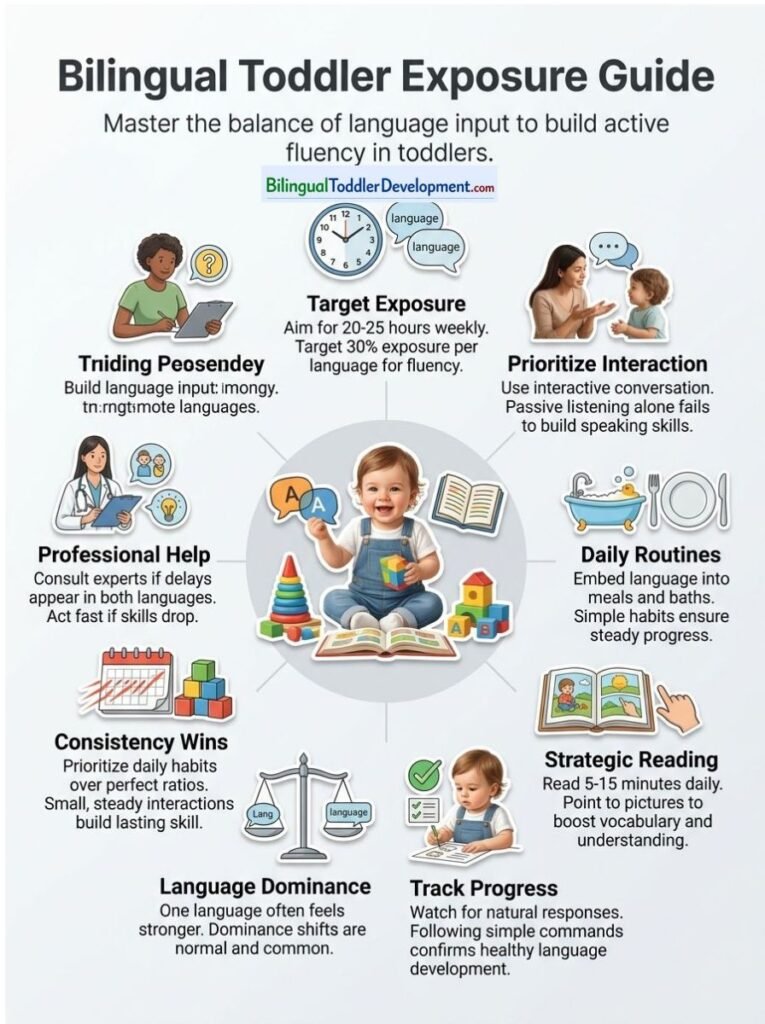
Why Language Exposure Matters in Bilingual Development
Language development grows through repetition, interaction, and meaningful communication.
The more often your toddler hears and uses a language during real-life situations, the easier it becomes for that language to feel natural and usable instead of something they only recognize passively.
Exposure Helps Build Vocabulary and Understanding
The more consistently toddlers hear and use a language, the more opportunities they have to build vocabulary and strengthen understanding.
Bilingual children often split vocabulary across both languages. Your toddler may know food words in one language, playground words in another, and emotional words in whichever language is used most during comfort and connection.
That is completely normal.
Instead of comparing each language separately to a monolingual child, it helps to look at your child’s total communication skills across both languages.
A few simple ways to strengthen vocabulary growth include:
- Use the language in different settings: try to move beyond one routine like bedtime only.
- Repeat important words naturally: toddlers learn through hearing the same words in meaningful situations.
- Talk during everyday activities: meals, playtime, bath time, and errands all create opportunities for language learning.
- Track progress over time instead of day to day: bilingual growth is often uneven but still healthy.
If you want a more structured way to track language growth, parent tools like the MacArthur-Bates Communicative Development Inventories can help identify which words and communication skills are developing in each language.
Toddlers Need Repeated Interaction to Learn Language Naturally
Toddlers learn language best through back-and-forth interaction.
Researchers often call this “serve and return” communication. Your child makes a sound, gesture, word, or attempt to communicate, and you respond in a warm, meaningful way.
These repeated exchanges help strengthen language skills and support healthy brain development.
Simple interactions throughout the day can make a surprisingly big difference.
- Follow your child’s attention: talk about what they are already focused on.
- Pause and wait: toddlers often need extra time to respond.
- Expand what they say: if your child says “dog,” you can respond with “Yes, big dog!”
- Repeat familiar phrases across daily routines: repetition helps language stick.
Some families use strategies like OPOL (one parent, one language) to create consistency. Others prefer place-based routines, such as using one language mostly at home and another outside the home.
The exact method matters less than creating regular opportunities for your child to hear and use both languages naturally.
Hearing a Language Occasionally Is Usually Not Enough
Occasional exposure can help a child recognize a language, but it usually is not enough to build confident speaking skills.
This is especially true for a minority or heritage language that gets less support outside the home.
For example, if your toddler only hears a language during occasional visits with relatives, they may understand parts of it without feeling comfortable using it themselves.
That does not mean the language is “lost.” It usually means the child needs more consistent opportunities to hear and practice it during everyday life.
- Use short routines consistently: even a few minutes each day helps.
- Turn listening into interaction: ask simple questions your child can answer.
- Reuse favorite songs, books, and phrases: repetition builds familiarity and confidence.
- Create reasons for your child to respond: toddlers learn more when language feels socially useful.
Over time, these small moments add up and help both languages become part of your child’s normal daily experience.
Is There a “Magic Percentage” for Bilingual Exposure?
There is no single percentage that guarantees a toddler will become bilingual.
Many parents hope there is a perfect formula, but bilingual development usually works more like a long-term pattern than a strict math equation.
What matters most is whether each language shows up often enough to feel familiar, useful, and emotionally connected in everyday life.
Some toddlers thrive with fairly balanced exposure. Others become strongly bilingual even when one language clearly dominates the week.
The goal is giving your child regular opportunities to hear, understand, and use both languages consistently over time.
Why Experts Often Mention the 20% to 30% Guideline
You may sometimes hear that a child needs at least 20% to 30% exposure to a language for it to grow actively instead of becoming mostly passive.
This is not a strict rule or a pass-or-fail number.
Instead, it is best used as a rough planning tool that helps families think realistically about how often a language appears during daily life.
For example, many families naturally find that one language dominates once preschool, daycare, or social activities become part of the week.
That does not mean bilingualism is failing. It usually means the weaker language may need more intentional support at home.
A few consistent moments each day can create meaningful language exposure over time:
- Breakfast conversations
- Bath time routines
- Bedtime stories
- Songs during car rides
- Simple play-based conversations
These small interactions help a language stay active and emotionally familiar.
Why Some Children Need More Exposure Than Others
Every bilingual child has a different language environment.
Some toddlers hear one language almost everywhere outside the home, while others split time more evenly between languages.
That is why two children can respond very differently to the same amount of exposure.
Several factors influence how strongly a language develops:
- Language spoken directly to the child matters most: toddlers learn more from real interaction than from overheard conversation.
- Different settings build different vocabulary: a child may know playground language in one language and emotional language in another.
- Children use languages they need socially: if a toddler rarely needs a language to communicate, they may understand it without speaking it much.
- Confidence matters: children often become more willing to use a language when routines feel predictable and low pressure.
This is one reason bilingual development can look uneven at times, especially during big transitions like starting preschool.
Consistency Often Matters More Than Exact Percentages
Consistency helps a language feel normal.
When a language regularly appears during meals, play, comfort, stories, and daily routines, toddlers begin to expect it and respond to it more naturally.
That steady exposure is often more important than trying to calculate exact percentages every week.
Many families feel pressure to create a perfectly balanced bilingual environment. In real life, that is often difficult and unnecessary.
A simple, repeatable routine usually works better than an ambitious plan that becomes stressful to maintain.
A few strategies that often help include:
- Choose stable routines: use the same language during certain activities or times of day.
- Keep interactions low pressure: model the language naturally instead of constantly testing your child.
- Respond warmly to attempts: focus first on communication, then gently model the correct phrasing.
- Give routines time to work: language growth often becomes noticeable gradually, not overnight.
Over time, these small, predictable interactions help both languages feel like a natural part of your child’s everyday world.
What Counts as Language Exposure?
Language exposure is more than simply hearing a language in the background.
Toddlers learn best when language becomes part of real interaction, daily routines, play, and emotional connection.
Think conversational turns, not background noise.
The strongest language exposure usually happens when your child hears language, responds in some way, and receives feedback from a real person.
That response might be:
- a word
- a sound
- a gesture
- pointing
- eye contact
- a short phrase
These small back-and-forth moments help language become active and usable over time.
The good news is that many families already have natural opportunities for language exposure built into everyday life.
Talking During Everyday Routines
Daily routines are some of the easiest and most effective ways to build bilingual exposure.
Toddlers learn through repetition, and routines naturally repeat the same words, phrases, and interactions every day.
You do not need long lessons or complicated activities. Small conversations during familiar moments often work best.
Simple routines that support language development include:
- Mealtime: naming foods, asking simple questions, and practicing words like “more,” “all done,” or “drink.”
- Bath time: body parts, action words, and playful questions.
- Getting dressed: choices like “shirt or sweater?” followed by repeating the words naturally.
- Cleanup time: short instructions and praise using consistent phrases.
Some families use one language during certain routines and another language during different parts of the day. Others naturally use different languages with different family members.
Consistency and interaction matter more than finding the “right” method.
Reading Books Together
Reading together is one of the easiest ways to increase high-quality language exposure.
Books introduce vocabulary and sentence patterns that may not appear as often in everyday conversation, especially in a minority or heritage language.
Reading also creates something equally important: shared attention.
Your toddler hears language while looking, pointing, reacting, and interacting with you at the same time.
You can make reading more interactive by:
- Pointing and labeling pictures
- Asking simple questions
- Pausing for responses
- Repeating favorite phrases
- Connecting the story to real life
For toddlers, repetition is helpful, not boring. Reading the same favorite books again and again often strengthens language learning.
As children grow, longer stories and chapter books can continue supporting bilingual development through shared reading and conversation.
Songs, Play, and Interactive Activities
Songs and play naturally encourage repetition and participation, which makes them powerful tools for language learning.
Toddlers often learn best when language feels playful instead of instructional.
Simple activities can create many opportunities for language exposure:
- Short songs with repeated phrases
- Pretend play with dolls, puppets, or toy animals
- Games that involve simple choices or questions
- Action-based play using verbs and movement words
- Reusing familiar words during playtime
The goal is helping your child feel comfortable hearing and trying the language regularly.
Exposure From Family Members and Caregivers
Caregivers, relatives, and daycare providers often shape a large part of a toddler’s language environment.
If your child spends many hours each week with other adults, it can help to understand which language is being used most often during the day.
For example:
- Which language is used during play?
- Which language is used for comfort or emotional support?
- Which language is used for instructions and routines?
- Does your child have opportunities to respond in the minority language?
Even small amounts of support from caregivers can strengthen language consistency across the week.
Some families also find it helpful to provide books, songs, or simple phrases that caregivers can naturally use during the day.
Does Screen Time Count?
Screen time can support language exposure, but it does not replace live interaction.
Toddlers learn language best through real back-and-forth communication with responsive adults.
That said, screens can still become useful tools when they encourage interaction instead of passive listening.
More helpful forms of screen use include:
- Watching short videos together and talking about them afterward
- Video chatting with relatives in the minority language
- Singing along to songs together
- Using educational apps together instead of independently
Less helpful exposure usually includes:
- passive background television
- videos playing for long periods without interaction
- apps that focus only on memorization without conversation
Whenever possible, try to turn screen time into conversation time.
Even a short discussion after a video or song can help language become more meaningful and memorable for your toddler.
How Much Exposure Is Usually Needed to Speak Both Languages Well?
Most bilingual toddlers need regular opportunities to actively hear and use both languages throughout the week.
That does not mean every family needs perfectly balanced exposure. It means each language needs enough consistent interaction to feel familiar, useful, and comfortable for your child.
In most cases, short daily interactions work better than occasional long “catch-up” sessions.
Language grows through repeated use during real life:
- conversations
- routines
- stories
- play
- songs
- shared experiences
Understanding Passive vs Active Exposure
Passive exposure happens when a child hears a language without actively participating very much.
This can include:
- background television
- overheard conversations
- videos without interaction
- adults speaking around the child instead of with the child
Passive exposure can still help toddlers recognize sounds, words, and patterns. It often supports understanding before speaking develops.
But understanding a language and confidently using it are not always the same thing.
Active exposure is usually what helps language become usable.
Active exposure includes:
- back-and-forth conversation
- answering simple questions
- singing together
- pretend play
- reading interactively
- responding during routines
These small interactions teach toddlers that language is something they can use socially, not just something they hear.
Both types of exposure matter, but active interaction usually drives stronger speaking skills over time.
Why Speaking Practice Matters
Speaking practice helps toddlers turn understanding into usable language.
Many bilingual children understand far more than they can comfortably say at first. That is completely normal.
Toddlers often need repeated opportunities to try words, hear responses, and experience successful communication before speaking becomes more natural.
Simple techniques can make speaking feel easier and lower pressure:
- Offer simple choices: “Milk or water?” is easier than broad open-ended questions.
- Expand your child’s words naturally: if your child says “car,” you can respond with “Yes, red car.”
- Use short repeated phrases: familiar scripts during meals, bath time, or bedtime help toddlers predict language.
- Keep interaction playful: language grows best when children feel relaxed and engaged.
Over time, these repeated speaking opportunities help children build confidence in both languages.
Why Some Toddlers Understand More Than They Say
Many bilingual toddlers develop comprehension before expressive language.
In other words, they may understand much more than they are ready to speak.
This often worries parents unnecessarily.
A toddler who points correctly, follows directions, reacts appropriately, or understands questions is still showing important language growth, even if spoken vocabulary develops more slowly.
Bilingual children may also divide vocabulary across both languages.
For example, a child may know playground words in one language and bedtime or family words in another. That uneven distribution is common in bilingual development.
Instead of focusing only on how many words your child says, it helps to look at overall communication:
- understanding
- gestures
- attempts to respond
- turn-taking
- social interaction
- gradual vocabulary growth across both languages
Progress does not always happen evenly, but steady growth over time is usually a positive sign.
What Usually Helps Both Languages Grow Strongly
Children tend to make stronger progress in both languages when they regularly experience:
- Daily conversation instead of occasional exposure
- Real interaction instead of passive listening
- Consistent routines in both languages
- Opportunities to respond and participate
- Positive emotional connection with each language
- Low-pressure practice during normal activities
The goal is not creating a perfect bilingual environment.
The goal is helping both languages become meaningful parts of your child’s everyday life.
Signs Your Toddler Is Getting Enough Exposure
Enough language exposure usually looks like steady progress, not instant fluency.
Many bilingual toddlers develop unevenly across their two languages, especially during periods of change like starting preschool or daycare. That is completely normal.
Instead of looking for perfect balance, it helps to watch for gradual growth in how your child understands, responds, and communicates during everyday life.
Healthy bilingual development often looks like:
- Growing understanding in both languages
- More attempts to communicate over time
- Using words and phrases in different situations
- Taking turns during conversation or play
- Responding naturally during familiar routines
These signs usually matter more than trying to measure exact percentages or compare your child to another bilingual toddler.
They Understand Simple Instructions
One encouraging sign of healthy language growth is increasing understanding during daily routines.
Your toddler may begin:
- following simple directions
- recognizing familiar words
- responding to questions
- reacting appropriately during conversations
This understanding often develops before spoken language becomes fully consistent.
For example, your child may:
- bring shoes when asked
- point to familiar objects
- follow routines during meals or bedtime
- understand simple requests in both languages
These everyday moments show that language is becoming meaningful and usable.
They Respond Naturally in Both Languages
Many bilingual toddlers naturally respond in whichever language feels easiest in the moment.
Sometimes they answer in the same language they were spoken to. Other times they may mix languages or switch between them.
That flexibility is very common in bilingual development.
What matters more is whether your child is:
- engaging socially
- attempting communication
- understanding interaction
- participating during conversation and play
Comfort and confidence often grow gradually over time.
They Use Words or Phrases Across Different Situations
As language becomes stronger, toddlers often begin using words across multiple settings instead of only during one specific routine.
For example, your child may:
- use a food word during meals and later during pretend play
- repeat phrases from books during daily activities
- use familiar expressions in new situations
This kind of carryover is a positive sign that language is becoming more flexible and connected to real understanding.
Progress May Be Slow but Still Normal
Bilingual language development does not always happen evenly or quickly.
Some toddlers show long periods where understanding grows faster than speaking. Others become temporarily stronger in one language depending on preschool, caregivers, or social environments.
That unevenness is extremely common.
What usually matters most is whether progress continues gradually over time.
Try to focus on:
- increasing attempts to communicate
- growing understanding
- more participation during interaction
- steady exposure and routines
Small changes often add up quietly before parents notice larger language growth.
When It May Help to Seek Extra Support
While uneven bilingual development is very common, there are situations where additional support may be helpful.
You may want to speak with your pediatrician or a speech-language professional if your child:
- struggles to understand both languages
- stops using words or skills they previously had
- shows very limited communication attempts over time
- seems delayed across both languages instead of just one
The goal is not to panic over differences between bilingual children.
The goal is simply to make sure your child receives support if it is needed, while recognizing that bilingual development often follows a wide range of healthy patterns.
Even when bilingual development is progressing well overall, many families still notice periods where one language becomes much stronger than the other.
When One Language Becomes Stronger Than the Other
It is very common for bilingual toddlers to become temporarily stronger in one language.
In many families, this happens naturally once preschool, daycare, friends, television, or community activities introduce much more exposure to the community language.
For many children in the United States, that often means English begins growing faster than the minority or heritage language.
This shift can feel emotional for parents, especially when a child suddenly:
- answers in only one language
- resists speaking the home language
- mixes languages more often
- seems to understand the minority language but rarely use it
In most cases, this does not mean bilingualism is failing.
It usually means one language currently has more opportunities for active use during daily life.
Language Dominance Is Extremely Common
Most bilingual children go through periods where one language feels easier, faster, or more useful.
This is called language dominance, and it is a normal part of bilingual development.
Children naturally become stronger in the language they use most often socially.
For example, once preschool begins, toddlers may suddenly:
- hear one language for most of the day
- use it with friends
- follow instructions in it
- connect it with play and independence
That increased exposure can quickly strengthen one language without permanently damaging the other.
The important thing is not preventing all imbalance.
The important thing is continuing to create meaningful opportunities for both languages to stay active over time.
Language Dominance Can Shift Over Time
Language dominance is not always permanent.
A child who strongly prefers English at age 3 may become much more balanced later as routines, friendships, schooling, travel, or family interactions change.
Bilingual development often moves in phases.
Some children become stronger in the community language during preschool years, then reconnect more deeply with the heritage language later through:
- grandparents
- cultural events
- reading
- travel
- sibling interaction
- family traditions
That flexibility is one reason parents should avoid panicking during temporary language shifts.
Progress in bilingual development is rarely perfectly balanced all the time.
Why the Minority Language Often Needs More Protection
In many bilingual homes, the minority language has fewer natural opportunities to appear outside the family.
The community language often surrounds children through:
- school
- television
- friends
- activities
- public life
Because of that imbalance, the minority language sometimes needs more intentional support at home.
This does not mean turning your home into a classroom.
Usually, small predictable routines work best.
For example:
- bedtime stories
- mealtime conversation
- songs during car rides
- video chats with relatives
- pretend play
- family traditions connected to the language
These repeated moments help the minority language stay emotionally meaningful and socially useful.
Small Changes Can Make a Big Difference
Many parents assume they need dramatic changes to strengthen a weaker language.
Often, small consistent changes work surprisingly well over time.
Adding just a few regular opportunities for interaction each day can help a child feel more comfortable using the language again.
Helpful strategies may include:
- Creating two or three daily routines in the weaker language
- Giving your child more chances to respond during conversation
- Using books, songs, and play more consistently
- Connecting the language with warmth, humor, and emotional connection
- Reducing pressure and avoiding constant correction
Children are usually more willing to use a language when it feels natural, predictable, and emotionally safe.
Even small increases in meaningful interaction can gradually strengthen confidence and participation over time.
How to Increase Exposure Without Overwhelming Yourself
You do not need to run a full-time language immersion program at home to raise a bilingual child.
In most families, bilingual development grows through small, repeatable moments that fit naturally into daily life.
That is important because many parents put enormous pressure on themselves to “do enough,” especially when one language already dominates outside the home.
The good news is that consistency usually matters far more than perfection.
A few calm, predictable routines each day can create meaningful language exposure over time without turning your home into a classroom.
Build Language Into Daily Routines
The easiest place to start is with routines you already do every day.
Toddlers learn through repetition, and daily routines naturally repeat the same words, phrases, and interactions over and over again.
You do not need to redesign your schedule.
Instead, choose one small routine and consistently use the minority language during that time.
Good starting points often include:
- breakfast
- bath time
- bedtime
- getting dressed
- car rides
- cleanup time
Even a few minutes of interaction each day can add up surprisingly quickly over time.
To keep routines simple and manageable:
- Use the same familiar phrases regularly
- Ask one easy question your child can answer
- Pause and wait for any response
- Keep the interaction relaxed and playful
One consistent routine is often more effective than trying to completely change your entire day all at once.
Create Predictable Language Moments
Predictability helps language feel safe and familiar.
When toddlers know what to expect, they are often more willing to participate and respond.
For example, your child may begin expecting:
- a bedtime story in one language
- a morning song in another
- certain phrases during meals or play
These repeated patterns lower pressure because your toddler does not have to constantly adjust or guess which language is expected.
Predictable routines also help parents stay consistent during busy weeks.
The goal is not creating perfect language balance every day.
The goal is building small habits that feel realistic enough to continue long term.
Use Books, Music, and Playtime Strategically
Books, songs, and play naturally create repetition, interaction, and emotional connection.
That makes them some of the most effective tools for increasing exposure without adding extra stress.
You do not need long activities or elaborate lessons.
Simple, repeated interactions often work best for toddlers.
For example:
- Read a short favorite book and pause for responses
- Sing familiar songs with repeated phrases
- Use pretend play to repeat everyday vocabulary
- Reuse words from books during normal conversation
- Keep favorite stories and songs in regular rotation
Repetition is not a problem in toddler language development.
In many cases, repetition is exactly what helps language stick.
Encourage Real Conversations Instead of Drills
Toddlers learn language best through connection, not pressure.
That is why real conversation usually works better than formal practice sessions or constant correction.
Children are often more willing to participate when language feels playful, useful, and emotionally safe.
Simple back-and-forth interaction matters more than perfect pronunciation or complete sentences.
Helpful low-pressure strategies include:
- Offering choices instead of quizzes
- Expanding your child’s words naturally
- Responding warmly to communication attempts
- Using language during shared activities
- Keeping conversations short and interactive
The goal is helping your child experience language as part of everyday connection, not as a test they need to pass.
Small Daily Habits Matter More Than Perfection
Many parents worry they are not doing enough.
In reality, bilingual development usually grows through steady exposure over long periods of time, not through perfect routines every single day.
Some weeks will feel easier than others.
There may be periods where one language becomes much stronger. Busy schedules, preschool, stress, illness, and life changes can all affect language use temporarily.
That does not mean you are failing.
What usually matters most is returning to small, sustainable routines again and again over time.
If you miss a day, restart the next day.
If your child resists a language temporarily, keep interactions warm and low pressure.
Small moments of connection repeated consistently often matter far more than parents realize.
Common Challenges Families Face With Language Exposure
Most bilingual families face periods where language routines feel difficult, inconsistent, or emotionally complicated.
That is completely normal.
Raising a bilingual child often involves balancing:
- busy schedules
- preschool and daycare
- family expectations
- different caregiver languages
- emotional connection
- exhaustion
- uncertainty about whether you are “doing enough”
Many parents quietly worry they are falling behind or making the wrong choices.
In reality, bilingual development is rarely perfect or perfectly balanced. Small adjustments and realistic routines usually matter far more than trying to create an ideal system.
Focusing Too Much on Exact Percentages
Many parents become highly focused on creating a perfect language split.
While exposure matters, constantly calculating percentages can create unnecessary stress and make bilingual parenting feel overwhelming.
Toddlers usually benefit more from:
- consistent routines
- meaningful interaction
- emotional connection
- regular opportunities to respond
than from perfectly balanced schedules.
Instead of trying to track every hour, it often helps to focus on simple questions like:
- Does this language appear regularly during daily life?
- Does my child have chances to actively use it?
- Does the language feel emotionally meaningful and familiar?
Consistency over time usually matters more than exact numbers.
Switching to Only One Language Too Quickly
Many families gradually begin using mostly the community language because it feels easier during preschool years or busy family routines.
This is extremely common.
Children often respond more quickly in the language they hear most outside the home, which can naturally shift family habits over time.
That does not mean families are failing or making harmful decisions. These changes usually happen for understandable reasons.
At the same time, when the minority or heritage language disappears completely from daily routines, children often lose opportunities to actively use and strengthen it.
Small consistent routines can help maintain connection without creating pressure.
Helpful approaches often include:
- Keeping comfort and emotional connection in the home language
- Using stories, songs, and play naturally
- Responding warmly instead of correcting constantly
- Modeling the language without forcing repetition
Children are usually more willing to continue using a language when it feels emotionally safe and connected to relationships they value.
Expecting Fast Results
Bilingual language development often moves more gradually than parents expect.
Some toddlers understand a great deal before they begin speaking confidently. Others show rapid growth in one language while the second language develops more slowly for a period of time.
That uneven progress is very common.
Language growth often happens quietly before parents notice obvious changes.
For example, a child may:
- suddenly begin using phrases they seemed to only understand before
- start responding more often during routines
- become more comfortable mixing into conversation
- show stronger understanding long before expressive language catches up
Small daily interaction usually matters more than dramatic short-term progress.
Comparing Your Child to Other Bilingual Children
It is easy for parents to compare their child to other bilingual children online, at preschool, or within extended family.
The problem is that bilingual children rarely have the same:
- language exposure
- preschool environments
- caregiver support
- personalities
- communication styles
- opportunities to use each language
One child may hear a minority language all day at home. Another may only hear it during evenings and weekends.
Those differences matter.
Instead of comparing your child to another family’s situation, it often helps to focus on your child’s own gradual progress over time.
Questions that are usually more helpful include:
- Is communication growing?
- Is understanding increasing?
- Is my child participating more comfortably?
- Are both languages still present in meaningful ways?
Bilingual development rarely follows a perfectly straight line.
Steady connection, consistent exposure, and emotionally positive interaction usually matter far more than comparison or perfection.
When to Seek Extra Support
Most bilingual toddlers develop at their own pace, and uneven language growth is very common.
Some children become temporarily stronger in one language. Others understand much more than they can comfortably say for a period of time.
In many cases, these patterns are completely normal parts of bilingual development.
At the same time, there are situations where extra support or evaluation may help provide clarity and guidance.
Seeking help does not mean you have failed or that bilingualism is causing a problem.
Often, it simply gives families more information and support moving forward.
When Delays Appear in Both Languages
One important thing to watch for is whether concerns appear across both languages instead of only one.
For example, you may want to speak with your pediatrician or a speech-language professional if your child:
- struggles to communicate in both languages
- has difficulty understanding simple language overall
- shows very limited progress over time
- rarely attempts communication in either language
Bilingual children sometimes look uneven when one language is stronger than the other.
What matters more is whether overall communication skills continue growing across both languages combined.
When Understanding Seems Limited in Both Languages
Many bilingual toddlers go through quiet periods where speaking develops slowly.
That alone is not usually a reason to panic.
However, if your child consistently struggles to understand familiar words, directions, routines, or interaction in both languages, it may help to discuss those concerns with a professional.
Sometimes hearing issues, developmental differences, or other communication challenges can affect language growth.
Early support can often make things easier for both children and parents.
When Skills Suddenly Decrease
A temporary preference for one language is common.
But if a child suddenly stops using words, loses communication skills they previously had, or becomes noticeably less socially responsive, it is important to seek guidance.
Try to notice:
- when the changes began
- what skills changed
- whether the changes appeared in one language or both
- whether social interaction also changed
Sharing these observations with your pediatrician or specialist can help provide a clearer picture of what is happening.
What Evaluations and Support Can Look Like
Many parents feel nervous about evaluations.
In reality, evaluations are often designed to better understand how a child communicates and whether additional support could help.
A bilingual-informed evaluation should consider:
- both languages
- family routines
- communication opportunities
- parent observations
- social interaction
- overall development
Parents can often help by sharing:
- examples of words or phrases their child uses
- which languages are spoken at home
- who speaks each language
- situations where communication feels easier or harder
In the United States, families can also ask pediatricians about Early Intervention services for young children if they have ongoing concerns about communication or development.
Trust Your Observations Without Panicking
Parents often notice changes or concerns before anyone else does.
It is OK to trust your instincts while also remembering that bilingual development can vary widely from child to child.
The goal is not to panic over every uneven pattern or temporary delay.
The goal is simply to make sure your child receives support if it is needed while continuing to create warm, consistent opportunities for communication in both languages.
Final Thoughts
Raising a bilingual toddler does not require perfect routines, perfectly balanced exposure, or constant language practice throughout the day.
In most families, bilingual development grows through small moments repeated consistently over time.
A bedtime story, a conversation during breakfast, a favorite song in the car, or a playful exchange during bath time may seem small in the moment. But together, these interactions help language become familiar, meaningful, and emotionally connected.
It is also completely normal for bilingual development to feel uneven at times.
One language may temporarily become stronger. Your child may understand more than they say. Some weeks may feel consistent while others feel chaotic.
That does not mean bilingualism is failing.
What usually matters most is continuing to create warm, low-pressure opportunities for communication in both languages as your child grows.
Bilingual language development is not simply about vocabulary or percentages. It is also about connection, relationships, family identity, and shared experiences.
Children are more likely to hold onto a language when it feels tied to comfort, play, love, stories, traditions, and everyday life with the people closest to them.
You do not need to create a perfect bilingual environment to make meaningful progress.
Small, sustainable routines repeated with patience and consistency often matter far more than parents realize.
Frequently Asked Questions
Can a toddler become bilingual with only one bilingual parent?
Yes. Many children successfully become bilingual even when only one parent regularly speaks the minority or heritage language.
What usually matters most is consistency and meaningful interaction over time.
If the community language already dominates through preschool, daycare, or daily life outside the home, the bilingual parent often becomes an especially important source of exposure and emotional connection to the second language.
Small daily routines can make a big difference.
Helpful strategies may include:
- Using the minority language during familiar routines
- Reading books together regularly
- Video chatting with relatives who speak the language
- Creating playful opportunities for conversation
- Keeping interaction warm and low pressure
You do not need perfect balance for bilingual development to grow successfully.
Is passive listening enough for bilingual development?
Hearing a language regularly can help toddlers recognize sounds, words, and familiar phrases.
But children usually become more confident speakers through real interaction and conversation.
Toddlers learn best when they can:
- respond
- take turns
- ask for things
- hear feedback
- use language socially
That is why active interaction usually matters more than passive background exposure alone.
Even short conversations during play, meals, reading, or daily routines often support language growth more effectively than long periods of passive listening.
What if my child refuses one language?
This is extremely common in bilingual development, especially once children begin spending more time in the community language.
Many toddlers naturally choose whichever language feels easier socially in the moment.
In most cases, this does not mean the second language is permanently lost.
What usually helps most is keeping the language emotionally positive and low pressure.
Instead of forcing repetition or correcting constantly, try to:
- continue using the language naturally
- create playful interaction
- connect the language to comfort and routines
- give your child reasons to use it socially
Children are often more willing to return to a language when it feels connected to relationships, fun, and everyday life instead of pressure.
Is it too late to increase language exposure after age 3?
No. Age 3 is absolutely not too late.
Bilingual development continues well beyond the toddler years, and children can still strengthen a language significantly after age 3 through regular exposure and interaction.
The most important thing is creating sustainable opportunities for communication over time.
You do not need to completely change your household overnight.
In many families, small consistent routines work very well:
- bedtime stories
- conversations during meals
- songs and play
- visits with relatives
- shared activities in the language
Language growth often happens gradually, especially when children feel emotionally comfortable and engaged.