
A bilingual child may struggle on a standardized language test yet communicate confidently during everyday conversations.
That is why language sample analysis is such an important part of a bilingual speech evaluation.
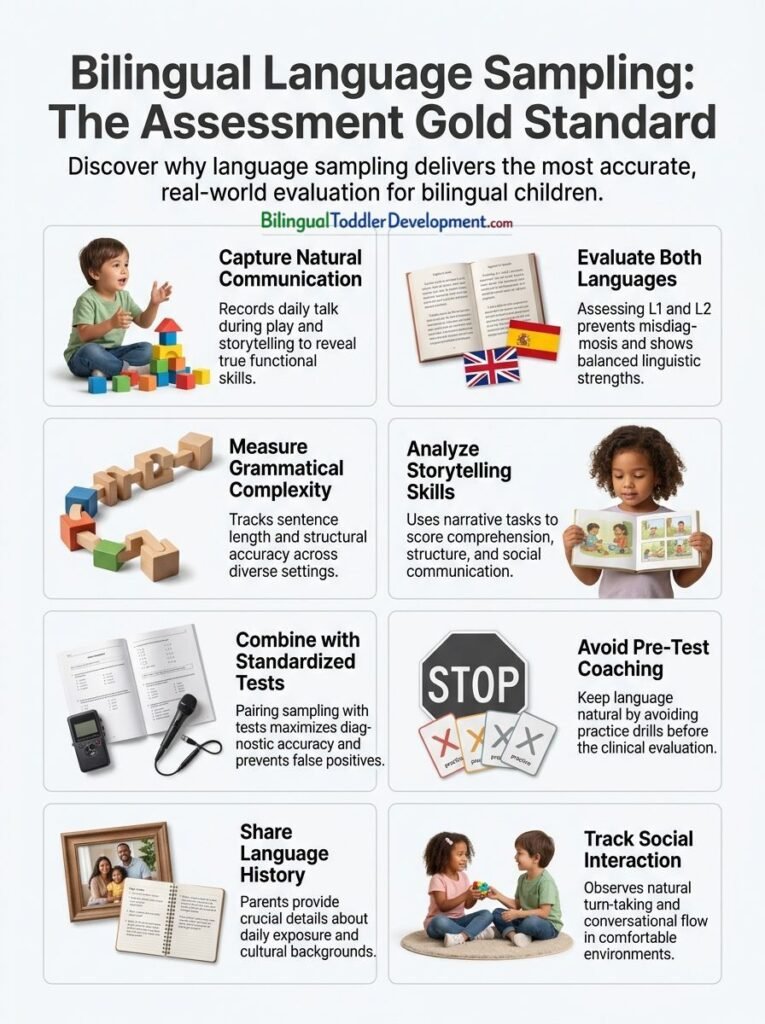
Instead of measuring how well your child answers test questions, language sampling looks at how they naturally use language during conversations, storytelling, play, or picture description. The speech-language pathologist (SLP) records these interactions, creates a transcript, and analyzes important language skills such as vocabulary, grammar, sentence structure, storytelling, and social communication.
Research also supports its value. A 2026 systematic review and meta-analysis found that language sample analysis provides fair to good diagnostic accuracy depending on the measures used, and that it is most effective when combined with other assessment methods rather than used alone.
In this guide, you’ll learn what language sampling is, why it plays such an important role in bilingual evaluations, what speech-language pathologists look for, and how it helps distinguish typical bilingual language development from a true language disorder.
Key Takeaways
- Language sampling captures real communication. It shows how your child uses language during everyday conversations instead of relying only on standardized test scores.
- Bilingual children often show different strengths in each language. Sampling both languages gives speech-language pathologists a more complete and accurate picture of language development.
- Clinicians analyze more than vocabulary. They examine grammar, sentence complexity, storytelling, conversational skills, and social communication to identify meaningful language patterns.
- Language sampling works best alongside other assessment methods. Most comprehensive evaluations combine language samples with standardized testing, dynamic assessment, caregiver interviews, and clinical observation.
- Parents play an important role. Sharing your child’s language history and everyday communication experiences helps clinicians interpret the results more accurately.
What Is Language Sampling?
Language sampling is a structured way for speech-language pathologists to observe how a child naturally communicates. Instead of asking a series of test questions, the clinician encourages your child to talk during activities such as play, storytelling, picture description, or conversations about familiar experiences.
The interaction is recorded and later transcribed so the SLP can carefully examine how your child uses language in real situations. Rather than focusing on a single test score, language sample analysis looks at patterns across many areas of communication, including vocabulary, grammar, sentence length, storytelling, and social language skills.
Because the sample reflects everyday communication, it often provides a more realistic picture of your child’s language abilities than formal testing alone. It also creates a permanent record that clinicians can review later, discuss during evaluation meetings, and compare with future language samples to monitor progress over time.
How Language Sampling Captures Everyday Communication
Although language sampling feels like a natural conversation, it follows a carefully planned process. The clinician selects activities that encourage your child to speak freely while creating opportunities to observe a wide range of language skills.
Common activities include:
- Wordless picture books, which encourage children to create their own stories.
- Picture sequence activities, which help children organize events into a logical narrative.
- Conversations about familiar topics, such as family routines, favorite games, or recent experiences.
These activities allow children to demonstrate how they naturally explain ideas, answer questions, organize stories, and participate in conversations. They also reveal the small but important parts of language, such as connecting words, pronouns, verb endings, and conversational repair strategies, that standardized tests often miss.
Why Language Sampling Is Especially Important for Bilingual Children
Bilingual children do not develop language in exactly the same way as monolingual children. Their vocabulary, grammar, and communication skills are shaped by how much they hear and use each language, who they speak with, and the situations where each language is used.
For example, a child may use rich vocabulary in their home language when talking with family but know more school-related words in English. That difference is a normal part of bilingual development, not necessarily a sign of a language disorder. Understanding a child’s total vocabulary across both languages can therefore be more informative than looking at vocabulary in only one language.
Language sampling helps speech-language pathologists see these natural patterns by observing how children communicate in real conversations instead of relying on a single test score. When clinicians collect samples in both languages whenever possible, they gain a much clearer understanding of a child’s overall language abilities.
Language Exposure Shapes What Children Can Show
One of the most important factors in any bilingual evaluation is language exposure. A child who has only recently begun using English should not be expected to perform the same way as a child who has spoken English since infancy.
That is why speech-language pathologists look beyond what a child says during a single testing session. They also want to understand the child’s language history, including:
- Which language is spoken by different family members.
- When each language was introduced.
- How often each language is used at home, school, and in the community.
- Which language the child uses during everyday activities such as play, storytelling, and conversations.
This background helps clinicians interpret language samples more accurately and reduces the risk of confusing limited language exposure with an underlying language disorder. Structured caregiver questionnaires can also provide valuable information about a child’s language development and daily language use.
Natural Communication Reveals Strengths That Tests May Miss
Standardized tests provide useful information, but they cannot always capture how children communicate during everyday interactions.
Language sampling allows clinicians to observe skills that are difficult to measure with formal testing alone, including how children:
- Tell stories that make sense from beginning to end.
- Explain ideas and experiences.
- Ask and answer questions naturally.
- Stay on topic during conversations.
- Repair misunderstandings when someone does not understand them.
- Combine vocabulary and grammar to communicate effectively.
Storytelling tasks are especially valuable because they allow clinicians to compare how children organize and communicate ideas across both languages using similar activities. This helps create a fairer picture of bilingual language development.
Language Sampling Helps Reduce Misdiagnosis
One of the greatest challenges in bilingual speech evaluation is distinguishing a true language disorder from normal differences that occur when learning two languages.
For example, bilingual children may mix languages within the same conversation, use vocabulary that is stronger in one language than the other, or show different grammatical patterns depending on which language they are speaking. Behaviors such as code-switching in bilingual children are often a normal part of bilingual communication rather than evidence of a language problem.
Language sampling gives clinicians the opportunity to look for consistent patterns across different activities and, when possible, across both languages. Those findings are then considered alongside other information, such as dynamic assessment, caregiver interviews, and standardized testing, to build a more complete and accurate evaluation.
Rather than relying on a single score, clinicians can make decisions based on how a child actually communicates in everyday life, greatly reducing the likelihood of misdiagnosis.
How Speech-Language Pathologists Collect Language Samples
Language sampling is designed to capture natural communication. Rather than asking your child to answer a series of test questions, the speech-language pathologist (SLP) creates opportunities for conversation through activities that encourage spontaneous language.
During the evaluation, the SLP records your child’s speech, creates a transcript, and analyzes how your child uses language during different activities.
Many clinicians also try to collect language samples in both of your child’s languages whenever possible. This helps create a more complete picture of bilingual language development and makes it easier to distinguish a language difference from a language disorder.
Play-Based Conversations
Young children often communicate best when they are relaxed and engaged in play. That is why many language samples begin with toys, games, or conversations about familiar topics rather than formal testing.
Play-based activities encourage children to use spontaneous language while reducing the pressure they may feel during structured assessments. As they interact, the SLP observes how your child:
- Uses vocabulary during conversation.
- Combines words into sentences.
- Takes turns speaking.
- Responds to questions.
- Starts and maintains conversations.
- Repairs misunderstandings when communication breaks down.
Because the goal is natural communication, clinicians also try to keep their own language simple enough that the child does most of the talking. This produces a richer and more representative language sample.
Storytelling and Picture Description Activities
Storytelling tasks are one of the most valuable ways to collect a language sample because they encourage children to produce longer, more complex language than they typically use during casual conversation.
The SLP may ask your child to tell a story from a wordless picture book, describe a sequence of pictures, or retell a story they have just heard. These activities help reveal how well your child:
- Organizes ideas into a logical sequence.
- Uses descriptive vocabulary.
- Connects events with appropriate grammar.
- Explains cause-and-effect relationships.
- Builds complete, coherent narratives.
Because similar storytelling activities can be used in both languages, they also provide a fair way to compare communication skills across your child’s bilingual development.
Conversations About Everyday Experiences
Children often produce their most natural language when talking about people, places, and activities they know well.
For that reason, an SLP may ask questions about your child’s family, favorite games, pets, school experiences, or daily routines. Familiar topics reduce anxiety and allow children to focus on communicating rather than trying to think of the “right” answer.
These conversations give clinicians valuable insight into how your child uses language during everyday life, including vocabulary, grammar, storytelling, and conversational skills.
What Clinicians Look for During Language Sample Analysis
Collecting a language sample is only the first step. Once the conversation has been recorded and transcribed, the speech-language pathologist carefully analyzes how your child communicates across several areas of language.
Rather than focusing on isolated mistakes, clinicians look for consistent patterns. They want to understand how your child communicates overall, including the words they choose, how they build sentences, how they organize ideas into stories, and how they interact with other people.
Clinicians evaluate both the building blocks of language, such as vocabulary and grammar, and the larger communication skills that help children organize stories and conversations.
- Microstructure, which includes vocabulary, grammar, sentence length, and other building blocks of language.
- Macrostructure, which looks at the overall organization of stories and conversations, including how ideas connect and whether the message is clear.
Together, these measures provide a much richer picture of language development than any single test score could offer.
Vocabulary and Word Choice
One of the first things clinicians examine is the variety of words your child uses during the sample.
Rather than simply counting how many words your child says, they look at how effectively vocabulary is used to communicate ideas. Children who use a wide variety of words often demonstrate stronger language organization and greater flexibility in expressing themselves.
When comparing language samples, clinicians also consider factors such as sample length and the context in which the conversation took place. This helps ensure that comparisons are fair and meaningful.
Sentence Length and Grammar
Speech-language pathologists also examine how your child combines words into sentences.
They look for patterns in grammatical development, including sentence complexity, verb forms, word order, and other language structures. Rather than relying on a single average sentence length, clinicians consider how consistently your child produces both shorter and longer sentences throughout the conversation.
Looking at these patterns helps distinguish normal bilingual language differences from signs of an underlying language disorder.
Storytelling and Conversation Skills
Stories reveal much more than vocabulary and grammar alone.
As children tell stories or describe experiences, clinicians observe how they organize events, explain relationships between ideas, and guide a listener from beginning to end. During conversation, they also look at how children stay on topic, answer questions, clarify misunderstandings, and respond to what another person says.
These skills provide valuable information about how language is used in everyday communication, not just during formal testing.
Social Communication
Language sampling also helps clinicians evaluate the social side of communication.
During natural interactions, the SLP observes how your child initiates conversations, responds to others, maintains eye contact when appropriate, takes conversational turns, and adapts when communication breaks down.
Because these behaviors occur naturally during conversation, they often provide a more accurate picture of everyday communication than structured test questions alone.
Communication Across Both Languages
For bilingual children, clinicians also consider how language is used across both languages.
They recognize that vocabulary, grammar, and sentence structure may differ depending on where and with whom each language is spoken. They also understand that behaviors such as code-switching are a normal part of bilingual communication and should be interpreted within the context of bilingual language development rather than viewed as mistakes.
Looking for consistent patterns across both languages helps clinicians make fairer and more accurate evaluation decisions.
How Language Sampling Fits into a Complete Speech Evaluation
Language sampling is one of the most valuable tools speech-language pathologists use during a bilingual speech evaluation, but it is not the only one.
Instead of relying on a single test score, clinicians combine language sampling with other assessment methods to build a complete picture of how your child communicates. Looking at multiple sources of information helps reduce bias and leads to more accurate evaluation decisions.
A comprehensive bilingual evaluation may include:
- Language sample analysis
- Standardized assessments, when appropriate
- Dynamic assessment
- Parent and caregiver interviews
- Classroom or natural environment observations
Each method provides different information, and together they help clinicians determine whether a child is showing typical bilingual language development or signs of a true language disorder.
Language Sampling and Standardized Tests Serve Different Purposes
Standardized language tests measure how a child’s performance compares with a group of children who took the same assessment under the same conditions.
Language sampling measures something different. It shows how your child actually communicates during everyday conversations, storytelling, and play.
Both approaches can be valuable, but they answer different questions.
A standardized test may identify areas that deserve closer attention, while a language sample reveals how those skills are used in real-life situations. Together, they provide a much more complete understanding of your child’s language abilities than either method could provide alone.
For bilingual children, this distinction is especially important because standardized tests may not accurately reflect language abilities if the child differs from the population used to develop the test. Language sampling helps fill that gap by capturing natural communication across meaningful activities.
Why Evaluating Both Languages Matters
Whenever possible, speech-language pathologists try to evaluate bilingual children in both of their languages.
This helps answer one of the most important questions in the evaluation process:
Are the language concerns present across both languages, or do they appear primarily in one language because of differences in exposure and experience?
Children often use each language in different settings and for different purposes. One language may be stronger for conversations at home, while the other is used more often in school. Looking at only one language can leave important information out of the evaluation.
By collecting language samples in both languages, clinicians can compare communication patterns more fairly and gain a better understanding of the child’s overall language development. Our guide to whether a bilingual child should be evaluated in both languages explains why this broader approach is so important.
When a Bilingual Clinician Is Not Available
Not every speech-language pathologist speaks your child’s home language. When that happens, trained interpreters can play an important role in helping collect accurate language samples.
A well-planned evaluation begins before the testing session. The clinician and interpreter discuss the activities, agree on how prompts will be given, and review your child’s language background. Afterward, they work together to interpret the language sample within the context of your child’s bilingual development.
This collaborative approach helps ensure that language differences are understood accurately and that the evaluation reflects how your child communicates in everyday life.
How Parents Can Help Improve the Quality of a Language Sample
Parents play an important role in helping speech-language pathologists understand how a bilingual child uses language every day.
You do not need to prepare your child for the evaluation or practice test questions. In fact, the most helpful thing you can do is provide accurate information about your child’s language experiences and allow the clinician to observe natural communication.
Share Your Child’s Language History
Before the evaluation, think about how your child uses each language throughout the day.
Helpful information includes:
- When each language was introduced.
- Who speaks each language with your child.
- Which language is used at home, school, and in the community.
- Any recent changes in language exposure, such as starting school or moving to a new environment.
The more complete this background is, the easier it is for the SLP to interpret your child’s language sample accurately.
Bring Examples of Everyday Communication
If possible, bring a few examples of how your child communicates naturally at home.
Short recordings of conversations, storytelling, or play can provide valuable context, especially if your child is more comfortable speaking their home language outside the clinic.
It is also helpful to tell the clinician about your child’s favorite topics, interests, and activities. Children often produce richer language when they are talking about something they genuinely enjoy.
Let Your Child Communicate Naturally
It is understandable to want your child to do well during an evaluation, but coaching or rehearsing answers beforehand can make the language sample less representative of everyday communication.
Instead, keep routines normal before the appointment, make sure your child is well rested, and encourage them to simply be themselves during the evaluation.
The goal is not for your child to perform perfectly. The goal is to understand how your child naturally communicates so the evaluation reflects their true language abilities.
Final Thoughts
Language sampling is one of the most valuable parts of a bilingual speech evaluation because it shows how children communicate in real life, not just how they perform on a standardized test.
By observing conversations, storytelling, and everyday language use, speech-language pathologists can see patterns that formal testing alone may miss. When language samples are collected in both languages whenever possible and interpreted alongside your child’s language history, dynamic assessment, standardized testing, and clinical observations, they provide a much more complete picture of bilingual language development.
No single assessment can answer every question about a child’s communication skills. However, language sampling helps clinicians understand how children use language naturally, making it easier to distinguish typical bilingual development from a possible language delay.
As a parent, one of the most valuable things you can do is share your child’s language history, describe how each language is used at home and school, and allow your child to communicate naturally during the evaluation.
The best speech evaluations do more than generate scores. They help families understand how a child truly communicates, so every recommendation is based on real strengths, real challenges, and real everyday language.
Frequently Asked Questions
Why is language sampling important for bilingual children?
Language sampling shows how your child naturally communicates during conversations, storytelling, and play. Because it captures real-life language use rather than responses to test questions, it gives speech-language pathologists a better understanding of bilingual language development and helps reduce the risk of misdiagnosis.
Will my child be asked to speak both languages?
Whenever possible, yes. Evaluating both languages gives clinicians a more complete picture of your child’s communication abilities and helps distinguish normal bilingual language differences from a language disorder. The exact approach depends on your child’s language background and whether a bilingual clinician or trained interpreter is available.
How long does language sampling take?
The amount of time varies depending on your child’s age, attention span, and the activities used during the evaluation. Some children produce a useful language sample during a single play session, while others may participate in more than one activity or have samples collected across separate sessions to capture both languages comfortably.
Can language sampling diagnose a language disorder by itself?
No. Language sampling is an important part of a bilingual speech evaluation, but it is most effective when combined with other assessment methods, such as standardized testing, dynamic assessment, caregiver interviews, and clinical observation. Looking at multiple sources of information helps clinicians make more accurate diagnostic decisions.
Should I prepare my child before the evaluation?
No special preparation is necessary. Rather than practicing answers or coaching your child, focus on helping them arrive well rested and ready to communicate naturally. It is also helpful to share your child’s language history and any concerns you have so the speech-language pathologist can interpret the language sample within the context of your child’s bilingual development.