
A bilingual child can sometimes appear behind on a test given in just one language, even when they communicate well in everyday life.
That is one reason speech-language pathologists may use dynamic assessment when evaluating bilingual children.
Instead of looking only at what your child knows at the beginning of an evaluation, dynamic assessment looks at how your child responds when the clinician teaches, prompts, and provides support.
This can provide important clues about whether your child is showing a normal bilingual language difference or having difficulties that may point to a language disorder.
Quick Answer
Dynamic assessment is an evaluation approach that looks at how well a child learns with support, rather than measuring only what the child already knows.
A speech-language pathologist might first ask your child to complete a language task, teach or demonstrate the skill, and then see how your child performs when the task is presented again.
For bilingual children, this can be especially useful because vocabulary, grammar, and language experience are often divided across two languages. A child who performs poorly on an English-language task may simply have had less exposure to the words or language patterns being tested.
Dynamic assessment helps the clinician look beyond that initial performance and ask a different question:
How does this child learn when given appropriate help?
Key Takeaways
- Dynamic assessment looks at learning and response to support, not just right and wrong answers.
- A common approach is called test-teach-retest.
- The clinician pays attention to how much help your child needs and whether that help can gradually be reduced.
- Strong learning after a small amount of support may suggest that limited language experience contributed to poor initial performance.
- Continued difficulty despite appropriate teaching may provide additional evidence of an underlying language disorder.
- Dynamic assessment should usually be considered alongside language history, observation, language samples, and other appropriate assessment methods.
- For bilingual children, the goal is to understand abilities across the child’s languages rather than treating English performance alone as the complete picture.
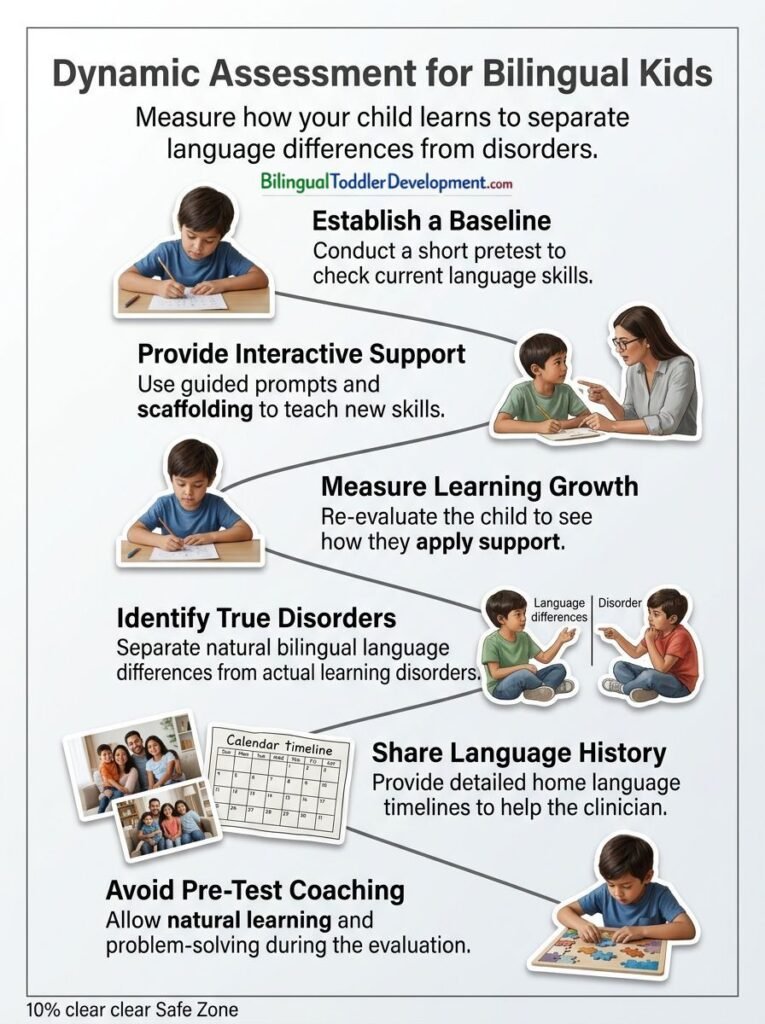
What Is Dynamic Assessment?
Dynamic assessment is an interactive way of evaluating how a child learns.
In a traditional test, the clinician generally presents questions or tasks and records the child’s answers. There may be limits on how much help the clinician can provide because the test must be administered in a standardized way.
Dynamic assessment works differently.
The clinician is allowed to teach, demonstrate, give clues, and adjust the amount of support. The child’s response to that help becomes part of the assessment.
The clinician may look at questions such as:
- Does the child understand the skill after it is demonstrated?
- How much prompting is needed?
- Does the child improve quickly with feedback?
- Can the prompts gradually be reduced?
- Can the child use what was learned in a different activity?
This gives the speech-language pathologist information that a single test score may not provide.
Learning Potential Versus What a Child Already Knows
Suppose a child does not know a particular word during an evaluation.
A traditional test might simply record the answer as incorrect.
Dynamic assessment goes further.
The clinician might teach the word, use it in context, provide visual or verbal clues, and then see whether the child can remember and use it later.
The important question is no longer simply:
Did the child know the answer?
It becomes:
What happened when the child was given an opportunity to learn it?
That distinction can be particularly important for bilingual children because what a child knows in each language depends partly on when, where, and how often that language is used.
Why Is Dynamic Assessment Useful for Bilingual Children?
Bilingual children do not necessarily develop identical skills in both languages at the same time.
A child might know the names of household objects in Spanish because Spanish is spoken at home but know school-related vocabulary primarily in English.
Another child might understand a home language very well but speak mostly English.
These patterns can be part of normal bilingual development.
If an evaluation focuses too heavily on one language, particularly the child’s less-developed or less-exposed language, the results can underestimate what the child actually knows and can do.
That is why a good bilingual evaluation considers the child’s entire language experience.
You can read more about this in Should a Bilingual Child Be Evaluated in Both Languages?.
Language Exposure Can Affect Test Performance
Language skills develop partly through opportunities to hear and use a language.
A child who has heard English regularly for only a short time should not necessarily be expected to have the same English vocabulary as a child who has heard English since birth.
That does not automatically indicate a disorder.
Dynamic assessment gives the clinician an opportunity to determine whether the child can learn unfamiliar language skills when appropriate teaching is provided.
If you are trying to understand how the amount and type of language input can affect development, see How Much Language Exposure Does a Bilingual Toddler Need?.
How Does Dynamic Assessment Work?
One of the most common approaches is test-teach-retest.
The exact activities vary depending on the child’s age and the skills being evaluated, but the basic process has three parts.
1. Test: See What Your Child Can Do Independently
The clinician first establishes a starting point.
For a young child, this might involve play, pictures, books, conversation, following directions, learning new words, or telling a simple story.
The speech-language pathologist observes what your child can do without significant help.
The goal is not simply to count mistakes. The clinician may also look at the kinds of mistakes your child makes and the strategies your child already uses.
2. Teach: Provide Support
Next comes the teaching portion.
The clinician might:
- demonstrate the skill
- provide verbal or visual clues
- model an answer
- break the task into smaller steps
- repeat important information
- show the child a strategy for solving the task
The amount of help may change depending on how your child responds.
This is one of the most valuable parts of dynamic assessment because the clinician can observe how readily your child responds to teaching.
3. Retest: See What Changed
The clinician then gives your child another opportunity to perform the skill, usually with less support.
The speech-language pathologist may look at whether your child:
- remembers what was taught
- needs fewer prompts
- uses the strategy independently
- applies the skill to something new
- corrects mistakes after feedback
The goal is not necessarily for your child to perform perfectly.
The clinician is looking for a pattern of learning.
What Does the Speech-Language Pathologist Look For?
During dynamic assessment, the clinician is interested in more than whether your child gets an answer right.
One important concept is modifiability, which simply refers to how much a child’s performance changes in response to teaching.
For example, the clinician may consider:
Response to prompts: Does a small hint help, or does your child need repeated explanation and modeling?
Speed of learning: Does your child begin to understand the skill after a few examples?
Ability to use feedback: Does your child change an answer or strategy after receiving guidance?
Independence: Can the clinician gradually reduce the amount of help?
Transfer: Can your child use the newly learned skill with different words, pictures, stories, or activities?
These observations can provide important information about your child’s learning potential.
Can Dynamic Assessment Help Tell the Difference Between Bilingual Development and a Language Disorder?
It can provide an important piece of the answer, but it should not be used by itself.
A bilingual child may have difficulty on a language task simply because the vocabulary, grammar, or testing language is less familiar.
If the child improves quickly when the clinician explains the task or teaches the skill, that can suggest that experience and exposure contributed to the initial difficulty.
A child with an underlying language disorder may continue to have difficulty learning or applying the skill even after receiving appropriate instruction.
The distinction is not based on one response or one session.
Clinicians should consider patterns across the child’s languages, language history, everyday communication, language samples, observations, and other appropriate assessment measures.
This broader distinction is explained in Language Delay vs. Bilingual Development: How Can Parents Tell the Difference?.
Dynamic Assessment vs. Standardized Testing
Dynamic assessment and standardized testing answer somewhat different questions.
A standardized test generally asks:
How did this child perform compared with the children in the test’s reference group?
Dynamic assessment asks:
How does this child respond when given an opportunity to learn?
Both types of information can be useful.
The challenge for bilingual children is that standardized test results can sometimes be difficult to interpret when the child does not closely match the population on which the test was developed.
Language experience, cultural background, amount of exposure to each language, and familiarity with the test language can all affect performance.
Dynamic assessment does not eliminate the need for other assessment methods. Instead, it gives the clinician another way to understand what may be behind a child’s performance.
For a broader explanation of how evaluations can differ, see Bilingual vs. Monolingual Speech Evaluation: What’s the Difference?.
Dynamic Assessment Is Only One Part of a Bilingual Evaluation
No single test or assessment technique can provide a complete picture of a bilingual child’s communication abilities.
A comprehensive evaluation may include several sources of information.
Language History
The clinician should understand:
- which languages your child hears
- who speaks each language with your child
- how long your child has been exposed to each language
- where each language is used
- whether the amount of exposure has changed over time
This context helps the clinician interpret your child’s performance more fairly.
Language Sampling
A language sample allows the clinician to hear how your child actually communicates during conversation, play, storytelling, or another natural activity.
This can reveal abilities that structured tests may miss.
Language sampling can be particularly valuable when information is gathered across both languages. You can learn more in What Is a Language Sample in a Bilingual Speech Evaluation?.
Parent and Caregiver Observations
Parents often see communication skills that do not appear during a short clinical appointment.
Tell the clinician how your child communicates at home.
For example:
- How does your child ask for help?
- Does your child follow everyday directions?
- Can your child tell you about something that happened?
- Which language does your child use with different family members?
- Does your child communicate differently with familiar and unfamiliar people?
Those observations can provide valuable context for interpreting assessment results.
What Should Parents Expect During Dynamic Assessment?
For toddlers and young children, dynamic assessment may not look much like a formal test.
The clinician might use toys, books, pictures, games, or short stories.
Your child may be asked to learn a new word, follow a pattern, describe something, retell part of a story, or use a particular type of sentence.
The speech-language pathologist may provide increasingly helpful clues until your child understands what to do.
Then the clinician may reduce the support and see whether your child can continue independently.
In other words, you may see the clinician teaching during the evaluation.
That is intentional.
The teaching itself provides information about how your child learns.
How Parents Can Help Before the Evaluation
You do not need to practice test questions or drill your child before a dynamic assessment.
In fact, seeing your child’s natural response to an unfamiliar task can be useful to the clinician.
What you can do is provide a detailed picture of your child’s language experience.
Be prepared to explain:
- which languages your child hears and speaks
- approximately how much exposure your child has to each language
- whether one language has become stronger recently
- how your child communicates with different family members
- what you have noticed that concerns you
- what your child does particularly well
- whether teachers or caregivers have noticed similar concerns
Concrete examples are especially helpful.
Instead of saying, “His Spanish isn’t very good,” you might explain, “He understands almost everything his grandmother says in Spanish, but he usually answers her in English.”
That gives the clinician much more useful information.
Questions to Ask About Dynamic Assessment
If your bilingual child is being evaluated, it is reasonable to ask how the clinician plans to account for bilingual development.
Useful questions include:
- Will you use dynamic assessment as part of the evaluation?
- How will you assess my child’s abilities across both languages?
- Will you collect language samples in both languages?
- How will you consider my child’s amount of exposure to each language?
- What did my child’s response to teaching tell you?
- How much prompting did my child need?
- Was my child able to use the skill independently after teaching?
- How did dynamic assessment affect your interpretation of the other test results?
You do not need to know technical terminology to ask good questions.
What matters is understanding why the clinician reached a particular conclusion.
What Dynamic Assessment Cannot Tell You
Dynamic assessment can provide valuable information, but it cannot diagnose a language disorder by itself.
A child’s response can be affected by attention, comfort with the clinician, fatigue, familiarity with the activity, and other factors.
The quality of the assessment also depends on whether the clinician chooses appropriate tasks and interprets the results in the context of the child’s language background.
That is why dynamic assessment works best as one part of a broader evaluation rather than as a stand-alone test.
If you are wondering whether your child’s communication difficulties have reached the point where an evaluation may be appropriate, see When Does a Bilingual Child Need a Speech-Language Evaluation?.
Final Thoughts
Dynamic assessment changes the focus of an evaluation from “What does this child know right now?” to “How does this child learn when given appropriate support?”
For bilingual children, that difference can matter.
A child may perform poorly on a task because of limited experience with the test language, unfamiliar vocabulary, or uneven exposure across two languages. Looking at how the child responds to teaching gives the speech-language pathologist another way to understand what may be behind that performance.
Dynamic assessment is most useful when it is combined with a careful language history, observation, language sampling across the child’s languages, and other appropriate assessment measures.
Together, those pieces can provide a much clearer picture of whether your child’s language development reflects normal bilingual variation or whether additional support may be needed.
Frequently Asked Questions
Why is dynamic assessment recommended for bilingual children?
Dynamic assessment can help reduce the influence of differences in language exposure by looking at how a child responds to teaching.
Instead of relying only on what the child already knows in one language, the clinician can observe how quickly the child learns, how much help is needed, and whether the child can use the newly learned skill independently.
Does every bilingual speech evaluation include dynamic assessment?
No. The methods used depend on the clinician, the child’s age and languages, the reason for the evaluation, and the setting.
If your child is being evaluated, you can ask whether dynamic assessment will be used and how the clinician plans to account for your child’s experience in both languages.
Can dynamic assessment diagnose a language disorder?
Not by itself.
Dynamic assessment can provide important evidence about how a child learns, but clinicians should consider it alongside language history, language samples, observations, and other appropriate assessment measures.
What is the test-teach-retest method?
Test-teach-retest is a common form of dynamic assessment.
The clinician first sees what the child can do independently, then teaches or provides support, and finally presents the task again to see what the child has learned and how much support is still needed.
What does modifiability mean in dynamic assessment?
Modifiability refers to how much a child’s performance changes in response to teaching or prompting.
A clinician may look at how quickly the child responds to help, how much prompting is needed, whether prompts can be reduced, and whether the child can apply what was learned to a new activity.
Should I ask whether my child’s evaluation will include dynamic assessment?
Yes. It is reasonable to ask how the clinician will evaluate learning potential rather than relying only on standardized scores.
You might ask: “Will you use dynamic assessment, and how will you combine those results with my child’s language history and abilities in both languages?”