
It can be confusing when your bilingual child talks happily at home but becomes almost completely silent around teachers, relatives, or other children. You may wonder whether they’re simply shy, adjusting to a second language, or showing signs of something more serious. It’s a situation that leaves many parents questioning whether their child’s behavior is a normal part of bilingual development.
The reassuring news is that many bilingual children go through quiet periods as they build confidence using more than one language. Some children are naturally cautious in new situations, while others prefer to observe before they begin speaking. In most cases, this quietness is temporary and does not mean bilingualism is causing a language problem.
In this guide, you’ll learn why some bilingual children seem reluctant to speak, how to recognize the signs of healthy language development, and practical ways to build your child’s confidence without adding pressure. You’ll also learn when quietness may deserve a closer look and where to find additional guidance if you have ongoing concerns.
Quick Answer
Yes. It is completely normal for many bilingual children to be shy or quiet in certain situations, especially while learning a second language or adjusting to a new environment. Many children spend time listening, observing, and building confidence before they feel ready to speak, and this quiet phase is often a normal part of bilingual language development rather than a sign that something is wrong.
Most quiet bilingual children continue to develop healthy language skills even if they speak very little in certain settings. The key is to look at their overall communication, including what they understand, how they interact through play and gestures, and whether they continue making progress across both languages. However, if your child shows limited progress in both languages or their silence persists across many situations, it’s worth discussing your concerns with your pediatrician or a speech-language pathologist.
Here are a few ways you can support your child:
- Look for understanding, not just talking: Following directions, responding appropriately, pointing to familiar objects, and engaging in play are all signs of healthy language development.
- Encourage communication without pressure: Celebrate every attempt to communicate, whether it’s a gesture, whisper, single word, or complete sentence.
- Keep both languages part of everyday life: Build language naturally through conversations, meals, stories, songs, and play instead of turning speaking into a test.
- Seek guidance if concerns persist: If your child shows little progress in either language or their quietness significantly affects daily life, a professional evaluation can help determine whether additional support is needed.
Remember: A quiet bilingual child is often learning far more than they’re saying. Progress is measured by understanding, confidence, and communication across both languages, not simply by how much your child talks.
Key Takeaways
- Many quiet bilingual children are developing normally. Shyness often reflects personality, confidence, or adjusting to a second language rather than a speech or language problem.
- Listening is an important part of language learning. Many bilingual children spend time observing, understanding, and processing language before they begin speaking confidently.
- Look at your child’s overall communication, not just how much they talk. Understanding, gestures, play, and progress across both languages provide a much clearer picture of healthy language development.
- Build confidence instead of applying pressure. Everyday conversations, books, songs, play, and predictable routines encourage communication far better than correcting or testing your child.
- Trust your instincts if concerns continue. If your child shows little progress across both languages or you’re worried about their overall communication, talk with your pediatrician or a speech-language pathologist for guidance.
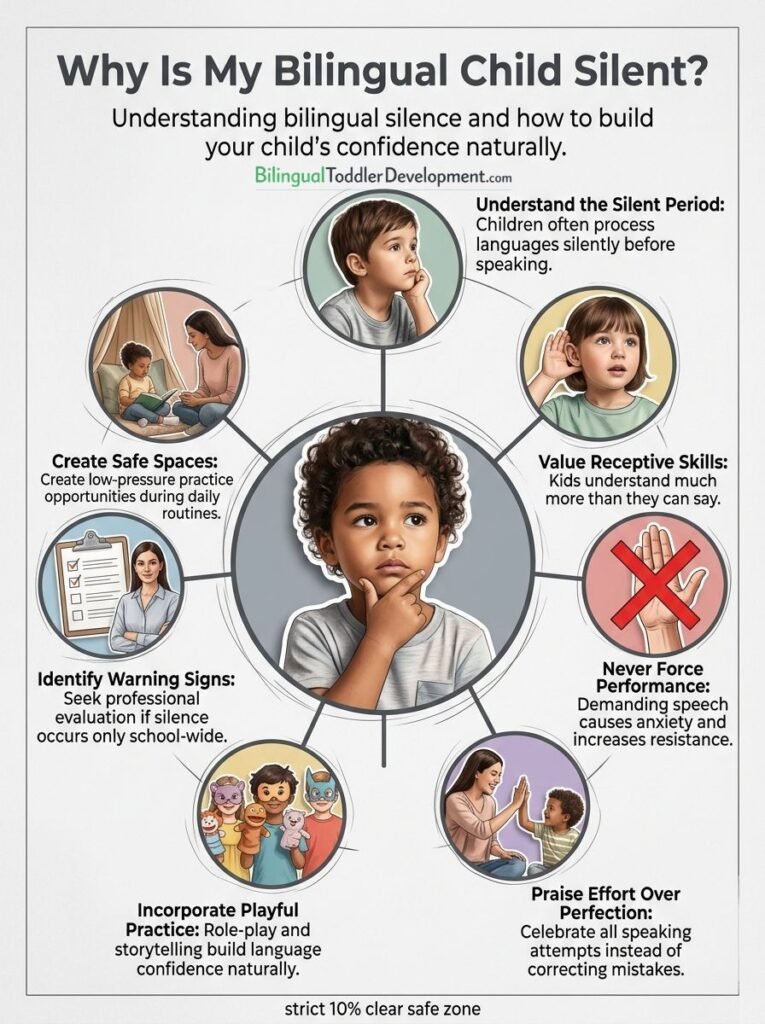
Why Some Bilingual Children Seem Too Shy to Speak
Every bilingual child develops confidence at their own pace. Some eagerly try new words as soon as they hear them, while others spend days, weeks, or even months listening, observing, and practicing quietly before they’re ready to speak. Understanding why this happens can help you recognize when your child’s quietness is simply part of learning rather than a sign that something is wrong.
One of the easiest ways to understand your child’s behavior is to look at what you’re seeing, what it may mean, and how you can respond.
| What you see | What it can mean | What you can do next |
|---|---|---|
| Quiet in groups, warmer one-on-one | Cautious personality or a normal “warming up” period | Start with small speaking opportunities during familiar daily routines. |
| Understands directions but says little | Receptive language is developing faster than expressive language | Offer simple choices, use predictable phrases, and give plenty of time to respond. |
| Speaks freely at home but is quiet at school | A normal bilingual silent period, adjusting to a new environment, or building confidence | Work with your child’s teacher and give your child time to become comfortable before expecting frequent speech. |
| Limited progress in both languages | A possible speech or language delay | Consider discussing your concerns with your pediatrician or a speech-language pathologist. |
Shyness Is Not the Same as a Speech Delay
Shyness affects when a child chooses to talk. A speech or language delay affects what a child is able to understand or communicate, even when they’re in a comfortable, familiar environment.
One practical guideline is to look at both of your child’s languages together. Children with a true language disorder typically show communication difficulties across both languages, not just in one. That’s why bilingual evaluations consider a child’s complete language profile rather than judging them by only one language.
If you’d like to learn more about this distinction, see our article on Language Delay vs. Bilingual Development.
Some encouraging signs that your child is developing normally include:
- Green flags: Your child follows routines, understands simple directions, points to familiar objects, and uses gestures or facial expressions to communicate.
- Yellow flags: Your child speaks very little in one setting but communicates comfortably with trusted people and continues gaining new words over time.
- Red flags: Your child has difficulty understanding everyday language, loses skills they previously had, or makes little progress across both languages for an extended period.
If you’re unsure whether your child’s quietness is still within the range of typical development, read our guide When Is a Quiet Bilingual Child a Cause for Concern?, which explains the warning signs and when a professional evaluation may be appropriate.
Quiet Children Often Communicate in Other Ways
Speech is only one part of communication. Many bilingual children show their language skills through gestures, facial expressions, pretend play, and their ability to understand what others are saying long before they feel comfortable speaking in every situation.
Instead of focusing only on how many words your child says, pay attention to how they communicate throughout the day. Children often show meaningful progress by:
- Pointing to request or share something interesting
- Nodding or shaking their head appropriately
- Following one-step and two-step directions
- Using pretend play to act out familiar situations
- Using consistent words, sounds, or gestures to communicate
Looking at your child’s overall communication, rather than speech alone, gives you a much more accurate picture of their language development. You can learn more about these important differences in our articles on Receptive vs. Expressive Language in Bilingual Children and Bilingual Toddler Total Vocabulary.
Why Bilingualism Usually Isn’t the Cause
Many parents worry that raising a child with two languages has made them hesitant to speak. Fortunately, research consistently shows that bilingualism itself does not cause shyness or speech delays.
What often looks like a bilingual problem is actually a combination of confidence, personality, language exposure, and the social demands of a new environment. It’s also completely normal for children to know many words across both languages without using them equally in every situation.
If your child knows 25 words in English and 25 words in Spanish, they still have a total vocabulary of about 50 words, even though those words are divided between two languages.
The goal isn’t to make both languages perfectly balanced every day. The goal is steady progress, meaningful communication, and positive experiences using both languages.
If you’re concerned about whether your child is getting enough exposure to each language, our articles on Bilingual Toddler Language Exposure, How to Encourage Your Bilingual Toddler to Speak the Home Language, and Language Dominance in Bilingual Toddlers provide practical strategies for supporting both languages without creating unnecessary pressure.
Common Reasons a Bilingual Child May Avoid Speaking
Children may avoid speaking for several different reasons, and most have nothing to do with intelligence or a language disorder. Some are still building confidence, some are adjusting to a new language or environment, and others simply have naturally cautious personalities. Understanding what’s behind your child’s quietness can help you respond in ways that encourage communication instead of adding pressure.
They Understand More Than They Can Express
It’s very common for bilingual children to understand far more than they can comfortably say. Receptive language, or the ability to understand words and sentences, often develops faster than expressive language, especially while learning two languages.
If your child follows routines, responds appropriately to questions, or understands directions but uses only a few words, they’re often making meaningful progress even if they aren’t speaking much yet.
Some simple ways to encourage expressive language include:
- Play “show me” games: Ask your child to point to familiar objects in either language.
- Use predictable phrases: Repeat short expressions during everyday routines so your child hears the same language patterns over and over.
- Give extra time to respond: Resist the urge to answer for your child immediately. A few extra seconds can make a big difference.
To learn more about how understanding and speaking develop at different rates, see our article on Receptive vs. Expressive Language in Bilingual Children.
They Feel More Comfortable Speaking at Home Than in Public
Many bilingual children speak freely at home but become much quieter at preschool, daycare, family gatherings, or other unfamiliar settings. Home feels safe and predictable, while public settings often involve new people, unfamiliar routines, and greater social pressure.
This difference doesn’t necessarily mean anything is wrong. Many children simply need time to observe before they feel comfortable joining conversations.
You can help by:
- Identifying one trusted adult who can help your child feel comfortable.
- Allowing your child to participate through gestures, pointing, or whispering before expecting full conversations.
- Celebrating small successes instead of focusing on how much your child talks.
If your child’s quietness continues for an extended period or begins affecting everyday life, our article When Is a Quiet Bilingual Child a Cause for Concern? explains the signs that may warrant a professional evaluation.
They Prefer the Language They Feel Most Comfortable Using
Children naturally choose the language that feels easiest and most useful in a particular situation. Once preschool or kindergarten begins, the community language often becomes the preferred choice because it’s the language they hear most often outside the home.
This doesn’t mean your home language is being forgotten. It usually means your child is responding to the environment around them.
To support both languages naturally:
- Reserve certain routines, such as bedtime stories or family meals, for your home language.
- Focus on consistency rather than perfection.
- Connect the home language to enjoyable activities, traditions, songs, and meaningful relationships.
If you’re wondering whether your child is getting enough exposure to both languages, our articles on Bilingual Toddler Language Exposure, Language Dominance in Bilingual Toddlers, and How to Encourage Your Bilingual Toddler to Speak the Home Language offer practical strategies.
They Have a Naturally Cautious Personality
Some children simply need more time before they feel comfortable speaking. They prefer to watch, listen, and learn about a situation before joining in.
A cautious temperament isn’t a weakness. In fact, many children who appear quiet at first become confident communicators once they feel safe.
You can encourage participation by:
- Giving your child a simple “helper” role during activities.
- Encouraging side-by-side play instead of putting them in the spotlight.
- Practicing the same short phrases during familiar daily routines so they become comfortable using them.
Remember that confidence grows gradually. Your goal isn’t to make your child talk more today. It’s to help them feel a little more comfortable each day.
They Worry About Making Mistakes
Children quickly notice when they’re being corrected or expected to perform. If they become worried about saying the wrong word or using the wrong language, staying quiet can feel like the safest choice.
Instead of testing your child’s language skills, focus on making conversations enjoyable and low pressure.
Try these strategies:
- Ask choice questions instead of quiz-style questions.
- Model mistakes yourself and show that everyone learns through practice.
- Save “repeat after me” activities for songs, rhymes, and games instead of everyday conversations.
If you’re looking for more ways to create rich language experiences throughout the day, our articles on Daily Routines That Build Toddler Vocabulary and Does Screen Time Affect Bilingual Language Development? offer additional practical ideas.
Understanding why your child may be quiet is reassuring, but many parents still wonder whether their development is on track. In the next section, we’ll look at the everyday signs that suggest your child is continuing to build healthy language skills across both languages.
Signs Your Child Is Developing Normally
A quiet child is not necessarily a child who is struggling. In fact, many bilingual children make steady language progress long before they’re willing to speak confidently in every situation. Rather than focusing only on how much your child talks, look for signs that they’re continuing to learn, understand, and communicate in meaningful ways.
They Understand More Than They Say
One of the strongest signs of healthy language development is understanding. Many bilingual children spend weeks or even months building their receptive language before their expressive language catches up.
You may notice your child:
- Follows everyday directions without needing extra help.
- Understands familiar routines and knows what comes next.
- Points to people or objects when you name them.
- Responds appropriately to simple questions, even with gestures or a few words.
These everyday moments show that your child is actively learning, even if they’re speaking less than you expected.
If you’d like to better understand how comprehension develops alongside speaking, see our article on Receptive vs. Expressive Language in Bilingual Children.
They Keep Finding New Ways to Communicate
Communication is much more than spoken words. As bilingual children gain confidence, they often find new ways to express themselves before they begin speaking more frequently.
You might notice your child:
- Pointing or gesturing to share ideas.
- Nodding or shaking their head appropriately.
- Using pretend play to act out stories and conversations.
- Combining gestures, sounds, and words to get their message across.
- Using a few new words each week, even if they’re not speaking in long sentences yet.
Every new way your child communicates is another sign that language skills are continuing to grow.
Our article on Bilingual Toddler Total Vocabulary explains why looking at all forms of communication, and both languages together, gives a much more accurate picture of progress.
Their Confidence Grows a Little at a Time
Language confidence rarely appears overnight. Most children become comfortable speaking in small, gradual steps.
For example, your child may:
- Speak freely with parents before talking to grandparents.
- Whisper to a trusted teacher before speaking during group activities.
- Answer simple questions before joining longer conversations.
- Become more talkative each time they visit a familiar place.
These small victories often matter much more than dramatic leaps in language ability. Consistent progress, even if it seems slow, is usually a very encouraging sign.
They Continue Learning Across Both Languages
Many parents expect both languages to develop at exactly the same pace, but that’s rarely how bilingual language development works.
Your child may learn many new words in one language while improving understanding in the other. They may prefer one language at preschool and another at home. They may even switch back and forth between languages depending on who they’re talking to.
All of these patterns can be completely normal.
Instead of comparing the two languages, look for overall progress across both of them. As long as your child continues building vocabulary, understanding more, and communicating in meaningful ways, they’re likely moving in the right direction.
You can learn more about these patterns in our articles on Bilingual Toddler Language Milestones, Language Dominance in Bilingual Toddlers, and How Does Being Bilingual Affect Child Development?
If most of these signs describe your child, there’s a good chance they’re continuing to build healthy language skills, even if they aren’t speaking confidently in every situation. Keep providing rich language experiences, celebrate small successes, and remember that confidence often develops gradually.
If, however, your child’s progress seems to stall or you begin noticing persistent concerns across both languages, our article When Is a Quiet Bilingual Child a Cause for Concern? explains the warning signs and when it may be time to seek a professional evaluation.
When Should You Be Concerned?
Most quiet bilingual children are simply developing at their own pace. They continue building language skills, gaining confidence, and finding new ways to communicate, even if they don’t speak much in certain situations.
However, it’s a good idea to take a closer look if you notice any of the following:
- Your child shows little or no progress across both languages over several months.
- Your child has difficulty understanding everyday language or following simple directions.
- Your child loses language or communication skills they previously used.
- Your child’s silence consistently interferes with learning, friendships, or everyday activities.
- Your pediatrician, teacher, or another trusted caregiver has expressed concerns about your child’s communication.
These signs don’t automatically mean your child has a speech or language disorder. In many cases, there are simple explanations, and an evaluation may simply provide reassurance. The important thing is to understand what’s happening so your child receives the support they need, if any is necessary.
If you’re unsure whether your child’s quietness falls within the range of typical bilingual development, our article When Is a Quiet Bilingual Child a Cause for Concern? explains how to distinguish normal shyness and the bilingual silent period from situations such as selective mutism, anxiety, hearing concerns, and speech or language delays.
You may also find these articles helpful as you learn more about your child’s development:
- Language Delay vs. Bilingual Development explains how professionals tell the difference between a language difference and a true language disorder.
- Bilingual Toddler Language Milestones outlines the language skills many bilingual children develop as they grow.
- Receptive vs. Expressive Language in Bilingual Children explains why some children understand much more than they are ready to say.
Remember that the goal isn’t to compare your child with other children. It’s to make sure your child continues making steady progress and receives support whenever it’s needed.
How to Help a Quiet Bilingual Child Feel More Comfortable Speaking
Helping a quiet bilingual child doesn’t mean encouraging them to talk more at every opportunity. Instead, the goal is to create everyday situations where communication feels safe, enjoyable, and rewarding. Small, consistent interactions often build confidence far more effectively than pressure or repeated encouragement to “use your words.”
Remove Pressure to Perform
Pressure is one of the fastest ways to discourage communication. When children feel like they’re being tested or expected to perform for others, they often become even more hesitant to speak.
Instead of focusing on how much your child says, focus on creating conversations that feel natural and enjoyable.
- Avoid asking your child to “perform” for relatives or friends.
- Don’t interrupt a brave attempt to correct pronunciation or grammar.
- Narrate everyday activities so your child hears rich language without feeling pressured to respond.
The more relaxed the interaction feels, the more likely your child will begin participating when they’re ready.
Build Confidence Through Play
Play is one of the most powerful ways to encourage language because children become focused on having fun rather than saying the “right” thing.
The best language-building activities naturally create opportunities for conversation without making children feel like they’re practicing or being evaluated.
Some simple ideas include:
- Puppet translator: Your child whispers to a puppet, and the puppet “tells” you what they said.
- Pretend grocery store or restaurant: Encourage simple requests and choices using your home language.
- Story retelling: Read the same favorite story several nights in a row, then pause and let your child fill in familiar words or phrases.
- Pretend classroom: Practice simple phrases your child might use at preschool, such as “My turn,” “Here,” or “Can I play?”
If you’re looking for additional ideas, our article Daily Routines That Build Toddler Vocabulary shows how everyday activities naturally encourage conversation.
Praise Communication Instead of Perfect Speech
Children become more confident communicators when they feel understood rather than evaluated.
Instead of correcting every mistake, acknowledge your child’s message first. You can always model the correct language naturally as the conversation continues.
| Instead of this | Try this |
|---|---|
| “No, say it correctly.” | “I understand. You want the red one.” |
| “Use a full sentence.” | “One word or pointing is fine. I know what you mean.” |
| “Tell Grandma what you said.” | “I’ll help. You can nod if I got it right.” |
The goal is to keep conversations flowing. Language develops best when children feel successful communicating, not when they feel they’re being graded.
One simple way to notice progress is to keep a “communication inventory” for a week. Instead of counting only spoken words, write down all the ways your child communicates, including:
- Pointing to request or share something interesting.
- Nodding or shaking their head appropriately.
- Following one-step and two-step directions.
- Using pretend play to act out familiar situations.
- Combining gestures, sounds, and words to communicate.
Many parents are surprised to discover just how much communication is happening, even before confident speaking develops.
Create Safe Opportunities to Practice the Home Language
Children are much more likely to use a language when it feels useful, familiar, and connected to people they love.
Rather than setting aside “language lessons,” build your home language into enjoyable family routines.
Ideas include:
- Reading bedtime stories together.
- Having one regular meal where everyone uses the home language.
- Singing favorite songs together.
- Scheduling relaxed video calls with grandparents or relatives.
- Arranging playdates with other bilingual children when possible.
These meaningful experiences help children associate the home language with comfort, belonging, and connection.
For more ideas, see our articles How to Encourage Your Bilingual Toddler to Speak the Home Language and Bilingual Toddler Language Exposure.
Be Patient and Celebrate Small Steps
Language confidence develops gradually. Most bilingual children don’t suddenly become talkative overnight. Instead, progress usually happens through a series of small successes.
You may notice your child moving from:
- Silence
- Pointing
- Whispering
- One-word responses
- Short phrases
- Comfortable conversations
Every one of these steps represents meaningful progress.
Celebrate each success instead of waiting for perfect conversations. Confidence grows one positive interaction at a time.
If you’re wondering whether your child’s progress is typical for their age, our article Bilingual Toddler Language Milestones explains what many bilingual children develop over time.
Common Mistakes Parents Should Avoid
Every parent wants to help their child become a confident communicator. Sometimes, though, the strategies we use with the best intentions can unintentionally make speaking feel more stressful. The good news is that a few small changes can make everyday conversations feel more relaxed, enjoyable, and supportive.
Forcing a Child to Speak on Command
When children feel they’re being put on the spot, their attention often shifts from communicating to worrying about getting the answer “right.” The more pressure they feel, the less likely they are to speak confidently.
Instead of expecting your child to perform, create opportunities where communication happens naturally.
Some helpful approaches include:
- Giving your child a “pass” option by allowing them to point, nod, or whisper instead of speaking.
- Building language into familiar daily routines instead of asking surprise questions.
- Letting your child join conversations when they feel ready rather than insisting they answer immediately.
Remember, confidence grows through positive experiences, not pressure.
Correcting Every Mistake
It’s natural to want to help your child learn the correct words and grammar. However, correcting every mistake can shift their attention away from communicating and toward avoiding errors.
Instead of interrupting the conversation, respond naturally and model the correct language in your reply.
For example:
Child: “Him goed.”
Adult: “Yes, he went home.”
This keeps the conversation moving while allowing your child to hear the correct form in a relaxed, supportive way.
Comparing Your Child to Other Bilingual Children
Every bilingual child develops at their own pace. Differences in personality, language exposure, family routines, and learning opportunities all influence how quickly children become comfortable speaking.
Comparing your child to a sibling, cousin, or classmate often creates unnecessary worry and may unintentionally increase pressure on your child.
Instead, focus on whether your child is making steady progress over time.
If you’re wondering how bilingualism influences development, our articles How Does Being Bilingual Affect Child Development? and Are Bilingual Toddlers Late Talkers? What’s Normal, What’s Not? explain why wide variations in language development are often completely normal.
Expecting Equal Progress in Both Languages
Many parents worry when one language seems to develop faster than the other. In reality, bilingual children rarely make identical progress in both languages.
The language your child hears most often at preschool, during play, or with family members may temporarily become stronger, while the other language continues developing more gradually.
Rather than expecting perfectly balanced language skills, look for steady overall progress across both languages.
If you’d like to learn more, our articles Language Dominance in Bilingual Toddlers and Bilingual Toddler Language Exposure explain why temporary differences between languages are a normal part of bilingual development.
Assuming Silence Means They Are Confused
Quiet children are not necessarily confused children.
Many bilingual children spend time listening, observing, and processing language before they feel comfortable speaking. During this time, they’re often learning much more than their spoken words suggest.
Before assuming your child isn’t making progress, look for signs that they’re:
- Understanding everyday conversations.
- Following directions.
- Participating in play.
- Communicating through gestures, facial expressions, or simple words.
- Gradually becoming more comfortable across different situations.
These signs often provide a much more complete picture of healthy language development than spoken words alone.
If you’re ever unsure whether your child’s quietness is part of typical bilingual development, our article When Is a Quiet Bilingual Child a Cause for Concern? explains the situations that may warrant a closer evaluation.
What Parents Can Expect Over Time
One of the most reassuring things to remember is that language confidence rarely appears all at once. Most bilingual children make progress gradually, building skills through hundreds of small interactions rather than one dramatic breakthrough.
As you continue providing a supportive, language-rich environment, you’ll likely notice small changes that add up over weeks and months. Looking for these gradual improvements can help you appreciate how much your child is learning, even during quieter periods.
Expect Small Wins Before Big Changes
Many children become more confident one step at a time.
At first, your child may simply watch and listen. Then they might begin pointing, nodding, or whispering to someone they trust. Over time, those small moments often grow into one-word responses, short conversations, and eventually more confident speaking in a variety of settings.
Every small success is meaningful because confidence is built through repeated positive experiences.
Language Growth Rarely Happens in a Straight Line
Language development often comes in waves. Your child may seem to make rapid progress one month, then appear to slow down the next. This is a normal part of learning and doesn’t necessarily mean anything is wrong.
Some weeks you may notice several new words or longer conversations. Other weeks, your child may simply become more comfortable listening, understanding, or participating without speaking much.
Steady progress over time is much more important than daily or weekly changes.
If you’re wondering what language development typically looks like at different ages, our article Bilingual Toddler Language Milestones provides a helpful overview.
Confidence Often Expands One Situation at a Time
Many bilingual children don’t suddenly become confident everywhere. Instead, they gradually become comfortable speaking with more people and in more places.
For example, your child might first speak freely:
- At home with immediate family.
- Then with grandparents or close relatives.
- Later with a trusted teacher.
- Then with one or two friends.
- Eventually in larger groups or unfamiliar settings.
This gradual expansion is often a sign that your child’s confidence is growing naturally.
Progress Across Both Languages Matters Most
It’s common for one language to develop more quickly than the other, especially after your child begins spending more time in preschool or daycare.
Rather than expecting both languages to grow at exactly the same pace, look for overall progress across both. Your child may learn many new words in one language while strengthening understanding, listening, or confidence in the other.
The goal isn’t perfectly balanced bilingualism. It’s steady growth, meaningful communication, and positive experiences using both languages.
To learn more about these patterns, see our articles Bilingual Toddler Total Vocabulary, Language Dominance in Bilingual Toddlers, and Bilingual Toddler Language Exposure.
The most important question isn’t, “Is my child talking as much as other children?” It’s, “Is my child becoming more confident, communicating in more ways, and continuing to make progress over time?”
If the answer is yes, you’re giving your child a strong foundation for long-term bilingual success. Continue celebrating small victories, keep both languages part of everyday life, and remember that every positive interaction helps build confidence for the future.
Final Thoughts
If your bilingual child seems too shy to speak, try not to assume that something is wrong. Many bilingual children spend time listening, observing, and building confidence before they’re ready to communicate more freely. Quietness is often part of the learning process, not a sign that bilingualism is causing a problem.
The most important thing you can do is continue creating a supportive environment where both languages are welcomed, conversations feel enjoyable, and mistakes are simply part of learning. Every story you read together, every game you play, and every everyday conversation helps strengthen your child’s language skills and confidence over time.
Instead of comparing your child with other children, look for steady progress in how they understand, communicate, and connect with the people around them. Those small steps often become the foundation for confident communication in both languages.
If you’d like to continue learning about bilingual language development, these articles may be helpful:
- Bilingual Toddler Language Milestones explains what many bilingual children develop at different ages.
- How to Encourage Your Bilingual Toddler to Speak the Home Language offers practical strategies for supporting your family’s minority language.
- When Is a Quiet Bilingual Child a Cause for Concern? explains the warning signs that may warrant a professional evaluation and when it’s appropriate to seek additional guidance.
Raising a bilingual child is a long journey, and every child follows a slightly different path. By providing patience, encouragement, and regular opportunities to use both languages, you’re helping your child build communication skills that can benefit them for years to come.
Frequently Asked Questions
Parents often have additional questions after learning why a bilingual child may seem reluctant to speak. Here are answers to some of the most common concerns.
Is it normal for bilingual toddlers to be shy?
Yes. Many bilingual toddlers are naturally cautious in new situations or when using a language they are still learning. As long as your child continues understanding language, communicating in other ways, and making steady progress over time, shyness is usually a normal part of development rather than a cause for concern.
Why does my child speak at home but not at school?
Home is familiar, predictable, and emotionally safe. School introduces new people, routines, and social expectations, which can make some bilingual children hesitant to speak.
Many children gradually become more comfortable as they build confidence. Encourage communication without pressure and celebrate small successes rather than expecting immediate changes.
How long does the bilingual silent period usually last?
The bilingual silent period varies from child to child. Some children begin speaking in their new language within a few weeks, while others remain mostly quiet for several months as they listen, observe, and build confidence.
The important question isn’t how long your child is quiet, but whether they’re continuing to understand language, participate in activities, and make steady progress. If you’re unsure whether your child’s quietness is typical, our article Language Delay vs. Bilingual Development explains the differences between normal bilingual development and possible language concerns.
Should I answer for my child when they’re too shy to speak?
Sometimes, yes.
If your child appears overwhelmed or uncomfortable, it’s perfectly appropriate to help by answering briefly or giving them another way to communicate, such as pointing or nodding. As your child’s confidence grows, gradually encourage them to answer simple questions on their own without creating pressure.
The goal is to support communication while helping your child feel successful.
Should I force my child to speak our home language?
No. Pressure often makes children even more reluctant to speak.
Instead, create enjoyable opportunities to use your home language through books, games, meals, songs, family traditions, and everyday conversations. Children are much more likely to use a language when it feels meaningful and connected to positive experiences.
For additional ideas, see our article How to Encourage Your Bilingual Toddler to Speak the Home Language.
Will my child eventually grow out of being shy?
Many children become much more confident as they grow older, especially when they have regular opportunities to communicate in supportive environments.
Confidence usually develops gradually rather than all at once. Continue providing rich language experiences, celebrate small improvements, and remember that every child develops at their own pace.
When should I worry that my child’s shyness is more than normal?
If your child shows little progress across both languages, has difficulty understanding everyday language, loses previously learned communication skills, or their quietness consistently interferes with daily life, it’s worth discussing your concerns with your pediatrician or a speech-language pathologist.
For a detailed explanation of warning signs, evaluations, and the differences between typical bilingual development and conditions such as selective mutism or speech and language disorders, read our guide When Is a Quiet Bilingual Child a Cause for Concern?