
Your toddler knows exactly what happens next in a favorite story. Before you can finish the sentence, they point to the picture, make an animal sound, or say the next word.
Now imagine sharing that same story in Spanish, Mandarin, Arabic, or another language your family speaks.
The story is already familiar, so your child can concentrate on the words and expressions used to tell it. They may recognize a few phrases, join in with a sound, or simply enjoy hearing the language.
That’s one reason storytelling can be useful for bilingual toddler language development.
Stories introduce vocabulary, demonstrate how sentences work, and give young children opportunities to listen and communicate. When adults invite children to participate, storytelling becomes a conversation rather than something the child only listens to.
And you don’t need special books or teaching materials. Family photographs, favorite toys, everyday experiences, and a little imagination are enough to get started.
How Does Storytelling Help Bilingual Toddlers Develop Language Skills?
Storytelling supports bilingual language development by introducing words and sentence patterns in meaningful situations.
When you tell a story, your toddler hears language connected to characters, actions, feelings, and events. Familiar stories also give children repeated opportunities to hear expressions they may eventually begin using themselves.
Interactive storytelling can help toddlers:
- Hear and learn new vocabulary in either language.
- Practice listening and understanding.
- Become familiar with sentence patterns.
- Connect words with actions, pictures, and emotions.
- Participate through gestures, sounds, words, or short sentences.
- Experience the home or heritage language in an enjoyable setting.
The most important ingredient is interaction.
A toddler doesn’t need to sit quietly through an entire story or answer every question. Pointing to a picture, laughing at a funny moment, or helping move a puppet can all be meaningful ways to participate.
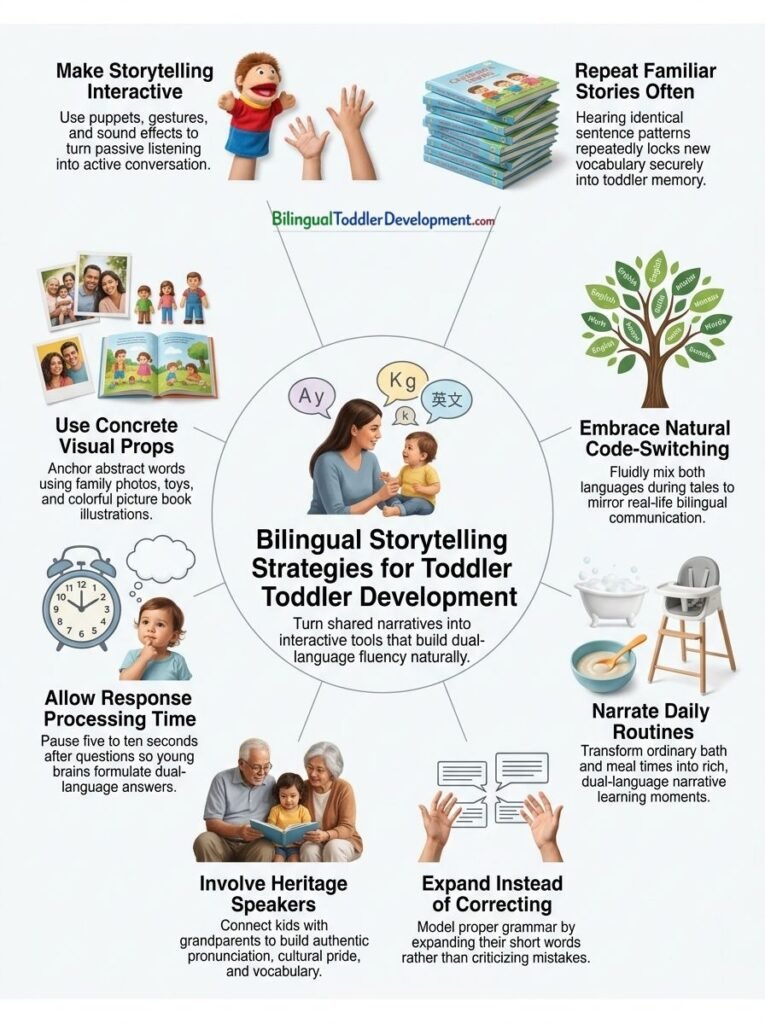
Why Storytelling Supports Bilingual Toddler Language Development
Stories offer something different from isolated vocabulary practice.
Instead of hearing a word by itself, your child hears it as part of something happening.
That context can make the word easier to understand and remember.
Stories Introduce Vocabulary in Context
Imagine telling your toddler a short story about a hungry rabbit.
The rabbit looks for a carrot, hops through the garden, and finally finds something to eat.
As you tell the story, your child hears words related to animals, food, movement, and feelings.
You might say:
“The rabbit is hungry. He wants a carrot. Look! He’s hopping through the garden.”
You can tell the story in whichever language you’re using with your child.
If your toddler already knows what a rabbit looks like, pictures or toys can help them connect unfamiliar words in the heritage language with familiar ideas.
You can also repeat useful words naturally.
“The rabbit found a carrot. It’s a big carrot. Now he’s eating the carrot.”
This gives your toddler several opportunities to hear the same word without asking them to memorize it.
Stories Help Children Understand Sentences
Toddlers need more than individual words. They also need opportunities to hear how words fit together.
Stories provide examples of sentences that describe actions, relationships, and events.
Consider these sentences:
“The dog is sleeping.”
“The dog wakes up.”
“The dog runs outside.”
Your child hears how language describes a sequence of events.
As their understanding develops, they may begin recognizing longer sentences, familiar expressions, and simple relationships such as what happened first and what happened next.
Each language has its own grammatical patterns. Hearing natural stories in both languages gives children opportunities to become familiar with those patterns.
Repeated Stories Make Language More Familiar
Toddlers often ask for the same story again and again.
Although adults may prefer variety, repetition can be useful for language learning.
When your child already knows the characters and events, they don’t have to work as hard to understand what is happening.
That familiarity creates opportunities to notice words and phrases.
For example, you might repeat the sentence “Where is the little bear?” each time the bear hides.
Eventually, your toddler may point to the bear before you finish the question or attempt part of the phrase.
Repetition doesn’t guarantee that a child will learn particular words. But familiar stories provide repeated, meaningful exposure that can support learning over time.
Storytelling and Reading Aloud: What’s the Difference?
Storytelling and reading aloud are both valuable activities for young children.
The difference is mainly in how you share the experience.
When reading aloud, you usually follow the words printed in a book.
When telling a story, you can create your own words, change details, use gestures, and adapt the story as your child responds.
However, reading aloud doesn’t have to be passive.
You can pause during a book, talk about pictures, ask questions, and encourage your toddler to participate. This is often called interactive or dialogic reading.
Both approaches can support language development.
Make the Story a Conversation
Suppose you’re telling a story about a little dog looking for its ball.
You say, “The dog looked under the table. Was the ball there?”
Your toddler shakes their head.
“No, it wasn’t there! Where should the dog look next?”
Your child points toward the sofa.
“Let’s look behind the sofa!”
Your toddler has helped shape the story without needing to produce a complete sentence.
You can use the same approach in either language.
The goal is to create opportunities for communication while keeping the story enjoyable.
Should You Tell Stories in One Language or Both Languages?
There isn’t one storytelling method that works best for every bilingual family.
Some parents tell stories entirely in one language. Others use both languages naturally. Some tell the same story in different languages on different days.
All of these approaches can be useful.
Your choice can depend on your language abilities, your child’s understanding, and the languages you want to encourage.
Tell the Same Story in Both Languages
A familiar story can provide a helpful starting point for introducing vocabulary in a language your toddler hears less often.
For example, you might tell a simple story about a bear looking for honey in English.
A few days later, you could tell the same story in Spanish.
Your toddler already understands the basic events, so the Spanish words have a familiar context.
You don’t need to translate every sentence exactly.
Keep the main characters and events the same, use natural language, and support unfamiliar words with pictures or gestures.
For toddlers, short stories with a few familiar characters are usually easier to follow than complicated plots.
Is It Okay to Mix Languages During a Story?
Yes. Using words or phrases from more than one language is common in bilingual families.
You might tell most of a story in Spanish but use an English word your child already knows. Or your toddler might answer an English question using a Spanish word.
This kind of language mixing does not, by itself, indicate confusion or a language disorder.
If your goal is to increase exposure to the heritage language, try to provide plenty of complete, natural sentences in that language rather than translating every phrase into English.
However, there’s no need to interrupt an enjoyable story because someone uses a word from the other language.
For a fuller explanation, see Why Bilingual Toddlers Mix Languages.
Use Familiar Stories to Support the Heritage Language
Many bilingual toddlers hear English frequently at daycare, preschool, or in their communities.
Their home language may receive less exposure.
Storytelling can provide another opportunity to hear that language in a meaningful setting.
Start with stories your toddler already enjoys.
If your child loves animals, tell a simple animal story in the heritage language. If they enjoy cars, make up a story about a little car going on an adventure.
You don’t need to introduce unfamiliar cultural stories immediately.
A familiar subject can make it easier for your toddler to follow the language.
As their understanding grows, you can introduce family stories, traditional tales, and other narratives connected to your heritage.
7 Simple Bilingual Storytelling Activities for Toddlers
You don’t need an elaborate storytelling routine.
These activities use ordinary objects and experiences to help your toddler listen, participate, and become familiar with both languages.
1. Tell Stories Using Family Photographs
Choose a few pictures from a family outing, birthday party, or visit with relatives.
Use the pictures to tell a short story.
For example:
“Here’s Grandma. We went to her house. She made cookies. You helped stir the dough.”
Tell the story in your home language or another language your child is learning.
Point to familiar people and objects as you speak.
You can invite your toddler to participate by asking where Grandma is or what happened next.
If they point, smile, or answer in English, acknowledge their response and continue naturally.
Family photographs work especially well because your child already knows something about the people and events.
2. Make Up Stories From Picture Books
You don’t always have to read every word printed in a book.
Open a picture book and let your toddler choose an illustration.
Then create a simple story about what they see.
If the picture shows a duck near a pond, you might say:
“The duck is looking for her friends. She walks to the pond. Oh, there’s another duck!”
Your toddler might point to the second duck or make a quacking sound.
You can build on that response and continue the story.
This approach is particularly useful when you have a book in English but want to tell a story in your family’s heritage language.
3. Act Out Stories With Puppets or Stuffed Animals
Puppets and stuffed animals make stories more concrete for young children.
Choose two favorite toys and create a simple problem.
Perhaps a teddy bear has lost its blanket.
The bear looks under a chair, behind a pillow, and inside a toy box.
As you tell the story, move the bear and describe what it’s doing.
Invite your toddler to help the bear search.
You can repeat phrases such as “Where is it?” or “Let’s look here” in the language you’re using.
Your child can participate by moving the toy, pointing, making sounds, or using words.
4. Turn Everyday Experiences Into Little Stories
You don’t have to invent imaginary adventures.
Something that happened earlier in the day can become a short story.
For example:
“This morning, we went to the park. You saw a big dog. The dog chased a ball. Then we went home.”
You can tell the story while looking at a photograph or playing with a toy dog.
Older toddlers may begin adding details.
They might say “Big dog!” or point toward the door when you mention going outside.
This activity connects storytelling with experiences your child already understands.
For more ideas about building language into familiar activities, see Daily Routines That Build Toddler Vocabulary.
5. Retell Familiar Stories With Repeated Phrases
Choose a simple story your toddler enjoys.
It might be about a lost toy, a hungry animal, or a character trying to get home.
Include one or two phrases that repeat.
For example:
“Where is my ball?”
“Not here!”
Each time the character looks somewhere new, repeat the same phrases.
After several retellings, pause before the familiar words.
Your toddler may fill in the phrase, make a sound, or gesture toward the next location.
Don’t insist on a response. The pause is an invitation, not a test.
6. Create a Story Together With Toys
Place two or three toys in front of your toddler.
Let them choose a character.
You might begin:
“The little bear wants to go somewhere. Where should he go?”
Your toddler points to a toy car.
“The bear is going for a ride!”
Then let your child decide what happens next.
They might move the car, make a sound, or say a word.
You can turn those contributions into short sentences.
This kind of shared storytelling gives your toddler some control over the activity and creates natural opportunities for communication.
7. Invite Grandparents to Share Family Stories
Grandparents may know songs, expressions, and family stories that children don’t hear elsewhere.
Ask Grandma or Grandpa to tell a short story about something they enjoyed as a child.
For younger toddlers, the story can be very simple.
Grandpa might show a photograph of a childhood pet and explain what the animal liked to do.
Grandparents who live far away can share stories during video calls or send short voice recordings.
These experiences can introduce children to the heritage language while strengthening family relationships.
You can find more ideas in How Grandparents Can Help Bilingual Children Learn Their Heritage Language.
How to Make Storytelling Interactive
You don’t need to ask questions after every sentence to make a story interactive.
In fact, too many questions can interrupt the experience.
A few simple techniques can help your toddler participate without feeling pressured.
Follow Your Toddler’s Interests
Pay attention to what catches your child’s attention.
If they point to a dog in a picture, talk about the dog.
If they laugh when a puppet falls over, repeat that part of the story.
If they lose interest, shorten the story or try something different.
Your toddler doesn’t have to follow the story exactly as you planned.
Sometimes the best conversations happen when children notice something unexpected.
Ask Simple Questions and Allow Time to Respond
Questions can encourage participation when they’re appropriate for your child’s abilities.
For a younger toddler, try questions they can answer by pointing:
“Where’s the cat?”
For a child using single words, you might ask:
“What did the cat find?”
An older toddler may enjoy:
“What do you think happens next?”
After asking, pause and give your child time to respond.
If they don’t answer, you can provide the answer yourself and continue.
Avoid turning every page or sentence into a quiz.
Accept Gestures, Sounds, and Short Responses
A toddler who points to the correct picture may understand more than they can express in words.
Animal sounds, gestures, facial expressions, and single-word responses can all contribute to storytelling.
If your child says “Dog!” you might respond:
“Yes, the dog is running!”
This acknowledges their contribution while providing a longer sentence to hear.
There’s no need to insist that they repeat your words.
Expand What Your Child Says
Expanding means adding a little more language to your child’s response.
For example:
Child: “Baby sleep.”
Parent: “Yes, the baby is sleeping in her bed.”
Or:
Child: “Big truck!”
Parent: “That’s a big red truck!”
You can use this technique in either language.
The idea is to model slightly richer language while keeping the conversation natural.
How to Adapt Storytelling to Your Toddler’s Age
Children develop language skills at different rates, so age ranges are only general guides.
Choose activities based on what your child currently understands and enjoys.
Ages 1 to 2: Short Stories With Pictures and Actions
Younger toddlers often enjoy:
- Naming familiar people or animals.
- Looking at photographs.
- Making animal sounds.
- Watching puppets move.
- Hearing repeated words and short phrases.
Keep stories simple and follow your child’s attention.
A story lasting a minute or two may be enough.
Ages 2 to 3: Repetition and Simple Participation
Many children in this age range enjoy familiar stories with predictable events.
Try:
- Pausing before repeated phrases.
- Asking simple questions.
- Acting out stories with toys.
- Letting your child choose what happens next.
- Retelling something that happened earlier in the day.
Some children will contribute words or short sentences. Others may prefer gestures or listening.
Both can be part of a successful storytelling experience.
Ages 3 to 4: Longer Stories and Shared Ideas
Older toddlers and young preschoolers may enjoy stories with more events and characters.
You can invite them to:
- Choose a character.
- Describe what happens next.
- Explain how a character feels.
- Act out a favorite scene.
- Help retell a familiar story.
You can also introduce simple sequences such as “first,” “next,” and “last.”
Keep expectations flexible, especially when your child is using a language they hear less often.
What If Your Toddler Understands the Story but Doesn’t Speak?
Some bilingual toddlers understand stories in their heritage language but rarely respond in that language.
They may point to the correct picture, laugh at the right moment, or follow the story while answering questions in English.
This can happen when a child’s understanding of a language is stronger than their ability or preference to speak it.
Keep Storytime Comfortable
If your child understands the story but doesn’t want to speak, avoid repeatedly asking them to say words in the heritage language.
Instead, continue telling stories and offering opportunities to participate.
You might pause before a familiar sound, offer two choices, or let the child act out a scene.
If they answer in English, acknowledge what they said and respond naturally in the heritage language.
Over time, these interactions can provide more opportunities to hear and practice useful expressions.
However, storytelling alone cannot guarantee that a child will begin speaking a language fluently.
When to Seek Advice About Language Development
A child who understands one language but speaks another is not automatically showing signs of a language disorder.
However, persistent difficulties understanding or communicating across both languages deserve attention.
If you’re concerned about your child’s language development, speak with their pediatrician or a speech-language pathologist experienced in evaluating bilingual children.
Storytelling is a useful way to support communication, but it isn’t a substitute for an evaluation when one is needed.
For additional guidance, see Language Delay vs. Bilingual Development: How to Tell the Difference.
Common Bilingual Storytelling Mistakes to Avoid
Storytelling should be enjoyable for both you and your toddler.
A few common habits can make it less helpful.
Asking Too Many Questions
It’s easy to turn storytime into a series of questions:
“What color is that?”
“What’s this called?”
“What happens next?”
Questions can be useful, but children also need time to listen and enjoy the story.
Balance questions with comments, descriptions, and pauses.
Sometimes simply saying “Oh, the puppy is hiding!” creates a better opportunity for interaction than asking another question.
Correcting Every Word
If your toddler mispronounces a word or mixes languages, avoid stopping the story to correct them repeatedly.
Instead, respond to their meaning and model natural language.
The story should feel like something you’re enjoying together, not a test of vocabulary or grammar.
Choosing Stories That Are Too Complicated
A story with many characters, unfamiliar words, and a complicated plot may be difficult for a toddler to follow.
This can be especially challenging in a language your child hears less frequently.
Start with familiar characters, simple events, and repeated phrases.
You can gradually introduce more complex stories as your child’s understanding develops.
Expecting Your Toddler to Retell the Whole Story
Retelling a complete story requires vocabulary, memory, and language organization skills that are still developing during the toddler years.
Your child may understand a story long before they can explain it.
Let them participate in smaller ways.
Pointing to pictures, moving puppets, supplying a familiar word, or choosing what happens next can all be useful steps.
How to Build a Simple Bilingual Storytelling Routine
A storytelling routine doesn’t need to be long or complicated.
Start with something your toddler already enjoys and build from there.
Try a Five-Minute Family Photo Story
Here’s one simple activity you can try at home.
- Choose two or three photographs from a recent family activity.
- Tell a short story about what happened, using the language you want to encourage.
- Point to familiar people and objects as you speak.
- Pause occasionally to let your toddler contribute.
- Return to the same photographs another day and tell the story again.
You might notice that your child begins anticipating familiar words, pointing to pictures, or adding details.
You can gradually introduce new words or slightly longer sentences as the story becomes familiar.
Make Repetition Part of the Routine
If your toddler wants the same story every evening, there’s no need to change it.
Repeated stories can help children become more familiar with the language.
You can also make small changes when your child is ready.
Perhaps the bear finds a different toy, or the family visits a different place.
These changes introduce new language while preserving a familiar story.
Keep the Routine Flexible
Some evenings your child may enjoy a longer story.
Other times, they may want to look at only one picture or listen to a favorite phrase.
That’s fine.
The value of storytelling comes from meaningful interaction over time, not from completing a certain number of pages or minutes.
Frequently Asked Questions About Bilingual Storytelling
Does Storytelling Help Bilingual Toddlers Learn to Speak?
Storytelling can support vocabulary, listening comprehension, and opportunities to practice communication.
Interactive storytelling is particularly useful because children can respond through gestures, sounds, words, and sentences.
However, speaking skills develop through many kinds of interactions, not storytelling alone.
Will Telling Stories in Two Languages Confuse My Toddler?
No. Hearing stories in two languages does not, by itself, confuse children or cause language delays.
Bilingual children can learn to understand and use more than one language, although their skills may develop differently in each language.
It’s also normal for young bilingual children to mix words from their languages.
Should I Translate Every Sentence?
No. You don’t need to translate every sentence when telling a story.
Pictures, gestures, familiar events, and natural explanations can help children understand unfamiliar words.
Translation is fine when it’s helpful, but constant sentence-by-sentence translation isn’t necessary for meaningful storytelling.
What If My Toddler Won’t Participate?
Some toddlers prefer to listen, especially when a story is unfamiliar or told in a language they don’t speak comfortably.
Try shortening the story, using familiar toys, or inviting simple gestures.
Avoid pressuring your child to answer questions or repeat words.
If you’re concerned about their communication skills more generally, seek advice from a qualified professional.
Can I Tell Stories in a Language I Don’t Speak Fluently?
Yes. You can share simple stories using words and expressions you’re comfortable with.
You don’t need perfect fluency to enjoy a story with your child.
For richer language exposure, you can also involve fluent family members, bilingual books, or community storytelling activities.
Are Storytelling Videos and Apps as Helpful as Telling Stories Together?
Videos and apps can introduce children to stories and language, but they don’t provide the same opportunities for responsive, back-and-forth conversation as interacting with another person.
If you use a storytelling video, consider watching together and talking about what happens.
For toddlers, live interaction remains especially valuable.
Final Thoughts: Making Bilingual Storytelling Part of Everyday Life
Bilingual storytelling doesn’t require special teaching skills, expensive materials, or a complicated routine.
You can begin with a favorite picture book, a family photograph, a stuffed animal, or something that happened earlier in the day.
Tell a simple story in English, your heritage language, or both. Follow your toddler’s interests, welcome their responses, and return to familiar stories as often as they enjoy them.
Some days your child may contribute several words. Other days, they may prefer to listen.
Both can be part of learning.
What matters is giving your toddler enjoyable opportunities to hear language, understand meaning, and communicate with someone who is paying attention.
Over time, those shared stories can become a familiar and meaningful part of growing up bilingual.