
You know the worry: if your child hears multiple languages at home, will they get “behind” in speech or school?
In the U.S., multilingual homes are common. The U.S. Census Bureau reports that about 22% of people ages 5 and older spoke a language other than English at home in the 2017-2021 period.
Here’s the practical takeaway. Language exposure shapes how quickly a child can use each language, but it does not “break” language development.
So I’m going to walk through what the research really supports, what it does not, and the most useful ways you can support bilingual children day to day.
Key Takeaways
- Multilingual households are a normal part of life in the U.S., so your child will not be alone in learning from more than one language environment.
- Babies can tell languages apart very early, studies with newborns show they can discriminate two languages even before they can talk.
- Some studies find cognitive advantages like stronger task switching, but a large 2021 meta-analysis found the average “bilingual advantage” in children’s executive function was small and could disappear after accounting for publication bias.
- It’s common for bilingual toddlers to know fewer words in each language at first. If you look at their combined vocabulary size (what they can express across both languages), many children track closer to monolingual children over time.
- Language mixing (code mixing) is typically a normal, rule-governed part of bilingual development. The key is giving enough clear input in each language to support vocabulary development and confidence.
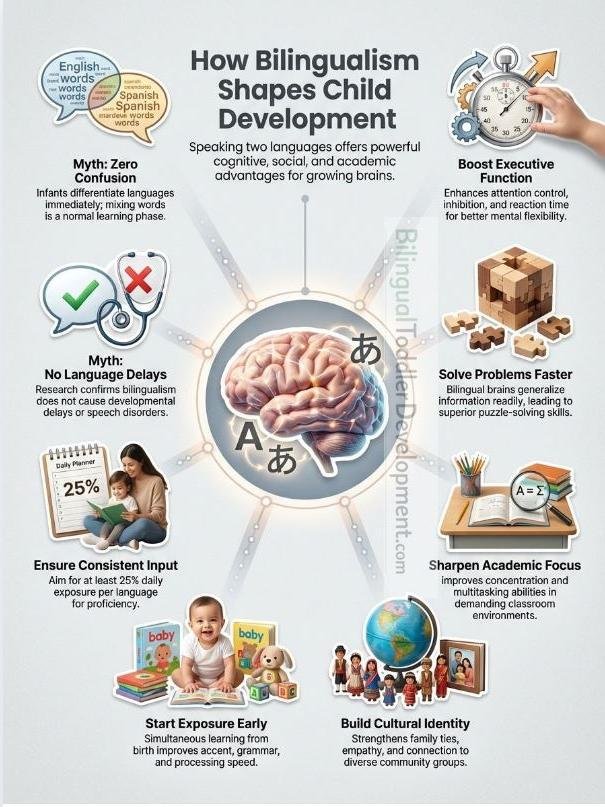
Cognitive Development in Bilingual Children
Bilingual children often practice skills that look a lot like executive function: they choose words, switch rules, and pay attention to who understands what.
That said, the “bilingual advantage” is not automatic. The strongest, most consistent benefits show up when your child gets steady chances to use both languages in real life, not just hear them in the background.
- What you can expect: better comfort switching between “systems” (who speaks what, which word fits, what the listener needs).
- What you should not assume: a guaranteed boost in IQ, faster overall learning, or “smarter” development compared to monolingual children.
Improved executive functioning
Executive function is a set of skills that help your child focus, resist impulses, and switch tasks. In research, you’ll often see measures like the Dimensional Change Card Sort, Flanker-style attention tasks, and working-memory games.
In a 2021 meta-analysis that pooled thousands of children ages 3-17, the average bilingual edge in executive functioning was very small, and it was not reliable after bias adjustments. Use that as a reality check: bilingualism can support these skills, but it’s not a magic lever.
Where you can make it matter is in the daily routine. Give your child reasons to use each language on purpose, because intentional use is what forces the brain to plan, inhibit, and switch.
- Build “switching” naturally: play games like “Simon Says” in one language, then repeat the game in the other.
- Make attention visible: use short directions (one step, then two steps) and gradually increase complexity as your child succeeds.
- Track language progress correctly: tools like the Peabody Picture Vocabulary Test (PPVT-5) and Expressive Vocabulary Test (EVT-3) measure English receptive and expressive vocabulary, but they do not measure the whole bilingual brain. If you are concerned, ask for a plan that looks at both languages.
Enhanced problem-solving skills
Problem solving is where bilingual advantages can show up in a very practical way: your child has to figure out meaning from context more often.
One 2023 study of low-income preschoolers found Spanish-English bilingual children performed better on an English novel word-learning task than monolingual peers, and the difference was linked to short-term memory. That’s useful because it points to a specific mechanism you can support at home: repeated, meaningful word practice.
- Teach a new word in context: “This is the colander. We use it to drain pasta.”
- Use it again the same day: “Can you put the grapes in the colander?”
- Bring it back later: the next day, ask for the word again during the same routine.
Greater cognitive flexibility
Cognitive flexibility is the ability to shift rules without melting down. Bilingual kids get extra reps because the “right” language changes with the person, the place, and the topic.
There’s also a helpful caution here. Eye-tracking research with bilingual infants shows that mid-sentence language switches can add processing load (you’ll see this as a brief slowdown). That doesn’t mean switches are bad, it means you should be strategic when you’re teaching something brand-new.
- For new concepts: keep the sentence in one language, then repeat the idea in the other language after a pause.
- For familiar routines: language mixing is usually fine, because your child already knows what’s going on.
When your child switches languages, they are practicing flexible attention. Your job is to make sure they still get clear, confident models in each language.
Language Development and Language Exposure in Bilingual Children
Language acquisition takes different paths for simultaneous bilinguals (two languages from the start) and sequential bilinguals (a second language later). Both paths can lead to strong language proficiency.
The detail that matters most is not the label, it’s the pattern of language exposure: how much your child hears, who they hear it from, and whether they need to use it to get their needs met.
Simultaneous vs. sequential bilingualism
Simultaneous bilinguals build two sound systems early. Sequential bilinguals often move fast in the new language once they have motivation, consistent input, and a safe place to make mistakes.
A large analysis shared by researchers at MIT suggests grammar-learning ability stays strong into the late teens, but reaching truly native-like grammar gets much harder if learning starts after about age 10. That’s a reason to start early if you can, but it’s also a reason to stay calm if you are starting later: your child can still learn a second language well.
For sequential bilinguals, plan for a transition period where comprehension grows before speaking. That pattern is common in early childhood and does not automatically signal a language delay.
- If your child is starting a second language in childcare: prioritize warm, predictable routines with short repeated phrases.
- If your child is starting English in school: keep building the first language at home. A strong first language supports learning another language, including reading and writing.
Influence on vocabulary acquisition
Bilingual toddlers often have smaller vocabularies in each language at first, because they are splitting learning time between two systems.
The simplest way to track progress is to watch “total meaning,” not just “total words.” If your child knows “dog” in English and “perro” in Spanish, that’s one concept with two labels, and it still counts as vocabulary development.
Exposure targets help you plan. Research frequently cites that you may need roughly one-third of a child’s weekly input in a language to support stronger vocabulary growth in that language, especially if you want skills closer to monolingual children in that specific language.
| What you track | What it tells you | How to use it at home |
|---|---|---|
| Words in Language A | Strength in that language | Increase Language A during routines where your child must respond (meals, bath, errands) |
| Words in Language B | Strength in that language | Set a daily “need-to-use-it” moment (storytime plus a short discussion) |
| Conceptual vocabulary (both) | Overall language learning | Stop using “only English words” as the scoreboard |
Cross-language interaction
Language mixing is normal. Kids mix for smart reasons: they choose the word they know, they match the listener, or they use the word that fits the emotion best.
The American Speech-Language-Hearing Association emphasizes that being multilingual is not a communication disorder, but it does change how clinicians should evaluate language. If there is a concern, your child should be considered in both languages, not judged by one.
- Don’t force constant translation: it can create anxiety and does not reflect real communication.
- Do model “one clear version” after a mixed sentence: you can repeat the idea in one language without correcting or shaming.
- Keep the long view: consistency over months matters more than perfection in any single conversation.
Social-Emotional Development
Bilingual children often gain social tools that are easy to overlook because they don’t show up on a vocabulary quiz.
They learn to read the room, adjust to different listeners, and stay connected to family across generations, which supports child development beyond language alone.
Strengthened cultural identity
Language is one of the fastest ways a child builds identity. When your child can speak with grandparents and relatives in the family’s first language, they feel belonging, not just “ability.”
In many U.S. households that speak a language other than English at home, Spanish is the most common, followed by languages like Chinese and Tagalog. That means many communities already have story, music, and children’s programming in these languages, you just need to tap into what’s nearby.
- Pick one “identity routine”: bedtime stories, holiday cooking, or weekly calls with relatives in the heritage language.
- Use culture-specific words on purpose: foods, family roles, traditions, and places are sticky vocabulary.
Improved communication with diverse groups
Bilingual kids often get more practice with perspective taking, because they learn early that not everyone has access to the same words.
You can build this skill without turning your home into a language class. Use simple listener-based prompts: “Does Grandma understand this word?” or “Which language are we using at the park?”
- Choose a context: home, school, playground, relatives’ house.
- Name the language plan: “At home, we use Mandarin with Dad and English with Mom.”
- Practice repair: teach one polite fix-it phrase in each language (“I mean…”, “Let me say it another way”).
Maintaining family and community ties
Family ties are one of the strongest reasons to keep a home language. The goal is real connection, not perfect grammar.
The Office of Head Start notes that children who speak home languages other than English make up at least one third of Head Start enrollment, and these children speak more than 140 languages. That’s a strong reminder that bilingual development is a mainstream need in U.S. childcare, not a niche issue.
- Make the minority language the “relationship language” at home: jokes, comfort, affection, and routines.
- Invite more speakers: cousins, family friends, neighbors, and community events increase motivation and vocabulary size.
- Keep the first language growing: older kids still need new words, especially for school topics and emotions.
Academic Advantages
In school settings, bilingual advantages tend to show up as learning behaviors: shifting attention, tolerating ambiguity, and using context to figure things out.
It also helps to know the school reality. The National Center for Education Statistics reported that English learners were 10.6% of U.S. public school students in fall 2021, so many schools already have systems for supporting second language learning.
Enhanced focus and attention
Attention is trainable, and bilingual kids often get extra practice through daily language choices. Still, the best support is not pressure. It’s clarity.
Use short, repeatable phrases for directions in the language you want to strengthen, then confirm understanding with action, not just a verbal reply.
- Use “do” checks: “Put the book on the table,” instead of “Do you understand?”
- Keep directions consistent: use the same words for the same routines for 2-3 weeks, then expand.
- Support phonological awareness: clap syllables, play rhyme games, and notice beginning sounds in each language.
Improved multitasking abilities
Multitasking is a tricky term because kids still have developing cognitive processes. The realistic goal is smoother switching between tasks, like moving from math to reading without losing the thread.
You can support this skill with structured “switch practice” that feels like play, not testing.
- Set a timer for 3 minutes: build, draw, or sort.
- Switch the rule: sort by color, then sort by shape.
- Switch the language label: name colors in one language, shapes in the other.
Higher adaptability in learning environments
Bilingual children often adapt faster when teachers change routines, because bilingual life already includes shifting rules. That said, the classroom model matters.
In dual-language and language immersion programs, you’ll commonly see designs like 50/50 (half the day in each language) or 90/10 (more of the partner language early, then gradually balancing). Ask which model the school uses, and how they support literacy in both languages.
| Program question | Why it matters |
|---|---|
| How much instruction time is in each language? | Time drives vocabulary development and writing system practice. |
| How do you teach reading and writing in each language? | Biliteracy needs explicit instruction, not just conversation. |
| Who gets priority for seats? | Strong programs protect access for the students the program is meant to serve. |
Common Myths About Bilingualism
Most fears about bilingualism come from watching a child struggle for a short period and assuming it predicts the future.
In reality, bilingual development can look different day to day while still being healthy language development.
Does bilingualism cause language delays?
Bilingualism does not cause a language disorder. A review published by the American Academy of Pediatrics notes that a bilingual environment is not an adequate explanation for a significant language delay, so clinicians should look for other causes if a child is truly behind.
The real risk is mislabeling. If a child is evaluated only in English, they can look weaker than they are, especially if their first language is doing much of the heavy lifting at home.
- Protect against misdiagnosis: ask for evaluation that considers both languages and your child’s language exposure history.
- Use the right tools when available: for Spanish-English children ages 4-6, the Bilingual English-Spanish Assessment is designed to help differentiate second language learning from a true disorder.
- Check hearing and development too: language concerns deserve a full picture, not assumptions.
Are bilingual children confused by two languages?
Healthy bilingual kids are not “confused,” they are sorting. Studies with bilingual newborns show they can discriminate between two languages, which is the opposite of confusion.
What parents often notice is this: the child pauses, searches, or mixes languages. That’s a normal part of word learning, especially when a child’s vocabularies are growing in two directions at once.
If your child uses the “wrong” word in the “wrong” language, treat it as a communication win first. Then model the version you want them to learn.
Tips for Supporting Bilingual Development
The best plan is the one you can actually keep for years. Consistency beats intensity.
Focus on language exposure your child must respond to, not just background audio.
Encourage consistent language exposure
If you want a child to speak a language fluently, they need regular opportunities to hear it and use it. That includes play, discipline, jokes, and real conversations, not only “lesson time.”
A practical benchmark many families find useful is aiming for roughly a third of weekly interaction in the less-used language, then adjusting based on how your child responds and what your goals are.
- Anchor a language to a person: one-person-one-language can work well if each caregiver spends meaningful time with the child.
- Anchor a language to a place: “home language at home” creates predictability for bilingual toddlers.
- Anchor a language to a routine: bedtime, meals, and errands create daily repetition that builds vocabulary size.
Promote language mixing in natural contexts
Language mixing is common in bilingual families and communities. Your child may also create compounded words or use a placeholder word when the exact term has not “stuck” yet.
You can keep it healthy by avoiding shame and adding structure. Use mixing as a bridge, then offer a clean model.
- Acknowledge meaning: “Yes, you want the big truck.”
- Offer the target word: “In Spanish, that’s camión.”
- Invite a quick repeat: one repetition is enough, then move on.
Involve bilingual resources and activities
Choose activities that force real language use: conversation, storytelling, pretend play, and games that require turn-taking. These build vocabulary learning, morphology, and confidence in both languages.
If you’re working with a speech-language pathologist or childcare provider, ask how they support dual-language development. Many programs can support bilingual children well, but only if they plan for it.
- Interactive reading: stop and ask “why” and “how” questions, and retell the story in your child’s words.
- Sound play: rhymes, syllable clapping, and plural or singular and plural practice help phonological awareness.
- Simple data tracking: once a month, list new words or phrases in each language so you can see progress without obsessing daily.
Conclusion
Being bilingual can support child development, especially social communication and flexible language learning, when your child gets consistent opportunities to use both languages.
Your child may grow vocabularies in two systems at different speeds, and that is normal.
The most reliable driver is language exposure that requires interaction, not passive listening.
If you ever worry about language delay, ask for an evaluation that considers both languages, because the right context makes all the difference.
FAQs
1. How does being bilingual affect child development?
Bilingual children often show strong language development and a bilingual brain that handles two systems, and they gain cognitive advantages that support overall child development.
2. Will my child’s vocabulary be smaller than monolingual children?
Total vocabulary size often matches or exceeds that of monolingual children when you count both languages, though early language learning can show uneven vocabulary development and some language mixing.
3. Does learning two languages slow language acquisition or cause confusion?
No, language acquisition usually follows the same path as in monolingual children; some mixing happens early, and bilingual toddlers learn to separate languages with time.
4. What cognitive changes happen in a bilingual brain?
Bilingual kids tend to show better cognitive flexibility and metalinguistic awareness, they can solve problems more easily, and some cognitive processes like attention control improve, with possible small gains in psychomotor speed.
5. How can parents support early bilingual learning and help a child speak a language fluently?
Provide steady language exposure, read in both languages, and use songs and play to aid vocabulary learning, including plurals, possessives, adjectives, comparative and superlative forms, and compounded words; keep a warm, affective routine and foster cultural connection to build language proficiency.
6. Are there risks or reasons to seek help?
Bilingualism itself does not cause autism spectrum disorders or language disorders, but if you worry about slow progress, seek a professional check; tests should assess both the first and foreign language and the writing system, experts will compare skills to peers in early childhood and the global society, and remember, accents are normal.