
Grandma speaks Spanish, but your child answers her in English. Grandpa tells a story in Mandarin, and your toddler seems to understand every word but says very little in return.
Situations like these are common in bilingual families. Children may understand a heritage language well while feeling more comfortable speaking English, especially when English is the language they use at school, with friends, and in their community.
Grandparents can play an important role in keeping the family language part of a child’s life. They offer something that books, apps, and language lessons cannot fully replace: a personal relationship in which the language has a meaningful purpose.
And grandparents don’t need to become language teachers to make a difference. Everyday conversations, familiar songs, shared stories, and time spent together can all create valuable opportunities for children to hear and use their heritage language.
Quick Answer: How Can Grandparents Support Heritage Language Development?
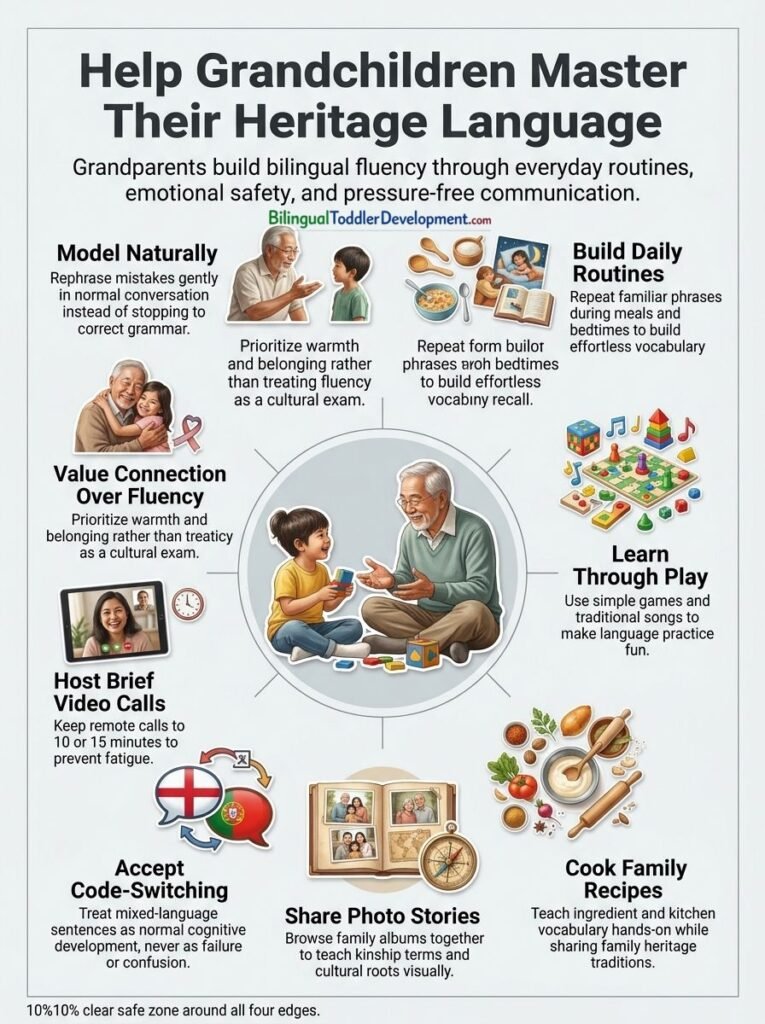
Grandparents can support heritage language development by speaking naturally with their grandchildren, involving them in familiar activities, and creating regular opportunities for interaction.
Some of the most helpful approaches include:
- Speaking the heritage language during everyday activities.
- Reading picture books and telling family stories.
- Playing simple games that encourage conversation.
- Singing familiar songs and nursery rhymes.
- Encouraging responses without demanding perfect pronunciation or grammar.
- Maintaining contact through visits, video calls, or voice messages.
The goal isn’t to make every interaction a language lesson. It’s to help children associate the heritage language with people they love and experiences they enjoy.
Why Grandparents Matter in Heritage Language Learning
A heritage language is a language connected to a child’s family, ancestry, or cultural community. In an English-dominant environment, it may be the language spoken by parents, grandparents, or other relatives.
For some children, grandparents are among the few people who regularly speak that language.
This makes their relationship particularly valuable.
Grandparents Give Children a Reason to Use the Language
Children learn language through meaningful interaction. They need opportunities to hear words, understand what others mean, and participate in conversations.
A grandparent who speaks the heritage language can provide those opportunities naturally.
For example, a child might use Spanish to ask Grandma for a favorite snack, understand a joke told by Grandpa, or listen to a family story that has been shared for generations.
The child isn’t simply practicing vocabulary. They’re communicating with someone important to them.
That personal connection can encourage continued interest in a language, even when another language becomes stronger.
Grandparents Connect Language With Family History and Traditions
Grandparents often share expressions, songs, recipes, and stories that children might not encounter elsewhere.
A familiar saying may carry a particular meaning in the family’s language. A traditional song might remind Grandma of her own childhood. A recipe may come with stories about relatives the child has never met.
These experiences help children understand that their heritage language is connected to real people and family traditions.
However, speaking a heritage language fluently is not a requirement for cultural belonging. Children can have meaningful connections to their family and heritage even when their language abilities are limited.
For a broader explanation, see How Does Growing Up Bilingual Affect a Child’s Identity?.
How Grandparents Can Support Bilingual Language Development
Grandparents don’t need special training or a formal teaching plan to support language learning.
The most useful starting point is ordinary conversation.
Talk About What You’re Doing Together
Everyday activities provide opportunities to introduce and repeat useful words.
While preparing lunch, a grandparent might name ingredients, describe actions, or ask the child to choose between two foods.
During a walk, they might talk about birds, flowers, cars, or the weather.
While playing with blocks, they might use phrases such as:
- “Let’s build a tower.”
- “Put the red block on top.”
- “Oh no, it fell!”
- “Should we build it again?”
These phrases should be spoken naturally in the heritage language.
For younger children, short sentences connected to visible actions are often easier to understand than long explanations.
The important part is responding to the child’s interests rather than constantly asking them to identify or repeat words.
Give Children Time to Respond
A bilingual child may understand a question but need extra time to find the words to answer it.
Grandparents can help by slowing down and allowing the child to respond without rushing.
For example, instead of asking several questions in a row, Grandma might ask which toy the child wants and then wait.
A response might be a gesture, a single word, a short phrase, or a sentence.
All of these can be meaningful forms of communication, depending on the child’s age and language abilities.
If the child struggles, Grandma can offer two choices, point to the objects, or provide a simple phrase the child can use.
The goal is to make communication easier, not to create pressure.
Model Words Instead of Correcting Every Mistake
Children often make grammatical mistakes, mispronounce words, or combine their languages as they develop bilingual skills.
Grandparents can respond by naturally modeling the intended language.
Suppose a child says something equivalent to “Dog running” in the heritage language.
Grandpa might respond, “Yes, the dog is running fast!”
The child hears a more complete sentence without having to stop and repeat it.
This approach keeps the conversation focused on meaning while providing useful language examples.
7 Simple Heritage Language Activities Grandparents Can Do With Children
The best language activities are often the ones grandparents and grandchildren already enjoy.
These seven ideas can be adapted to different ages, interests, and language abilities.
1. Read Picture Books Together
Picture books give grandparents and children something to look at and discuss.
Grandma might point to an animal, describe what it’s doing, or ask the child to find something on the page.
For toddlers, simple questions work well:
- “Where’s the dog?”
- “What is the baby doing?”
- “Which one is bigger?”
The questions should be asked in the heritage language, with gestures or pointing when needed.
Children don’t have to answer every question. Sometimes listening, pointing, or making a sound is enough to keep the interaction going.
Reading the same book repeatedly can also help children become familiar with words and sentence patterns.
2. Share Family Stories and Childhood Memories
Grandparents have something especially valuable to offer: their own experiences.
They can tell children about games they played growing up, places they lived, family celebrations, or funny things that happened when their parents were young.
For toddlers, stories should be short and easy to follow.
A grandparent might show a childhood photograph and say, “This was my dog. His name was Max. He loved to run.”
An older child might enjoy hearing a longer story and asking questions.
Family storytelling gives children opportunities to hear the heritage language while learning about the people and experiences that shaped their family.
If you’d like more ways to turn stories into language-learning opportunities, see How Bilingual Storytelling Supports Toddler Language Development.
3. Sing Familiar Songs and Nursery Rhymes
Songs can introduce words and phrases through repetition, rhythm, and familiar patterns.
Grandparents might teach lullabies, nursery rhymes, counting songs, or traditional songs from their childhood.
Young children often enjoy hearing the same songs repeatedly.
Once a child becomes familiar with a song, Grandma can pause before a predictable word and see whether the child wants to fill it in.
Adding gestures or simple movements can make participation easier.
There’s no need to insist that the child sing every word correctly. Listening, clapping, moving, or joining in occasionally can all be part of the experience.
4. Play Games That Encourage Conversation
Play gives children reasons to communicate without making language the main focus.
For toddlers, grandparents can try:
- Matching pictures or objects.
- Pretend cooking or shopping.
- Playing with toy animals.
- Simple hide-and-seek games.
- Taking turns building with blocks.
Older children may enjoy board games, guessing games, or activities that involve following instructions.
During play, grandparents can use familiar phrases such as “Your turn,” “Where did it go?” or “Let’s try again.”
These repeated exchanges give children opportunities to hear and use language in meaningful situations.
5. Cook Family Recipes Together
Cooking combines language, family traditions, and hands-on learning.
A grandparent can name ingredients, describe what they’re doing, and invite the child to participate in safe, age-appropriate tasks.
For example, a toddler might help wash vegetables, stir ingredients in a cool bowl, or count pieces of fruit.
An older child might follow a simple recipe or ask questions about a traditional dish.
Grandparents can also explain when the family usually prepares the food and who taught them the recipe.
The activity becomes an opportunity to share both language and family history.
6. Look Through Family Photographs
Family photographs provide natural conversation starters.
Grandparents can point out relatives, name family relationships, and describe events shown in the pictures.
They might say:
- “That’s your aunt when she was little.”
- “We took this picture at Grandpa’s house.”
- “Do you remember this birthday party?”
Young children may enjoy identifying familiar faces. Older children might ask questions about relatives or family events.
Photographs can be especially useful when grandparents and grandchildren don’t have many shared words yet.
The pictures provide context that makes conversations easier to follow.
7. Create a Special Grandparent-Grandchild Routine
A familiar routine gives the heritage language a predictable place in the child’s life.
It might be:
- A special greeting at every visit.
- A favorite song before lunch.
- A picture book read together each Sunday.
- A weekly cooking activity.
- A short conversation about something the child enjoyed that day.
The routine doesn’t need to be elaborate.
What matters is that the child recognizes it as something enjoyable they do with Grandma or Grandpa.
Over time, familiar words and expressions may become easier to understand and use.
What If Your Child Understands Grandma’s Language but Answers in English?
This is one of the most common concerns in bilingual families.
A child may understand much of what Grandma says in Spanish, Korean, Arabic, or another heritage language but consistently answer in English.
That doesn’t necessarily mean the child is rejecting the heritage language.
Why Children Sometimes Prefer English
Bilingual children don’t always develop equal abilities in both languages.
A child who spends much of the day speaking English may find English easier to use, even when they understand the heritage language well.
Understanding language and producing spoken language are different skills.
A child might recognize familiar words, follow instructions, and understand stories in the heritage language while having difficulty finding the words to respond.
The child’s language preferences may also change with age, schooling, friendships, and opportunities to use each language.
How Grandparents Can Encourage Speaking Without Pressure
Grandparents can continue speaking the heritage language even when their grandchildren answer in English.
Suppose Grandma asks a question in Spanish and the child answers in English.
Rather than insisting on a Spanish response, Grandma can acknowledge the answer and continue in Spanish.
She might also provide the word the child needs or offer an easier question.
Other helpful strategies include:
- Asking questions with two possible answers.
- Giving children time to respond.
- Using gestures and familiar objects.
- Accepting short or mixed-language responses.
- Praising participation without making every word a performance.
For more detailed strategies, see How to Encourage Your Bilingual Toddler to Speak the Home Language.
What About Mixing Languages?
A child might begin a sentence in English and finish it in Spanish, or use words from both languages during the same conversation.
This is common in bilingual development.
Language mixing does not mean a child is confused about having two languages.
Grandparents can respond naturally and provide heritage-language words when helpful.
For example, if a child asks for an object using an English word, Grandpa can answer in the heritage language while naming the object.
There is usually no need to interrupt the conversation to correct every mixed-language sentence.
What If Grandparents and Grandchildren Don’t Share a Strong Common Language?
Sometimes grandparents speak very little English while their grandchildren have limited speaking ability in the heritage language.
This can make conversations difficult, especially when children are young or unfamiliar with the relative.
However, a limited shared vocabulary doesn’t prevent grandparents and grandchildren from developing close relationships.
Use Gestures, Pictures, and Shared Activities
Communication involves more than spoken words.
Grandparents can point, gesture, demonstrate actions, and use facial expressions to help children understand.
Activities such as drawing, building blocks, gardening, cooking, and looking at photographs provide shared experiences even when conversation is limited.
For example, Grandma might point to a flower, say its name in the heritage language, and invite the child to smell it.
The child can understand much of the interaction through context.
These small exchanges can help build familiarity with the language while keeping the relationship enjoyable.
Let Parents Provide Support When Needed
Parents can help grandparents and grandchildren understand one another without translating every sentence.
They might explain an unfamiliar word, clarify a misunderstanding, or help the child prepare a few useful expressions before a visit.
However, there is no need to avoid translation when it would make communication easier or prevent frustration.
The goal is to help grandparents and grandchildren communicate successfully while gradually creating more opportunities for direct interaction.
For additional ideas about handling family language barriers, see How to Help Bilingual Toddlers Communicate With Relatives Who Speak Another Language.
How Long-Distance Grandparents Can Support Heritage Language Learning
Grandparents don’t have to live nearby to play a meaningful role in a child’s bilingual development.
Video calls, voice messages, photographs, and occasional visits can help maintain relationships and provide additional language exposure.
The key is making interactions appropriate for the child’s age and interests.
Keep Video Calls Short and Interactive
Young children may struggle to participate in long video conversations.
Instead of expecting a toddler to sit and talk for half an hour, try a short activity.
Grandma might:
- Sing a familiar song.
- Ask the child to show a favorite toy.
- Look at a picture together.
- Play a simple guessing game.
- Read a few pages from a familiar book.
Some toddlers may enjoy only a few minutes, while older children can often participate for longer.
Let the child’s interest guide the length of the call.
Use Voice Messages and Photos Between Calls
Short voice recordings can help children recognize a grandparent’s voice and hear familiar expressions between visits.
Grandpa might record a greeting, sing a favorite song, or describe something interesting he saw that day.
Parents can play the recording when the child is interested and encourage a response if the child wants to participate.
Photographs can also give children something to discuss during the next conversation.
These activities won’t replace interactive conversation, but they can help keep the relationship and language familiar.
Create a Predictable Routine
A regular call or shared activity can help children know what to expect.
For example, Grandma might call every Sunday to sing the same song and ask about the child’s favorite toy.
Over time, the child may recognize the greeting, anticipate the song, and become more comfortable participating.
The routine should remain flexible. A tired or distracted toddler may not want to talk, and that’s okay.
Consistency is helpful, but maintaining a positive relationship matters more than completing every planned activity.
Common Mistakes Grandparents Should Avoid
Grandparents naturally want their grandchildren to learn and appreciate the family language.
Sometimes that enthusiasm can lead to expectations that make communication more difficult.
Pressuring Children to Speak
Repeated demands such as “Say it in Spanish” or “You know that word” can make speaking feel like a test.
Some children may become reluctant to participate when they worry about making mistakes.
Instead, grandparents can model useful words, offer simple choices, and create enjoyable opportunities to communicate.
A child who feels comfortable participating is more likely to remain engaged in the interaction.
Correcting Every Mistake
Pronunciation and grammar develop over time.
Grandparents can help by responding to what the child means and naturally using the correct words or sentence structure.
There is no need to turn every conversation into a lesson.
If a child is trying to share an exciting story, listening to the story is usually more important than correcting each sentence.
Comparing Children With Their Cousins or Siblings
Children have different language experiences.
One grandchild may speak the heritage language comfortably because they hear it every day. Another may understand it well but have fewer opportunities to speak.
Comparisons can make children feel that their abilities are inadequate.
Instead, notice each child’s individual progress and interests.
Treating Fluency as Proof of Cultural Belonging
A child does not need perfect heritage-language skills to belong to their family or cultural community.
Grandparents can encourage language learning while making it clear that the child’s place in the family is not conditional on speaking a particular language.
That distinction helps keep language learning connected to affection and belonging rather than obligation.
How Parents and Grandparents Can Work Together
Parents and grandparents can support one another by discussing realistic goals and choosing activities that fit the child’s needs.
Agree on What You Want to Encourage
Families may have different hopes for their children’s heritage-language development.
Some want their children to understand everyday conversations. Others hope they will eventually speak, read, and write the language comfortably.
These goals can change over time.
Parents and grandparents should discuss what is realistic given the child’s age, current abilities, and opportunities for exposure.
For a toddler who understands the heritage language but rarely speaks it, a useful starting goal might be participating in familiar conversations with gestures, words, or short phrases.
Choose Activities That Match the Child’s Abilities
A two-year-old and an eight-year-old need different kinds of interactions.
Toddlers often benefit from picture books, songs, pretend play, and short conversations connected to familiar objects.
Preschoolers may enjoy simple games, family stories, and activities that involve taking turns.
Older children may be more interested in cooking, hobbies, family history, or conversations about school and friends.
Grandparents can adjust the difficulty as the child’s understanding and communication skills develop.
Keep the Experience Enjoyable
Parents can help by preparing activities, sharing the child’s current interests, and encouraging regular contact.
Grandparents can contribute by speaking naturally, listening patiently, and accepting the child’s current language abilities.
Not every visit needs to produce a new word or a longer sentence.
Some interactions may involve mostly listening, gestures, laughter, or play.
Those experiences still matter because they help maintain the relationship that gives the heritage language personal meaning.
Frequently Asked Questions
Can Grandparents Help a Child Become Bilingual?
Yes. Grandparents can provide meaningful exposure to a heritage language through conversations, stories, songs, games, and shared activities.
However, grandparents alone may not provide enough exposure for a child to develop strong proficiency in every language skill. The outcome depends on the amount and quality of interaction, the child’s broader language environment, and opportunities to use the language with others.
Is Seeing Grandparents Once a Week Enough to Learn a Heritage Language?
Weekly contact can be valuable, but there is no single amount of contact that guarantees language development.
A child who also hears and uses the heritage language at home may benefit differently from weekly visits than a child whose only exposure comes from a grandparent.
Focus on meaningful interaction and look for additional opportunities when possible.
Should Grandparents Speak Only the Heritage Language?
Not necessarily.
Grandparents can use the heritage language consistently when it feels natural, but they don’t need to refuse English or insist that children answer in one particular language.
The most important consideration is maintaining communication while providing meaningful opportunities to hear and use the heritage language.
What If My Child Refuses to Speak the Heritage Language With Grandparents?
Avoid forcing the issue.
Continue offering opportunities to hear the language through enjoyable activities. Let the child respond in English, use gestures, or participate with a few familiar words.
If the child seems uncomfortable, consider whether the conversation is too difficult, whether they need more time, or whether a shared activity would make participation easier.
Can Grandparents Help When Parents Don’t Speak the Heritage Language Fluently?
Yes. Grandparents may provide valuable language exposure when parents have limited proficiency in the heritage language.
They can share natural expressions, family stories, songs, and conversations that parents may not be able to provide themselves.
Parents can support these interactions by arranging regular contact, participating in activities, and encouraging their children without making language ability a source of pressure.
Final Thoughts
Grandparents can give bilingual children something especially meaningful: a personal connection to the language of their family.
They don’t need elaborate lessons or strict language rules. Ordinary conversations, shared stories, favorite songs, and familiar routines can create opportunities for children to hear and use their heritage language.
Some children will become comfortable speaking it. Others may understand much more than they can say. Language abilities may also change as children grow.
What matters is keeping the language present in enjoyable, meaningful interactions.
When children associate their heritage language with the warmth, humor, and companionship of their grandparents, they have a personal reason to keep that connection alive.