
If your toddler is learning two languages and someone recommends a speech-language evaluation, you may wonder whether a regular evaluation will provide accurate results.
Will the speech-language pathologist need to speak both languages? Should your child be tested in English and their home language? And could a child who is still learning English mistakenly be identified as having a language delay?
These are reasonable questions.
A bilingual child may know certain words in one language but not the other, use longer sentences at home than at preschool, or mix languages naturally during conversation.
An accurate speech-language evaluation needs to account for these differences.
The good news is that your child doesn’t necessarily need an entirely different type of evaluation. What matters is whether the assessment appropriately considers their language experiences and communication abilities.
Quick Answer: How Are Bilingual Speech Evaluations Different?
The main difference between bilingual and monolingual speech-language evaluations is how the child’s language background is considered when assessing communication skills and interpreting results.
A monolingual evaluation focuses primarily on the language a child uses.
An evaluation of a bilingual child must consider the child’s abilities across their languages, how much exposure they have had to each language, and whether apparent difficulties reflect normal bilingual development or a possible communication disorder.
Both evaluations may use caregiver interviews, observations, language samples, standardized tests, and other assessment methods.
For bilingual children, the clinician must also consider how language exposure, cultural differences, and the characteristics of each language affect performance.
This does not necessarily require two complete evaluations or a clinician who personally speaks both languages.
It does require an assessment process that is appropriate for your child’s linguistic background.
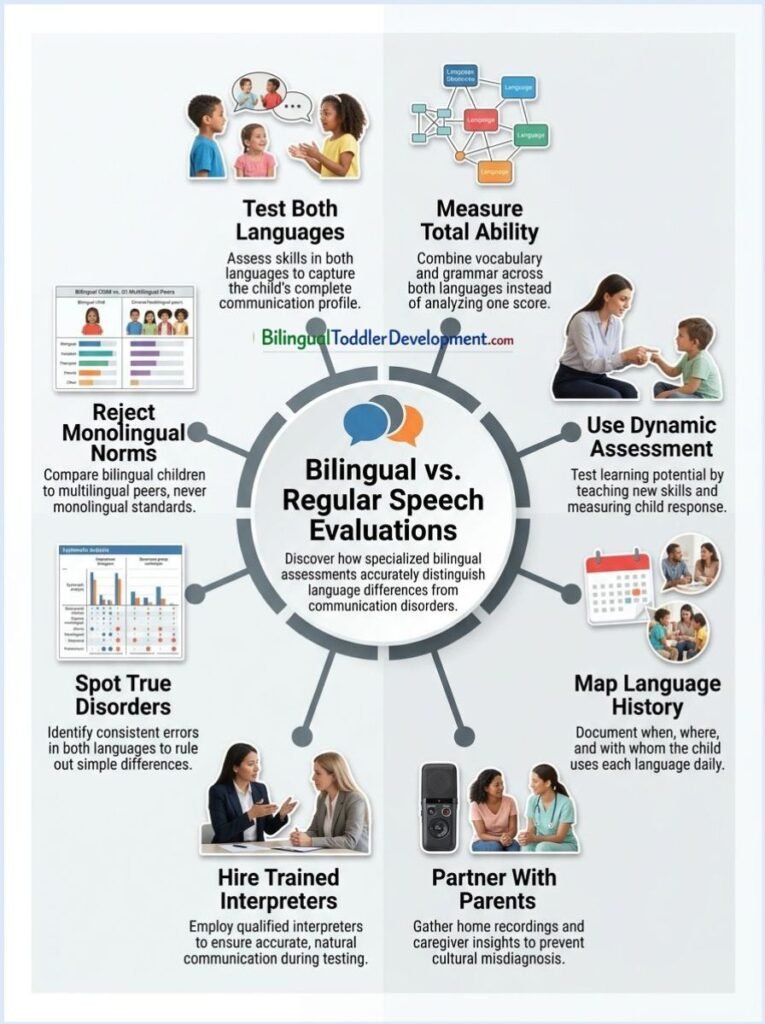
Bilingual vs. Monolingual Speech Evaluations: A Comparison
Both types of evaluations have the same basic purpose: to understand a child’s communication strengths, identify possible difficulties, and determine whether support is needed.
The differences involve how the clinician gathers and interprets information.
| Evaluation consideration | Monolingual child | Bilingual child |
|---|---|---|
| Language background | Usually focuses on one primary language | Considers all languages the child regularly hears or uses |
| Language exposure | Reviews opportunities to learn and use the child’s language | Examines when, where, and how much each language is used |
| Vocabulary | Considers words used in the child’s language | Considers vocabulary and communication across languages |
| Standardized testing | Uses tests appropriate for the child’s language and background | Must carefully consider whether tests are appropriate for the child’s languages and experiences |
| Caregiver input | Helps describe communication at home | Also helps explain abilities that may differ between languages or settings |
| Language samples | May examine communication during play or conversation | May gather samples from different languages and communication partners |
| Interpreters | Used when needed | May be needed when the clinician doesn’t speak the child’s home language |
| Interpretation of results | Considers age, development, and relevant cultural factors | Also considers bilingual development, language exposure, and cross-language differences |
These are general differences, not rigid rules.
A thorough evaluation of any child should consider more than standardized test scores.
For bilingual children, the additional challenge is ensuring that differences in language experience aren’t mistaken for evidence of a disorder.
Why Language Background Matters During an Evaluation
Children don’t necessarily develop identical skills in every language they hear.
A toddler may understand Spanish very well but use more English words at daycare. Another child may communicate comfortably in Mandarin at home but speak very little English during a clinic visit.
These patterns may reflect differences in language exposure rather than a communication problem.
If the evaluator considers only the child’s English performance, important abilities could be overlooked.
Vocabulary May Be Distributed Across Languages
Imagine a toddler who says “apple” and “dog” in English but uses Spanish words for milk, shoes, and several favorite toys.
An English-only vocabulary assessment would miss some of the words that child knows.
A clinician evaluating a bilingual child considers vocabulary across the languages the child uses, while also accounting for the child’s age and language experiences.
This doesn’t mean simply adding two vocabulary scores together and using the result to make a diagnosis.
Instead, the clinician examines vocabulary as one part of the child’s overall communication development.
One Language May Be Stronger Than Another
Bilingual children often have different levels of proficiency in their languages.
For example, a child who spends most of the day with Spanish-speaking family members may use more complex Spanish sentences than English sentences.
After starting an English-speaking preschool, that balance may change.
A difference in language strength is not automatically a disorder.
The clinician needs to understand which languages the child uses most often, with whom, and for what purposes.
Language Mixing Is Not Automatically a Problem
A bilingual toddler might say:
“More leche.”
Or:
“Look, un gato!”
Mixing languages, sometimes called code-switching, is a common part of bilingual communication.
It doesn’t mean a child is confused or unable to separate languages.
During an evaluation, the speech-language pathologist considers whether a child’s language patterns are appropriate for their developmental stage and linguistic experiences.
The goal is to distinguish expected bilingual variation from difficulties that warrant further assessment.
How Standard Speech-Language Evaluations Work
Before comparing evaluation approaches, it helps to understand what a speech-language evaluation typically involves.
A speech-language pathologist, often called an SLP, gathers information about a child’s communication development.
Depending on the child’s age and concerns, the clinician may examine:
- How well the child understands spoken language.
- Vocabulary and sentence development.
- Speech sounds and how clearly the child speaks.
- Social communication during play and interaction.
- Communication with caregivers and other familiar people.
- Developmental history and relevant hearing concerns.
The evaluation may involve play-based activities, conversation, caregiver interviews, observation, language samples, and standardized testing.
For toddlers, much of the assessment may look like ordinary play.
The clinician might observe how your child requests toys, follows directions, names objects, or interacts with a parent.
These methods are not exclusive to bilingual evaluations.
What changes for a bilingual child is how the clinician selects assessment methods, considers language abilities, and interprets the findings.
What Changes When the Child Is Bilingual?
Several aspects of the evaluation require particular attention when a child uses more than one language.
1. The Clinician Reviews Exposure to Each Language
A bilingual evaluation usually includes questions about the child’s language history.
The SLP may ask:
- Which languages does your child hear at home?
- Who speaks each language with your child?
- When was each language introduced?
- Which language does your child use most comfortably?
- What languages are spoken at daycare or preschool?
- Has your child’s language exposure changed recently?
These questions help explain why certain skills may be stronger in one language than another.
For example, a child who has heard English for only a few months shouldn’t automatically be expected to perform like a same-age child who has used English since birth.
However, limited English exposure also shouldn’t be used to dismiss other developmental concerns.
The clinician must consider the child’s overall communication abilities.
2. Both Languages Are Considered
For a bilingual child, it is important to consider communication abilities across the languages they regularly use.
This doesn’t necessarily mean administering the same standardized test twice.
Depending on the child’s age, language background, and available resources, the clinician may use:
- Caregiver interviews about home-language abilities.
- Play or conversation in familiar languages.
- Language samples collected with appropriate assistance.
- Observations from family members and teachers.
- Assessment tools developed for the child’s linguistic background.
- Qualified interpreters when needed.
The objective is to understand what the child can do across their languages, not simply to produce a separate score for each one.
For a closer look at this issue, see Should a Bilingual Child Be Evaluated in Both Languages?.
3. Standardized Test Scores Require Careful Interpretation
Standardized speech-language tests can provide useful information, but they have limitations.
Many tests were developed and standardized using children with particular language and cultural backgrounds.
If a bilingual child doesn’t match the population used to develop a test, the resulting scores may not provide a valid comparison.
For example, a child with limited English exposure may perform poorly on an English vocabulary test because they haven’t had sufficient opportunities to learn those words.
That result alone does not establish a language disorder.
Similarly, translating an English standardized test into another language does not automatically produce a valid standardized assessment.
The clinician must consider whether the test is appropriate and how its results can reasonably be interpreted.
When appropriate standardized measures are unavailable, other assessment information becomes especially important.
4. Language Samples May Come From Different Settings
Some bilingual children communicate differently depending on who they’re speaking with.
A toddler might be quiet during an unfamiliar clinic appointment but talk frequently while playing with a grandparent at home.
For this reason, a clinician may gather information from several settings or communication partners.
Language samples may come from:
- Play-based interactions during the appointment.
- Conversations with a parent or caregiver.
- Short recordings of natural communication at home.
- Observations or reports from preschool teachers.
- Interactions supported by an interpreter.
These samples help the clinician understand the child’s communication in everyday situations.
They may also reveal strengths that aren’t apparent during formal testing.
5. Cultural and Dialect Differences Are Considered
Children learn language within families and communities that may use different words, pronunciations, grammatical patterns, and communication styles.
A bilingual child may also speak a regional dialect or language variety.
These differences should not automatically be treated as errors.
An appropriate evaluation considers the child’s linguistic and cultural background before identifying a speech or language difficulty.
For example, a pronunciation or grammatical pattern that is typical in the child’s language or dialect shouldn’t be labeled disordered simply because it differs from Standard American English.
This principle applies to monolingual children as well, but it becomes particularly important when evaluating children who use multiple languages.
Does a Bilingual Child Need Two Separate Evaluations?
Not necessarily.
A bilingual child needs a speech-language evaluation that appropriately considers all relevant languages.
That is different from requiring two independent evaluations, one in English and another in the home language.
In some cases, the clinician may directly assess communication in both languages.
In others, the evaluation may combine direct testing in one language with caregiver interviews, home-language samples, interpreter-assisted activities, and additional observations.
The approach depends on factors such as:
- The child’s age.
- Which languages the child understands and uses.
- The amount of exposure to each language.
- The communication concerns being investigated.
- Available assessment tools and qualified language support.
The important question isn’t whether the clinician completes two sets of tests.
It’s whether the available evidence provides a sufficiently accurate picture of the child’s communication abilities.
What If the Speech-Language Pathologist Doesn’t Speak Your Child’s Home Language?
This is a common concern for bilingual families.
Ideally, an SLP evaluating a bilingual child will have appropriate experience with the child’s languages and cultural background.
However, a clinician doesn’t necessarily have to speak both languages personally to conduct an appropriate evaluation.
A qualified SLP may work with trained interpreters or other language professionals to gather and interpret relevant information.
How Interpreters Can Help
An interpreter can assist with communication between the clinician, child, and family.
Depending on the evaluation, an interpreter may help with:
- Parent interviews.
- Explaining assessment activities.
- Supporting interactions in the home language.
- Clarifying culturally or linguistically specific expressions.
- Assisting with the collection and interpretation of language samples.
The SLP remains responsible for choosing appropriate assessment methods, interpreting the overall findings, and making clinical decisions.
The interpreter supports the process but does not independently diagnose the child.
Whenever possible, professional interpreters with relevant training are preferable to relying on siblings or other untrained family members.
Why Home-Language Information Is Valuable
Parents often see communication abilities that don’t appear during an appointment.
For example, your child may regularly ask questions in Spanish at home but respond with only one or two English words at preschool.
Sharing that information helps the clinician understand the difference.
You may be asked to provide short recordings of your child communicating naturally.
These could include conversations during play, mealtimes, or reading.
You don’t need to coach your child or ask them to perform.
Ordinary interactions are often more informative.
Why Translated Tests Aren’t Always Appropriate
A test developed for English-speaking children cannot necessarily be translated word for word and used as though it were a standardized test in another language.
Languages differ in vocabulary, grammar, sound systems, and cultural expectations.
A translated item may not have the same difficulty or meaning in the second language.
An SLP may sometimes use translated materials informally, but the results should not automatically be interpreted using the original test’s standardized scores.
This is another reason a comprehensive evaluation relies on multiple sources of information.
How Does the Clinician Determine Whether a Disorder Is Present?
The clinician considers the child’s communication abilities, developmental history, language exposure, and performance across appropriate assessment activities.
A language disorder generally affects the child’s underlying ability to learn and use language, although the specific difficulties may appear differently across languages.
For example, the same child might show difficulties with sentence structure in one language and with particular grammatical forms in another.
The clinician looks at whether the overall pattern of difficulty can be explained by language exposure and expected bilingual development.
Assessment methods may include language sampling, observations, caregiver reports, standardized measures when appropriate, and dynamic assessment.
Dynamic assessment examines how a child responds to guided teaching and support. It can provide useful information about learning, but no single response or test result establishes a diagnosis.
Because this diagnostic process deserves a detailed explanation, we’ve covered it separately in How Speech Therapists Identify Language Disorders in Bilingual Children.
How Parents Can Prepare for a Bilingual Speech Evaluation
You don’t need to become an expert in language development before your child’s appointment.
However, a little preparation can help the SLP understand your child’s communication more accurately.
Write Down Your Child’s Language History
Before the appointment, make a few notes about:
- Which languages your child hears and speaks.
- Who uses each language with your child.
- When your child began hearing each language.
- Which languages are used at home and daycare.
- Any recent changes in language exposure.
- Communication concerns you’ve noticed.
You don’t need to calculate exact percentages of language exposure.
Approximate descriptions of your child’s daily routines are usually a useful starting point.
Bring Examples of Everyday Communication
Think about how your child communicates during familiar activities.
For example:
“She asks for food in Spanish but usually names animals in English.”
Or:
“He understands simple directions from his grandmother in Mandarin but rarely answers in complete sentences.”
These observations can help explain differences between languages.
If the clinician requests recordings, short examples of natural interactions may also be useful.
Bring Previous Reports
If your child has already received speech therapy, developmental screening, hearing testing, or a previous evaluation, bring the available reports.
Information from daycare or preschool teachers may also be helpful.
These records can provide context and show whether communication concerns have changed over time.
Continue Using Your Home Language
You don’t need to switch exclusively to English before the evaluation.
Speaking your home language does not cause a language disorder.
Continue using the languages you know and speak comfortably with your child.
Natural communication in familiar languages gives the clinician valuable information about your child’s abilities.
Questions to Ask Before Scheduling an Evaluation
One of the most useful steps parents can take is asking how the clinician will account for bilingual development.
You might ask:
- Do you have experience evaluating bilingual or multilingual children?
- How will you consider my child’s abilities in both languages?
- How will you account for differences in language exposure?
- What assessment tools or observations will you use?
- If you don’t speak our home language, will a qualified interpreter or other language support be available?
- How will you determine whether the results reflect a language difference or a possible disorder?
- How will you explain the findings and recommendations to our family?
The clinician should be able to explain the assessment plan in language you understand.
You can also ask how the results will be documented and whether the report will describe your child’s strengths and needs across languages.
Our guide to understanding a bilingual speech evaluation report explains what parents should look for in the results.
What If Your Child Has Already Had an English-Only Evaluation?
An English-only evaluation is not automatically invalid.
Its usefulness depends on the child’s language background, the concerns being investigated, and how the clinician interpreted the findings.
However, if your child uses another language regularly and the evaluation did not consider that language or their language exposure, the results may be incomplete.
You can ask the clinician:
- How was my child’s home-language development considered?
- Were the standardized tests appropriate for my child’s language background?
- Did the evaluation include caregiver observations from both languages?
- Would additional language samples or interpreter-assisted assessment help clarify the findings?
If important information was missing, you may wish to request additional assessment or a second opinion from an SLP experienced in multilingual evaluation.
The goal is not to reject the original findings automatically.
It’s to ensure that any diagnosis or recommendation is supported by an appropriate understanding of your child’s communication abilities.
When Should Parents Request an Evaluation?
If your child regularly uses more than one language, their language background should be considered whenever a speech-language evaluation is conducted.
You don’t need to wait until your child becomes fluent in English.
You also shouldn’t wait for identical difficulties to appear in both languages before seeking help.
If your child isn’t meeting expected communication milestones, has persistent difficulty understanding or expressing language, or loses previously acquired communication skills, discuss your concerns with a pediatrician or qualified SLP.
For more guidance about warning signs and when to seek help, read When Does a Bilingual Child Need a Speech-Language Evaluation?.
Key Takeaways
- Bilingual and monolingual speech-language evaluations share many of the same assessment methods.
- The main difference is that evaluating a bilingual child requires appropriate consideration of multiple languages, language exposure, and cultural and linguistic background.
- A bilingual child does not necessarily need two separate evaluations.
- A qualified monolingual SLP may evaluate a bilingual child with appropriate training, resources, and language support.
- Standardized test scores must be interpreted carefully when a child’s language background differs from the test’s intended population.
- Parents can help by sharing language histories, observations, and examples of communication at home.
- An accurate evaluation considers multiple sources of evidence rather than relying on one test score.
Final Thoughts
A speech-language evaluation should help you understand your child’s communication abilities, not leave you wondering whether learning two languages affected the results.
For bilingual children, an accurate assessment must account for how language skills develop across different languages and environments.
That doesn’t mean every child needs two complete sets of tests or that only a bilingual clinician can conduct the evaluation.
It means the SLP should understand your child’s language background, use appropriate assessment methods, and interpret the results within that context.
As a parent, you can help by sharing what your child understands and says at home, asking how both languages will be considered, and making sure you understand the findings.
The goal is a fair and useful evaluation that identifies your child’s strengths, clarifies any concerns, and helps your family decide what support, if any, is needed.
Frequently Asked Questions
Are bilingual speech evaluations different from regular speech evaluations?
They share many of the same methods, including caregiver interviews, observations, language samples, and appropriate testing.
The main difference is that an evaluation of a bilingual child must consider communication across languages and account for the child’s language exposure and linguistic background.
Should bilingual children always be tested in both languages?
Both languages should be considered whenever possible, but that doesn’t necessarily mean administering two complete sets of standardized tests.
The clinician may gather information through direct assessment, caregiver reports, interpreters, language samples, and other appropriate methods.
Can a monolingual speech-language pathologist evaluate a bilingual child?
Yes, provided the clinician has the necessary professional competence and uses appropriate resources.
This may involve qualified interpreters, language professionals, caregiver interviews, and other methods for understanding communication in the home language.
Are bilingual evaluations more accurate than English-only evaluations?
An evaluation that appropriately accounts for a bilingual child’s language background is generally more informative than one that ignores those experiences.
However, accuracy depends on the clinician’s methods and interpretation, not simply whether an evaluation is labeled bilingual.
Can an English-only speech test incorrectly identify a language disorder?
Yes, particularly if the test isn’t appropriate for the child’s language background or the clinician fails to consider language exposure.
A low English test score alone doesn’t establish a language disorder.
Additional information may be needed to understand the child’s overall communication abilities.
How long does a bilingual speech evaluation take?
The time varies depending on the child’s age, communication concerns, languages, and assessment needs.
Some evaluations may be completed in one appointment. Others require additional visits, language samples, interpreter-assisted activities, or information from caregivers and teachers.
The clinician should explain what the evaluation will involve and whether additional assessment is needed.