
You call your child’s name, and they turn.
You ask them to bring their shoes, and they do.
You read a book together, and they point to the right pictures.
But when it comes to talking, there are only a few words – or none at all.
If you’ve ever thought, “My bilingual toddler understands everything but doesn’t talk,” you’re not alone. This pattern is one of the most common – and most misunderstood – parts of early language development.
The missing piece is simple, but important: understanding and speaking are two different skills, and they don’t grow at the same speed – especially in bilingual children.
Once you see how receptive and expressive language develop, it becomes much easier to tell what’s typical, what needs support, and what actually deserves a closer look.
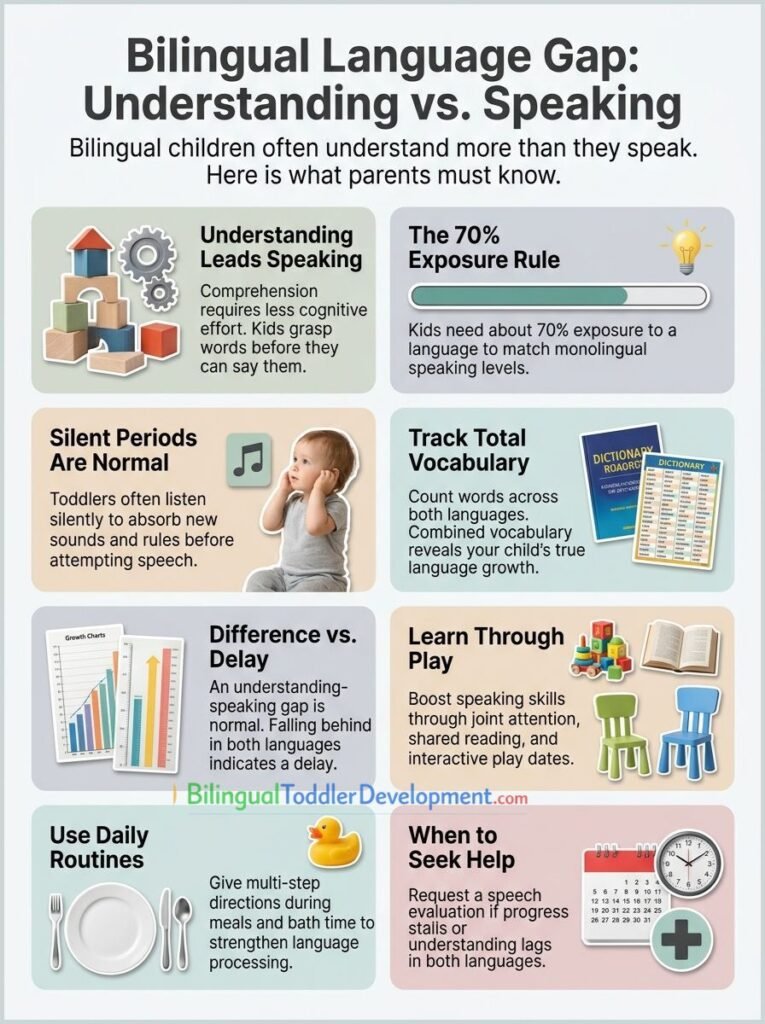
What Is the Difference Between Receptive and Expressive Language?
To make sense of this pattern, it helps to separate two parts of language development that often get grouped together: understanding and speaking.
These are known as receptive language and expressive language, and while they are closely connected, they develop at different speeds — especially in bilingual children.
Receptive language is how your child understands words, instructions, questions, and stories.
Expressive language is how your child uses language to share needs and ideas – through words, signs, or consistent gestures.
In bilingual development, it’s common to see a receptive–expressive gap, where a child understands more than they can say. This doesn’t mean something is wrong – it reflects how language develops.
Understanding a word is one step. Using it in real time is another.
Researchers such as Elizabeth D. Peña and Erika Hoff have shown that this gap is closely linked to language exposure. Children may recognize many words across both languages, but expressive vocabulary typically needs more frequent and consistent use to develop.
One explanation is the frequency lag hypothesis (sometimes called “weaker links”): hearing a word builds recognition, but saying it requires faster retrieval and stronger practice.
When clinicians evaluate a child who “understands but isn’t talking much,” they don’t rely on a single measure. They look at patterns across both languages and across real-life situations.
This may include:
- Receptive skills: following directions, answering simple questions, showing understanding in play
- Expressive skills: requesting, labeling, combining words, and sharing ideas
- Across both languages: total vocabulary and communication attempts
- Daily context: how language is used at home, in childcare, and with peers
A speech-language pathologist following American Speech-Language-Hearing Association (ASHA) guidance will interpret these patterns based on exposure, not just scores.
What Is Receptive Language (Understanding)?
Receptive language means your child can take in spoken language and make sense of it. You see it when they follow directions, point to the right picture, or react appropriately to a story.
In bilingual children, receptive vocabulary often grows earlier because kids can “collect” words from many speakers and situations, even when they are not ready to say those words yet.
A detail many parents miss is that comprehension is not just “following commands.” It also includes understanding relationships between words, like categories (foods vs toys), attributes (big vs little), and story meaning.
- Quick home check: Give a familiar two-step direction during play, then change one detail (for example, “put the car in the box, then give me the bear”). This helps you see if your child is following meaning, not memorizing a routine.
- Cross-language check: Try the same direction in each language on different days. A bilingual child understands but doesn’t speak in one language may still show strong receptive skills in both.
Children listen before they talk, and that listening builds the words they will one day use.
What Is Expressive Language (Speaking)?
Expressive language is how your child sends a message out to the world. That can be spoken words, signs, consistent gestures, or using a picture to request.
It includes vocabulary, grammar, sentence structures, asking questions, and telling stories. It also includes the “social rules” of conversation, like turn-taking and staying on topic.
If you are thinking, “my toddler understands but doesn’t speak,” you are describing a common profile where receptive skills are stronger than expressive skills.
- Practical tip: Track attempts, not perfection. A new sound, a partial word, a sign, or a point paired with eye contact can still be expressive communication.
- Common pitfall: Quizzing (“say it, say it”) can reduce talking for some kids, especially shy children. Short models and predictable routines usually work better.
Clinicians may use bilingual tools such as the bilingual english spanish oral screener (besos), language samples, and therapy probes to measure progress over time and across settings.
How Receptive and Expressive Language Work Together
Receptive and expressive language are connected, but they do different jobs in the brain. Comprehension can look strong because your child can use context, routines, and visual cues to understand.
Expressive language asks for faster access: your child has to pick a word, pull the sounds, build a sentence, and say it in real time.
One large study of bilingual children found that a receptive-expressive gap is very common, and that the gap is often larger in a child’s less-used language. In that same body of work, researchers often treat a gap as “clinically noticeable” when receptive scores exceed expressive scores by about 10 standard score points.
- If comprehension is strong: you can use it to “pull” expressive skills forward with predictable prompts and repeated story routines.
- If comprehension is also weak: you should move faster toward an evaluation, because that pattern is less likely to be explained by bilingual exposure alone.
Why Bilingual Children Often Understand More Than They Speak
Bilingual children often understand more than they can say because understanding is a lower-pressure task. A child can recognize a word without having to retrieve it and produce it in real time.
In many bilingual environments, exposure is also uneven. A child may hear one language more often at home and another at childcare or school. This builds strong recognition across both languages, while expressive skills depend more on frequent, active use.
Clinicians account for this by looking at patterns across both languages, not just performance in one. The goal is to distinguish a typical bilingual pattern from a true language delay by considering total exposure, vocabulary across languages, and how the child communicates in daily life.
- Action step: If you want to strengthen expressive vocabulary in the heritage language, create predictable speaking opportunities (mealtimes, bedtime routines, or regular conversations with family).
- Action step: If concerns appear in both languages, request a bilingual speech-language evaluation or a clinician who can work with a trained interpreter.
Why Understanding Develops Faster Than Speaking
Children hear far more language than they produce. This steady input builds recognition first, while expressive language depends on practice and retrieval.
In bilingual children, this can show up as passive bilingualism, where a child understands a language well but uses it less when speaking.
One effective approach is to turn understanding into simple speaking opportunities:
- Build from what they know: “Where is the dog?” -> “Dog” -> “Dog is running.”
- Use repetition: Keep short phrases consistent within routines
- Leverage peers: Many children speak more readily with other children than with adults
If you use apps or programs, treat them as support tools, not replacements for interaction. Research on language programs shows mixed results compared to real conversation and shared activities.
How Vocabulary Is Split Across Two Languages
Bilingual children often distribute vocabulary across their languages. They may know certain words in one language and different words in another, depending on context.
This is why total vocabulary matters. Counting concepts across both languages gives a more accurate picture than looking at one language alone.
- Simple tracking idea: Choose common concepts (foods, toys, actions) and note whether your child understands or says them in either language
- Work with caregivers: Ask which language your child uses with peers – this often drives expressive growth
If a language is heard but rarely used, expressive skills in that language may lag behind comprehension.
The “Silent Period” in Bilingual Language Development
Some children go through a “silent period,” especially after entering a new language environment.
This phase can last from a few weeks to several months. During this time, children are actively listening and building understanding, even if they are not speaking much.
- Reassuring signs: strong comprehension, gestures, eye contact, and engagement
- Concerning signs: weak understanding, reduced interaction, or loss of skills
A child who is listening and engaged is still learning.
Is It Normal for a Bilingual Child to Understand More Than They Say?
Yes, it can be normal for bilingual children to show stronger receptive language than expressive language, especially in toddlerhood.
That said, “normal” still has boundaries. Your job is to watch the trajectory: more communication attempts, more words over months, and stronger participation across settings.
A helpful rule from ASHA’s guidance on late language emergence is that when a child struggles to learn both languages, not just one, you should consider an evaluation rather than assuming it is only bilingual exposure.
- Action step: Track progress in both languages, even if one is stronger. Bring examples (videos, word lists, notes) to any appointment.
- Action step: If your child has a diagnosis or risk factors (hearing concerns, family history of language impairment, autism), do not wait for “they’ll grow out of it.” Get a plan.
What a Typical Receptive–Expressive Gap Looks Like
A typical gap looks like this: your child understands familiar words, follows routines, and responds to everyday language – but uses fewer words or shorter phrases than expected.
In bilingual children, this often reflects how language is used, not a problem with development.
- Green flag: You see steady progress – new words, new attempts, or more consistent responses over time.
- Yellow flag: Your child relies mostly on gestures or pulling you to objects, with fewer attempts to vocalize.
- Red flag: Understanding is limited in both languages, or progress has stalled over several months.
This pattern is often explained by the frequency lag hypothesis: understanding builds with exposure, but speaking requires repeated practice and faster word retrieval.
What matters most is not how many words your child says today, but whether their communication skills are expanding over time.
Real-Life Examples in Bilingual Toddlers
These everyday examples can help you recognize what a typical receptive–expressive gap looks like:
- A toddler follows directions in both languages during play but responds using only a few words.
- A child understands stories or routines in one language but prefers to speak in the other.
- A toddler points, gestures, or reacts appropriately, even when they don’t say the word.
- A child uses single words or short phrases, even though they clearly understand more.
- A toddler goes quiet in a new language setting but continues to show strong understanding.
These patterns often reflect how language is distributed across environments – not a delay.
You may see different patterns at home, at daycare, or with different caregivers.
What matters most is whether communication is increasing over time: more attempts, more words, and more interaction.
Why This Difference Is Often Temporary
For many children, the receptive-expressive gap shrinks when exposure stabilizes and kids get more chances to practice speaking.
This is especially true after a child adapts to a new school setting, makes friends, and learns the social routines of the classroom.
- Make practice unavoidable: Give your child a reason to speak, like choosing between two snacks, picking a book, or requesting a toy that is out of reach.
- Reduce pressure: Model a short phrase, then pause. If your child does not repeat it, accept a gesture and model again later.
When the Gap Between Understanding and Speaking May Be a Concern
A gap can be a concern when it affects both languages, limits daily communication, or stays flat over time.
It is also concerning when the gap comes with weak comprehension, limited play skills, or low social interaction, because those signs suggest more than a “talking later” pattern.
Clinicians can use bilingual screeners and deeper assessment to separate exposure effects from a true disorder. One study of the bilingual english spanish oral screener (besos) reported strong predictive sensitivity (about 95%) and moderate specificity (about 71%) when combining semantics and morphosyntax scores in the child’s best language, which is exactly why bilingual assessment tries to capture strengths across both languages.
- Action step: Ask whether results were interpreted using the child’s best language scores and whether total vocabulary was considered.
- Action step: If your child is losing words they used before, prioritize medical and developmental follow-up right away.
Difference vs Delay in Bilingual Language Development
| Aspect | Typical Difference (Bilingual Development) | Possible Delay (Needs Evaluation) |
|---|---|---|
| Core pattern | Understands more than they can say, especially after changes in exposure | Limited understanding and speaking in both languages |
| Vocabulary | Words are split across languages; total vocabulary grows steadily | Total vocabulary is limited and grows slowly across both languages |
| Progress over time | New words, gestures, or combinations appear over months | Little progress or loss of skills over time |
| Role of exposure | More exposure leads to noticeable improvement in that language | Struggles continue despite consistent exposure and practice |
| Communication | Uses gestures, pointing, eye contact, and attempts to communicate | Few attempts to communicate; limited interaction or engagement |
| Silent period | Temporary quiet phase with strong understanding and engagement | Extended quiet with weak comprehension or reduced interaction |
| Next step | Continue supporting both languages and monitor progress | Seek a bilingual speech-language evaluation |
Signs of Concern in Both Languages
Watch for trouble with understanding and talking in both languages. These signs can point to a language disorder, hearing issues, or broader developmental concerns.
- Low comprehension in both languages, for example, difficulty following simple one-step directions across routines.
- Very limited expressive vocabulary across both languages, with few new words over months.
- Few communication attempts, limited pointing, limited showing, and limited back-and-forth interaction.
- Parent and teacher concerns match, and play-based observation also shows weak language learning.
- Loss of skills, such as dropping words or gestures that were used consistently.
- Persistent frustration or behavior that seems driven by communication breakdown, not just temperament.
- A long-standing pattern where your child understands far more than they can express, with little change despite steady interaction.
When to Seek a Speech-Language Evaluation
If you are worried, you do not need to “wait it out.” A good evaluation gives you a baseline, a plan, and clear next steps.
- Seek support if your child has very limited speech by 24 months, especially if gestures and social interaction are also limited. The CDC developmental milestones emphasize watching for functional communication and combining words by the end of the second year.
- Arrange a hearing screen if your child does not respond to sounds, misses speech cues, or seems inconsistent in responding to their name.
- Request a bilingual evaluation if you see concerns in both languages, or if school reports differ from what you see at home and you need clarification.
- Ask for language sampling in play, not only table-top tasks, so the evaluator can see real communication and attention skills.
- Act quickly if your child loses words, stops using gestures, or becomes less interactive.
- If access is limited, ask whether telepractice is an option for coaching, parent strategy training, or follow-up monitoring.
- Ask for a written plan that includes home strategies, measurable goals, and a timeline for re-checking progress.
How to Tell If Your Bilingual Toddler Is Making Progress
Progress is easier to see when you look for patterns over weeks and months, not day to day.
Watch how your child responds to names, commands, and simple stories in both languages. Also watch how often they try to communicate, even without clear speech.
- Receptive progress: follows new directions, points to pictures when named, understands more “where/which” questions.
- Expressive progress: more sounds, more consistent words, more requests, and more combining.
- Interaction progress: stronger turn-taking, more showing, more joint attention during play.
Keep both languages active at home if the heritage language matters to your family. When families drop the heritage language completely, expressive ability in that language often fades first.
What Progress Looks Like Over Time
Progress often looks like “more frequent attempts,” then “more reliable words,” then “longer phrases.”
A practical way to measure this is with a short weekly note: new words, new gestures, new combinations, and any new social interaction wins.
- Month-to-month win: your child starts using the same word for the same purpose in multiple settings.
- Another win: your child begins to imitate short phrases from play or books, even if pronunciation is not clear.
Why Total Vocabulary Matters More Than One Language
Total vocabulary counts concepts your child can express across both languages. This is often more fair than judging only one language, especially when exposure is split between caregivers and school.
ASHA’s late language emergence guidance highlights approaches like conceptual scoring to show what a bilingual child knows, even when single-language scores look low.
- Home tool: Make a two-column list (heritage language and societal language). Write the word your child uses for each concept, in either language.
- Decision tool: If total vocabulary and learning rate keep rising, a temporary receptive-expressive gap is more likely. If learning rate is slow in both languages, push for evaluation.
The Role of Interaction and Communication Attempts
Interaction drives language growth. Your child learns fastest when language is tied to attention, emotion, and real goals.
- Use joint attention during play, name an object, then pause and wait, this gives your child a reason to respond.
- Offer short prompts in both languages, then accept any attempt (sound, gesture, word), and model the “next level” phrase.
- Protect the heritage language with predictable speaking roles, like one caregiver using it during meals or bedtime stories.
- Treat silence as information. If your child is engaged and understands, keep the interaction going without pressure.
- Share short video clips with your clinician, real-life language samples often show skills that clinic testing misses.
- Use open prompts during routines (“What do we need?” “Where did it go?”) to support narrative retell and sentence structures.
- Seek a bilingual speech-language evaluation if concerns show up in both languages, or if progress stays flat.
How to Support Receptive and Expressive Language at Home
You can support both receptive language and expressive language without turning your home into a classroom.
Focus on predictable routines, shared attention, and short language models. These are the fastest ways to reduce a receptive-expressive gap in daily life.
- For receptive language: give simple directions, add visuals, and check understanding with action (point, bring, show).
- For expressive language: create small, repeatable moments where your child needs to request, label, or choose.
Simple Ways to Build Receptive Language Skills
Use clear, daily habits to grow comprehension. Keep it short, playful, and repeatable.
- Use routines like snack or bath time for one- and two-step directions, then switch the order sometimes to confirm real understanding.
- Read picture books and pause for pointing. Ask “where” and “which” questions before “what is it,” because pointing is an easier bridge.
- Play joint attention games with a toy set, name objects, then wait for your child to look or point.
- Sort toys by color or size, then ask simple comprehension questions (“Which one is big?”).
- Use pretend play to teach verbs (eat, wash, sleep) since verbs often drive sentence growth later.
- Give choices (“cup or spoon?”), then label the choice in a short phrase.
- Use pictures and ask for predictions (“What happens next?”) to support story comprehension and later narrative generation.
Practical Ways to Encourage Expressive Language
Bilingual kids often understand more than they say. The goal is to make speaking feel useful and safe.
- Pause after you model a word. That pause is the “invitation” to talk.
- Use play-based scripts your child can learn fast (cars: “go,” “stop,” “my turn,” “your turn”).
- Expand child utterances: if your child says “ball,” you say “big ball” or “ball up.”
- Give your child a job in routines, like “tell me: more” or “say: open,” then celebrate the attempt.
- Use single pictures and multiple pictures to practice labeling and then describing, which supports narrative retell.
- Track a short weekly language sample, even 2 minutes of play talk helps you notice growth.
- If expressive skills lag hard in both languages, ask about language therapy and a plan you can carry into daily routines.
Using Daily Routines to Strengthen Both Languages
Routines create the repetition that moves words from receptive knowledge to expressive use.
- Use a simple routine chart, say the same short phrases each day in the target language.
- Read one short story daily and re-read favorites, repetition supports both receptive vocabulary and expressive vocabulary.
- Use meals for choices and requests, and repeat the same sentence frame (“I want ___.”).
- Set up peer time when possible, peer play creates natural pressure to talk without adult prompting.
- At bedtime, retell the day using two or three familiar events, this supports narrative generation and emotional regulation.
- If your child is in kindergarten or first grade, ask how classroom participation looks, that context matters for interpreting progress.
How Receptive and Expressive Skills Fit Into Bilingual Milestones
Bilingual children typically reach major language development milestones on a similar timeline to monolingual children, but the “shape” of skills can look different across languages.
Receptive skills often look stronger early. Expressive skills can surge later, especially after school and peer exposure increases in the societal language.
The frequency lag hypothesis explains why uneven development is expected. Your child is managing two systems, and production needs extra practice for word retrieval.
- What to watch: steady gains, new combinations, stronger story skills, and better ability to follow directions in real situations.
- What matters less: comparing one language to a monolingual peer without considering total vocabulary and exposure.
How This Connects to Language Milestones
Milestones help you decide whether a pattern looks typical development or whether it is time for evaluation.
When you see a big receptive-expressive gap, ask two questions: is comprehension growing, and are communication attempts increasing.
- If yes: support both languages and keep tracking.
- If no: a speech-language evaluation can clarify whether you are seeing exposure effects or a true delay.
Why Uneven Development Is Expected
Uneven development is common because exposure is uneven. School, peers, media, and extended family rarely give the same amount of input in both languages.
Also, expressive language is more sensitive to practice. When a heritage language is heard but rarely required, expressive skills in that language can fade while receptive skills stay higher.
- Pro tip: If you want your child to speak the heritage language, they need real reasons to use it, not just hear it.
- Pro tip: Use cognates strategically (music and música) because targets shared across languages can support learning in both, as noted in ASHA multilingual service delivery guidance.
What to Focus on Instead of Word Counts
Word counts alone can mislead you in bilingual development. Focus on learning rate, interaction, and how your child uses language to solve problems.
- Joint attention and turn-taking during play.
- Ability to follow new directions, not just routines.
- New words and new combinations over months.
- Story skills, like retelling a familiar event with help.
If gains stall in both languages, or if interaction drops despite steady exposure, move toward professional support.
When to Get Help for a Bilingual Child’s Language Development
Get help when you see a pattern that limits communication and does not improve with time and interaction.
Start with hearing screening and a speech-language evaluation that considers both languages, plus exposure and social interaction.
If your child is under three, your state’s early intervention system can be an entry point. A congressional summary of IDEA Part C notes that states operate early intervention systems for infants and toddlers, and that timelines such as completing steps after a referral are time-bound, with a commonly cited requirement to complete initial steps within 45 days of referral.
Key Signs That Warrant Professional Support
These signs are worth acting on, especially when they show up across both languages.
- No single words around 18 months, or no two-word combinations around 24 months, especially when paired with limited gestures.
- Little or no response to name or simple routine directions in either language.
- Regression, losing words or gestures once used consistently.
- Choking concerns, feeding issues, or speech clarity that blocks communication with caregivers.
- Progress that stays flat after months of consistent exposure and strong home strategies.
- Big concerns about attention skills, social interaction, or play skills alongside language concerns.
What to Expect From a Bilingual Evaluation
A bilingual evaluation should tell you what your child understands, what they can express, and how fast they learn language with support.
- Caregiver interview about language exposure and daily routines, plus concerns and goals.
- Play-based observation and a language sample to see real communication.
- Standardized measures when appropriate, interpreted with bilingual norms and best-language comparisons.
- Dynamic assessment, where the clinician teaches briefly and watches how your child learns, not just what they know that day.
- A clear plan with home strategies, therapy targets if needed, and a timeline for follow-up.
If narrative skills are part of the concern, clinicians may use tools such as the test of narrative language. A 2024 technical description of the TNL-2 narrative sample database lists an age range starting at 4 years through the mid-teen years, and it describes eliciting stories from sequenced pictures and a single picture, which mirrors how many clinicians structure narrative retell tasks.
Why Early Support Matters
Early support helps because you can change daily practice fast. Small changes in routines can create many more chances to understand and talk.
It also helps preserve a heritage language. When a child stops practicing speaking in the heritage language, expressive skills often decline before comprehension does.
Conclusion: Understanding the Difference Builds Confidence
If a bilingual toddler understands but doesn’t talk, the first step is to separate receptive language from expressive language and watch the learning trajectory across both languages.
Track total vocabulary and bilingual milestones, keep both languages active in daily routines, and schedule a speech-language evaluation if progress stalls or concerns show up in both languages.
FAQs
1. My bilingual toddler understands everything but doesn’t talk — is this normal?
In many cases, yes. Bilingual toddlers often develop receptive language (understanding) before expressive language (speaking). If your child follows directions, responds to language, and shows growing communication attempts, this pattern is often typical.
However, if understanding and speaking are both limited across languages, or progress is slow over time, it’s worth seeking a professional evaluation.
2. Why does my child understand two languages but only speak one?
This usually reflects language exposure and use. Children tend to speak the language they use most often or need in daily interactions, while still understanding both.
Expressive language requires more practice than understanding, so it’s common for one language to be stronger for speaking.
3. Does a receptive–expressive gap mean a speech delay?
Not necessarily. A gap between understanding and speaking is common in bilingual development.
A possible delay is more likely when:
- Both understanding and speaking are limited
- Communication attempts are minimal
- Progress is slow across both languages
4. How can I help my child move from understanding to speaking?
Focus on creating simple, repeatable opportunities to talk:
- Use familiar routines with predictable phrases
- Offer choices (“milk or water?”)
- Pause and wait after modeling a word
- Accept attempts and expand them
Consistent interaction helps turn understanding into speaking.