
You’re doing your best to raise a bilingual child… but somehow the weaker language keeps slipping through the cracks over time.
Not because you don’t care.
Not because you’re doing anything wrong.
But because real life moves fast, and language exposure doesn’t happen by accident.
The truth is, bilingual success at this age comes down to one thing: how often your child gets meaningful chances to hear and use each language during everyday moments.
The good news is you don’t need more time.
You need a simple system that fits into the routines you’re already doing.
In this guide, you’ll learn exactly how to build that system using meals, play, books, and daily routines, so the home language becomes a natural, consistent part of your child’s day.
Let’s start by clarifying what ‘language exposure’ really means in real life.
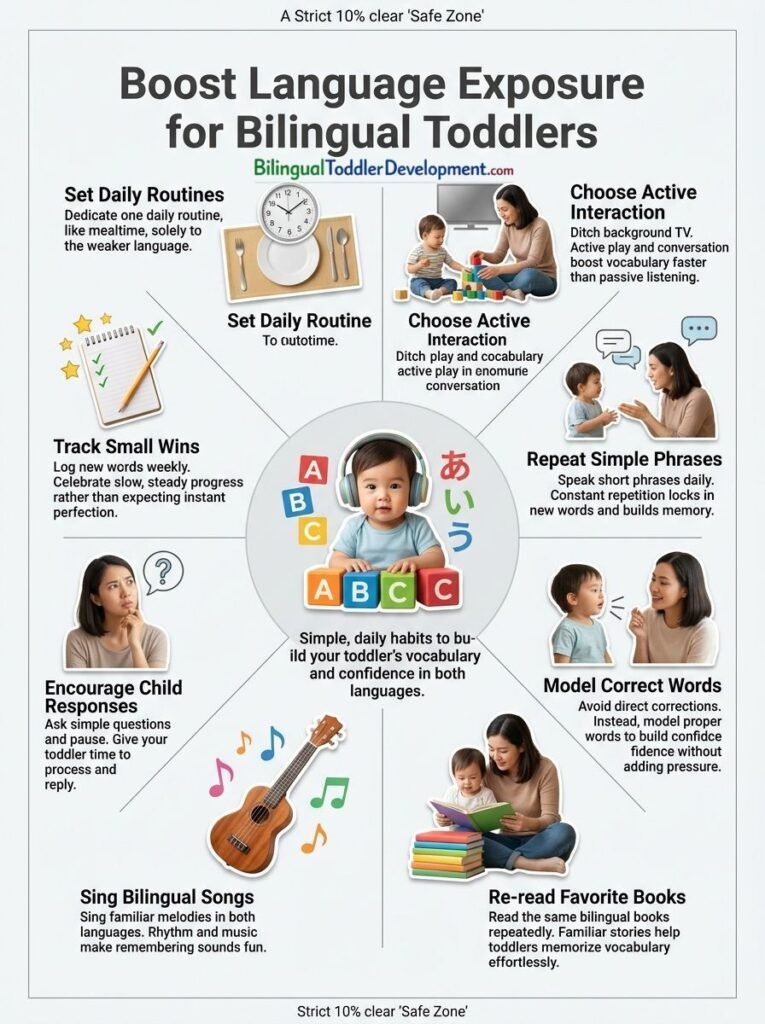
What Language Exposure Means for Bilingual Toddlers
Language exposure is not just how much language your child hears.
It’s how much meaningful, back-and-forth interaction they experience in each language throughout the day.
A child can hear hours of a language in the background and learn very little from it.
But a few minutes of real interaction, where they look, respond, and take turns, can drive much faster language growth.
Language exposure includes everyday moments like:
- talking during routines
- shared reading
- singing familiar songs
- play
- and simple back-and-forth conversation
A simple definition of language exposure
Exposure happens during play, reading, singing, and daily routines.
The easiest way to think about exposure is this: your child needs chances to connect words to real moments, then respond in some way.
One of the clearest ways to understand this comes from Harvard University’s Center on the Developing Child, which describes this as “serve and return,” where your child initiates with a look, sound, gesture, or word, and you respond in a way that fits the moment and keeps the interaction going.
- Follow their lead: talk about what they are already focused on.
- Label with purpose: name the object or action in a short phrase.
- Add one helpful detail: a color, feeling, or location.
- Pause: give your child time to answer with any sound, sign, or word.
- Repeat later in the day: repetition in a new moment helps it “stick.”
Speech-language pathologists and audiologists often emphasize the same principle in different words: children learn best through responsive interaction, not “perfect” speech drills.
Why interaction matters more than passive listening
Passive listening can add familiarity with sounds, but it rarely creates the back-and-forth practice toddlers need for language development.
What grows vocabulary fastest is contingent conversation, meaning you respond to what your child just did or said, and your child learns that language works.
The American Academy of Pediatrics also points families back to quality and co-use: for ages 2 to 5, they recommend keeping screen use to about one hour per day of high-quality content, and watching with your child so you can talk about what they see.
- If you use bilingual media, make it interactive: pause, label, and ask one simple question.
- Pick one “talk-heavy” activity right after: snack, bath, or blocks in the minority language at home.
- Use video chat strategically: real conversation with relatives creates natural conversational turns.
Why Language Exposure Is the Key to Bilingual Development
Language exposure works because toddlers don’t learn language one word at a time.
They learn it through patterns they hear again and again in real-life situations.
That’s what turns a word from something familiar into something they can actually use.
And in a bilingual home, those patterns are rarely equal.
One language gets repeated more often, used in more situations, and reinforced more quickly.
That is why it develops faster.
You are not competing with English.
You are giving the home language a consistent place in your child’s daily routines, where it can grow naturally.
How exposure shapes vocabulary and comprehension
Vocabulary does not grow randomly.
It grows around the routines your child experiences every day.
A useful way to think about progress is this:
comprehension comes first, then participation follows.
Your child hears a word in a familiar moment, begins to understand it, and then starts to respond with a look, a gesture, or a word.
Researchers often group early language development into a few core areas, but in real life, these all show up inside your daily routines:
- Oral language and vocabulary: the words used during meals, play, and transitions
- Book knowledge and print concepts: how books work and how you talk about them
- Alphabet knowledge and early writing: playful exposure to letters and marks
- Phonological awareness: rhymes, sound play, and syllables
- Background knowledge: naming what your child sees, does, and experiences
If you want one simple strategy that supports all of these at once, use dialogic reading, which turns reading into a conversation. Instead of reading every word, you prompt your chuild to notice, name, and respond.
Why toddlers learn through repetition and daily use
Repetition is not just helpful, it is how language sticks.
Toddlers need to hear the same words across different moments before they feel confident using them. The goal is not to repeat mechanically, but to repeat naturally throughout the day.
- Morning: “Shoes on. One shoe, two shoes.”
- Mealtime: “Pour. More? All done?”
- Play: “Build up. Crash down.”
- Bath: “Wash hands. Wash belly.”
In bilingual homes, repetition does something even more important. It creates predictability.
When your child knows what to expect, they can focus less on figuring out the situation and more on using the language. That makes it easier for the weaker language to take hold.
How Much Language Exposure Does a Toddler Need
Most parents ask the same question at some point:
“Is my child getting enough exposure?”
The honest answer is this:
There is no perfect number of hours.
Toddlers do not learn language based on time alone.
They learn it through consistent, meaningful interaction throughout the day.
That means a few short, engaged moments can matter more than hours of passive listening.
Why there is no perfect number of hours
There is no magic number that guarantees bilingual development.
What matters more is:
- how often your child hears the language
- how often they get a chance to respond
- and how predictable those moments are
A more useful way to measure exposure is this:
“How many times today did my child get a chance to participate in this language?”
- High-quality exposure: includes turn-taking, play, shared attention, and real interaction
- Low-quality exposure: mostly background audio or passive listening
- Best-case exposure: short, repeated moments across routines like meals, play, books, and transitions
Language mixing is also normal. When toddlers mix languages, they are using every tool they have to communicate, not showing confusion.
Why consistency matters more than quantity
Consistency works because toddlers learn patterns, not schedules.
They do not need long sessions.
They need predictable moments where a language shows up again and again.
That is what builds confidence and makes it easier for them to participate.
If you are trying to strengthen the weaker language, a simple rule works well:
Protect one daily routine in that language.
It does not have to be long.
Even 10 to 20 minutes of focused, consistent interaction can make a real difference over time.
Here are three simple approaches that many families use:
| Approach | What it looks like at home | Why it helps |
|---|---|---|
| One person, one language | Each caregiver consistently uses one language | Creates clear, predictable patterns |
| Minority language at home | One language inside the home, another outside | Protects the weaker language daily |
| Time and place | Specific routines in one language | Gives the language a reliable anchor |
How to Increase Language Exposure at Home
If you want to increase language exposure, you don’t need more time.
You need a simple system that fits into your daily routines.
The most effective approach is built on four things:
- consistent routines
- simple, repeated phrases
- interactive moments
- opportunities for your child to respond
Start small, stay consistent, and build from there.
If you follow this structure, the weaker language will begin to show up naturally throughout your child’s day.
Start with one consistent daily routine
Everything starts with one predictable moment.
Pick a routine that already happens every day, like breakfast, bath, or the car ride to child care programs.
Then script it with a short set of repeatable phrases, so you do not have to “invent” language on the spot.
- Greeting: “Good morning.” “How are you?”
- Action: “Pour.” “Stir.” “Cut.”
- Choice: “Milk or water?”
- Turn: “Your turn.” “My turn.”
- Wrap-up: “All done.” “Clean up.”
Once your child recognizes the routine, they start filling in the blanks, which is exactly what you want for language learning.
Use simple and repeated phrases every day
Toddlers learn language faster when they hear short, repeated phrases tied to what they are doing right now.
You don’t need long sentences.
You need clear, simple language that shows up again and again during daily routines.
A practical way to do this is through self-talk and parallel talk:
- Self-talk: “I’m washing the apple.” “I’m cutting it.”
- Parallel talk: “You’re stacking.” “You made it tall.”
- Expansion: If your child says “car,” you say “fast car” or “red car.”
These small, repeated phrases give your child a clear model to follow without pressure.
Talk about what your child is doing
Narrate what your child is doing in the weaker language, using short sentences and real verbs.
This is especially effective in play because your child’s attention is already locked in, so your words attach to what they see and feel.
- Blocks: “Up.” “Down.” “Again.” “Big tower.”
- Pretend food: “Cut.” “Hot.” “Taste.” “Yummy.”
- Animals: “Jump.” “Sleep.” “Eat.” “Run.”
Families using Spanish immersion programs like Casa de Corazón often rely on this same idea: label actions and routines first, then build longer phrases over time.
Attention drives learning, so when you talk about what they are already focused on, your words stick faster.
Create opportunities for your child to respond
Your child does not need to answer with full sentences for the moment to count as exposure. Any response is practice.
Set up “easy wins” where your child can point, choose, or fill in a familiar word.
- Offer choices: “Apple or banana?”
- Use playful sabotage: hand them the wrong spoon, then wait.
- Pause in songs: stop before the last word and look at them.
- Give one-step directions: “Bring the ball.” “Put it in.”
Waiting is part of the strategy. Give a few seconds, then model the answer if needed.
Read the same books multiple times
Rereading is one of the fastest ways to build language because the story becomes predictable. Your child can focus on the words instead of trying to figure out what happens next.
To make rereading work harder for you, pick two “target words” per book and repeat them across the week in daily routines.
- Book word: “bear”
- Daily routine link: “bear towel,” “bear shirt,” “bear sleep”
If you use bilingual books, you can read one page in each language, or read the full story in the weaker language and use the other language for a short recap.
Familiarity reduces effort, which makes participation easier.
Use songs and familiar language patterns
Songs work because they repeat the same sounds and phrases in the same order, and toddlers love predictable patterns.
Keep songs short and use them as routine markers, such as a clean-up song or a bath song.
- Pick two “daily” songs: one in each language, so both get consistent practice.
- Attach songs to actions: wash hands, brush teeth, put on shoes.
- Reuse the same lines as spoken phrases: take a lyric and say it during play.
If Spanish is your home language, Canticos is a popular option for bilingual music, and it can be especially useful when you replay the same song during the same routine each day.
If you keep one routine consistent, use the same phrases, and give your child chances to respond, you are already doing what matters most.
Language exposure does not come from doing everything perfectly.
It comes from repeating simple interactions that your child begins to recognize and join.
That is how the weaker language becomes part of everyday life.
How to Strengthen the Weaker Language Without Pressure
If you’re worried about doing this “the right way,” here’s the most important thing to know:
You do not need to pressure your child to use the weaker language.
In fact, pressure often slows progress.
What helps most is making the language feel useful, warm, and predictable during everyday moments.
Why avoiding correction builds confidence
When toddlers are learning two languages, they are already doing something complex.
If they feel corrected too often, they may start speaking less, especially in the weaker language.
Instead of correcting, respond to what they mean, then model the next step.
- Child: “Milk!”
- You: “More milk, please.”
Then later, repeat the same phrase in a natural moment.
This keeps communication flowing and gives your child a clear example to follow.
How to model language instead of correcting
Modeling means saying the phrase the way you want your child to learn it, without asking them to repeat it.
Keep it short, natural, and connected to what is happening.
- Recast: “Him go” -> “Yes, he’s going.”
- Expand: “Dog” -> “Big dog” or “The dog is sleeping.”
- Confirm: “You mean the blue cup.”
These small upgrades build language without adding pressure.
Why understanding comes before speaking
It’s normal for comprehension to grow before you hear more speech in the weaker language.
Your child may:
- follow directions
- react to familiar phrases
- anticipate routines
…long before they start saying more words.
That does not mean it isn’t working.
It means learning is happening below the surface.
If you stay consistent, speaking usually follows once your child feels confident and ready.
If your child feels comfortable, understood, and successful during these interactions, they will keep trying.
That is what builds real language growth over time.
Common Mistakes That Reduce Language Exposure
Most parents are not failing to provide language exposure.
They are just following patterns that slowly push the weaker language out of daily life.
These shifts are easy to miss, but once you see them, they become easy to fix.
1. Switching too quickly to the dominant language
When your child hesitates, it’s natural to switch to the dominant language to keep things moving.
But when this happens repeatedly, your child learns a simple pattern:
“If I wait, the easier language will take over.”
Instead, try this sequence:
- Pause first: give your child time to process
- Offer a choice: “Do you want X or Y?” in the weaker language
- Then model: say the phrase and continue
This keeps the interaction moving while protecting exposure.
2. Inconsistent use of the weaker language
Inconsistency is one of the most common reasons the weaker language fades.
Toddlers learn through patterns. If a language shows up randomly, it is much harder for them to use it.
You do not need to be consistent all day.
You just need to be consistent in one place.
- Choose one anchor routine
- Keep it short and predictable
- Repeat it daily
Even 10 to 20 minutes of consistent exposure can make a difference over time.
3. Relying too much on passive exposure
Background audio and videos can feel helpful, but they rarely create real language learning on their own.
Toddlers learn through interaction, not just exposure.
If media is part of your routine:
- Sit with your child and talk about what they see
- Pause and invite a response
- Repeat key words later during play
A few minutes of active interaction is far more effective than longer periods of passive listening.
If you avoid these three patterns, you are already on the right track.
Language exposure does not come from doing more.
It comes from making small, consistent changes that give your child more chances to hear, understand, and respond.
A Simple Weekly Plan to Increase Language Exposure
If you want to make this work in real life, keep it simple.
You don’t need a full schedule.
You need a small plan you can repeat every week.
Start with one routine, add one book, add one song, and build from there.
Step 1: Identify low-exposure moments
Start by noticing where the weaker language is missing or fading out.
Look for everyday moments where:
- conversation is minimal
- the dominant language takes over
- or interaction disappears completely
Common examples:
- meals when adults are multitasking
- quiet car rides
- diaper changes and transitions
- device time replacing interaction
Pick just one of these moments to improve this week.
Step 2: Assign one routine to the weaker language
Choose one daily routine and make it your weaker-language zone.
Keep it simple and predictable. Use the same phrases every day so your child begins to recognize the pattern.
| Daily moment | What you do | What your child can do |
|---|---|---|
| Breakfast | Label food, offer choices | Point, choose, repeat a word |
| Bath | Name body parts and actions | Hand items, imitate sounds |
| Bedtime | Read one book, sing one song | Fill in a word, turn pages |
Consistency matters more than variety.
Repeating the same routine is what makes language stick.
Step 3: Track small improvements over time
Progress may feel slow day to day, but it becomes clear over time.
Look for small changes like:
- new words (in either language)
- more pointing, imitation, or turn-taking
- better understanding of simple directions
- more confidence during routines
You don’t need to track daily.
Check in once a week, and take a closer look every month.
When the routine feels easy, add a second one.
If you focus on one routine, keep it consistent, and give your child chances to respond, you are already doing what matters most.
Language exposure grows through small, repeatable moments, not perfect plans.
Start with one change this week, and build from there.
Tools That Help Increase Language Exposure at Home
Tools can support language exposure, but they only work when they lead to interaction.
What matters is not the tool itself.
It’s whether your child gets a chance to hear, respond, and participate in language.
If a tool helps create that, it’s useful. If not, it adds very little.
Using books to build everyday vocabulary
Books are one of the easiest ways to create consistent language exposure.
They give you structure, repetition, and built-in opportunities to talk, without having to think of what to say.
To get more value from books:
- Read for a short time, then talk about the pictures
- Repeat the same book throughout the week
- Use key words from the book during daily routines
Simple, familiar books often work better than constantly introducing new ones.
Using songs and repetition to reinforce learning
Songs work because they repeat the same words in the same order.
That repetition helps toddlers recognize patterns and join in over time.
To make songs more effective:
- Use the same song for the same routine each day
- Keep songs short and predictable
- Reuse song phrases during play or conversation
Over time, those repeated phrases become part of your child’s everyday language.
Using play and interaction to encourage communication
Play is where toddlers are most willing to try new words.
Because the pressure is low, they are more likely to experiment and respond.
To increase exposure during play:
- Follow your child’s lead
- Use familiar words, then add one new phrase
- Repeat that phrase naturally during the activity
- Build simple turn-taking (“my turn,” “your turn”)
Even a few minutes of interactive play can create meaningful language growth.
If you’re not sure which tools to use, keep it simple.
A familiar book, a repeated song, and a few minutes of interactive play are enough to build strong language exposure over time.
What matters most is not the tool.
It’s the interaction you build around it.
What to Expect as Language Exposure Increases
As you increase language exposure, progress may not look dramatic at first.
In fact, it can feel like nothing is changing.
That’s normal.
Language development often starts quietly, especially in the weaker language.
Why progress may feel slow at first
In the early stages, most of the growth happens in comprehension.
Your child may:
- understand more words than they say
- follow directions more easily
- respond with gestures, looks, or actions
…before you hear more spoken language.
This can make it feel like progress is slow, even when learning is happening.
It’s also common for vocabulary to be split across two languages, which can make each language seem smaller on its own.
Research from the University of Washington’s I-LABS shows that bilingual children are not behind overall when you consider both languages together.
How confidence leads to more language use
Once your child starts to recognize patterns and feel comfortable in a routine, you’ll often see a shift.
They may begin to:
- attempt more words
- join in familiar phrases
- finish lines in songs
- initiate simple interactions
This is when language use becomes more visible.
Confidence builds through success, not pressure.
The more your child understands and experiences predictable routines, the more willing they are to participate.
- If progress feels slow, it does not mean it isn’t working.
- It means your child is building the foundation.
- Stay consistent with your routines, keep interactions simple, and give your child time to respond.
- Over time, those small moments add up to real language growth.
Conclusion: Language Exposure That Builds Real Bilingualism
Raising a bilingual child does not come down to doing more.
It comes down to making language part of your child’s everyday life.
Simple routines, repeated phrases, and consistent interaction create the exposure your child needs to learn and use both languages.
You don’t need perfect balance.
You don’t need long lessons.
You need small, predictable moments where your child can hear, understand, and respond.
Start with one routine.
Keep it consistent.
Give your child time to participate.
That’s how real bilingual development grows over time.
Common Questions About Language Exposure in Bilingual Toddlers
How can I increase language exposure at home for my bilingual toddler?
Start with one daily routine in the weaker language, such as meals, bath time, or bedtime. Use simple phrases, repeat them consistently, and create opportunities for your child to respond. Short, interactive moments repeated every day are more effective than longer, inconsistent sessions.
Is passive listening enough for language learning?
No. Passive listening alone does not provide enough interaction for toddlers to learn how language works. Children learn best through back-and-forth communication, where they hear language, respond, and receive feedback in real time.
How much language exposure does a toddler need to become bilingual?
There is no exact number of hours required. What matters most is consistent, meaningful interaction. Daily opportunities to hear and use each language in real-life situations are more important than total time.
Why does my child understand the language but not speak it yet?
This is normal. Comprehension usually develops before speaking. Your child may understand words, follow directions, and recognize routines before they feel confident using the language out loud.
Will mixing languages confuse my toddler?
No. Mixing languages is a normal part of bilingual development. Toddlers use all available words to communicate, and over time they learn how to separate languages based on context and experience.
What should I do if my child refuses to use the weaker language?
Avoid forcing it. Instead, increase exposure in enjoyable, low-pressure situations like play, books, and routines. Model the language naturally and give your child time to build confidence through understanding before expecting more speech.
How long does it take to see progress in language exposure?
Small changes can appear within a few weeks, but clearer progress usually takes a few months of consistent routines. Focus on steady exposure and interaction rather than quick results.
What are the best tools to support language exposure at home?
Simple tools work best. Books, songs, and interactive play provide the most effective language exposure when used consistently and with active participation. The key is not the tool itself, but how you use it to create interaction.