
You start counting the words your bilingual toddler says, and the number looks smaller than you expected.
Maybe they say “milk” in one language and “leche” in another. Maybe some words appear only with grandparents, while others show up only at daycare. When you write everything down, the list can feel confusing.
That confusion usually isn’t about your child’s language ability. It’s about how vocabulary is being measured.
Researchers and speech-language pathologists do not evaluate bilingual toddlers using a single language list. Instead, they look at total vocabulary and total conceptual vocabulary across both languages.
Once you understand how that works, the numbers often make much more sense.
What Is Total Vocabulary in Bilingual Toddlers?
Total vocabulary is the total number of word forms a bilingual child uses across both languages. If a child says “dog” in English and “perro” in Spanish, both words count toward total vocabulary.
Total conceptual vocabulary counts the number of unique ideas the child knows. In this case, “dog” and “perro” represent the same concept, so they count as one concept.
Key Takeaways
- Bilingual toddlers often split vocabulary across two languages. Counting words in only one language can make typical development look like a delay.
- Total vocabulary counts every word form your child says. If your child says “dog” and “perro,” both words count toward total vocabulary.
- Total conceptual vocabulary counts unique ideas. Translation equivalents like “dog” and “perro” represent one concept even though they use two labels.
- Vocabulary growth matters more than perfect balance. It’s common for one language to grow faster depending on where and how your child hears it.
- Track progress across both languages over time. A steady increase in words, concepts, and communication attempts is a better indicator of development than a single number.
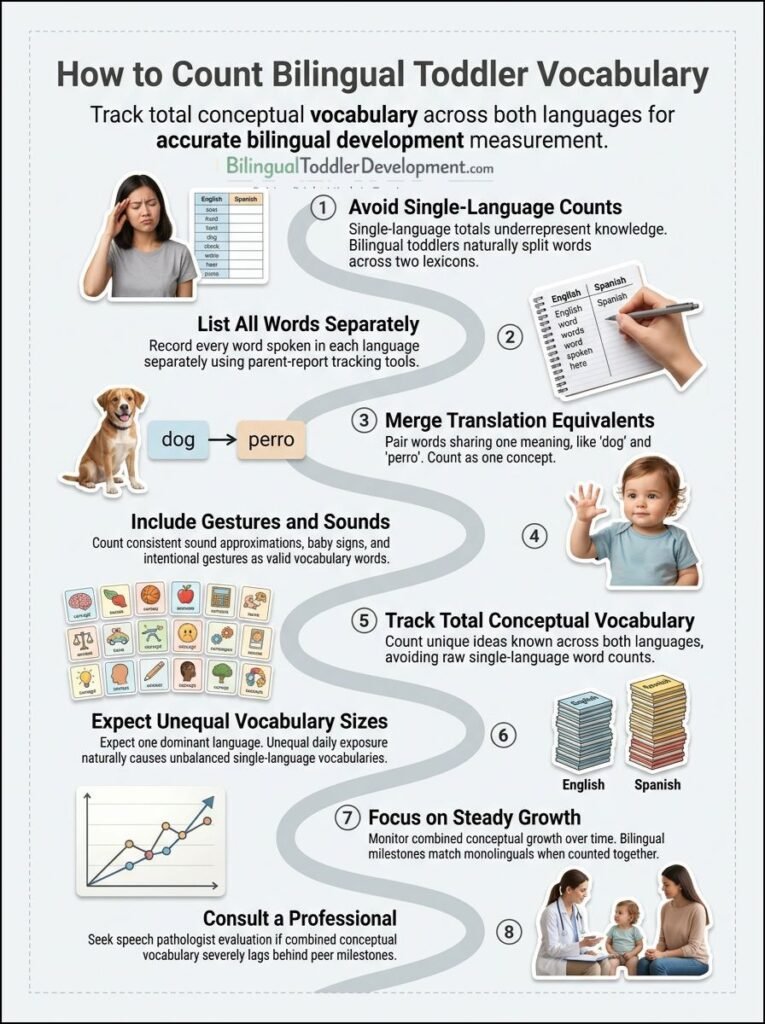
Quick Example: Counting Vocabulary in Two Languages
Here is a simple example of how bilingual toddler vocabulary might be counted.
| Word in English | Word in Spanish | Total Vocabulary Count | Concept Count |
|---|---|---|---|
| dog | perro | 2 words | 1 concept |
| milk | leche | 2 words | 1 concept |
| ball | — | 1 word | 1 concept |
| agua | water | 2 words | 1 concept |
Total vocabulary: 7 words
Total conceptual vocabulary: 4 concepts
Why Bilingual Toddlers Sometimes Seem “Behind” in Vocabulary
Bilingual toddlers often look “behind” if you only count one language. Their vocabulary is split across two lexicons, so a single-language list can look small even when their communication is growing steadily.
In other words, the child is learning two sets of labels. You are measuring only one set.
Annick De Houwer’s bilingual-monolingual comparison (published in 2012) found no solid basis for assuming young bilingual children are delayed just because they hear two languages.
- Track both languages together before you compare your child to any milestone chart.
- Watch the trend month to month, not a single week.
- Include consistent approximations and signs if your child uses them with clear meaning.
- Get help based on patterns across both languages, not a low count in only one language.
If you want to see how vocabulary counts fit into the bigger picture of language growth, read our guide to bilingual toddler language milestones, which explains what typical development looks like across two languages.
Why counting words in one language can be misleading
If you count only Language A, you will undercount what your child knows. That can make a typical bilingual pattern look like a language delay.
Researchers usually report two different numbers: total vocabulary (all word forms across both languages) and total conceptual vocabulary (unique ideas, after you merge translation equivalents).
When you use total vocabulary, many bilingual toddlers look much closer to monolinguals, even if each single-language score looks lower.
If the measurement ignores one of your child’s languages, the result is incomplete by definition.
How bilingual vocabulary is often distributed across languages
Vocabulary distribution follows input. If Grandma speaks Spanish and daycare runs in English, you will often see “home words” cluster in one language and “playground words” cluster in the other.
This is why balanced growth can still produce uneven word lists. A child can be strong in meaning and communication while showing different vocabulary sizes in each language.
- People and routines: bath time words may live in the home language, school routines may live in English.
- Topics: food words might be stronger in the language used at meals.
- Comfort: a shy child may speak more in the language tied to their safest settings.
- Mixing: code-switching changes which words you hear in each language, even when the underlying meaning is there.
Balanced input yields steady growth across both languages.
What Is Total Vocabulary in Bilingual Language Development?
Total vocabulary is the count of all the word forms your child produces across both languages. If your child says “dog” and also says “perro,” total vocabulary counts that as two words.
You can use total vocabulary to answer the practical question parents ask all the time: how many words should bilingual toddlers say, once you account for both languages.
For parent-report tracking, the MacArthur-Bates Communicative Development Inventories list separate forms for 8 to 18 months (Words and Gestures) and 16 to 30 months (Words and Sentences), and many families can complete them in about 20 to 40 minutes (as described by the MB-CDI program materials).
The difference between vocabulary words and vocabulary concepts
Vocabulary words are the spoken or signed forms in each language. Vocabulary concepts are the ideas behind those forms.
This difference matters because bilingual toddlers often know one idea in two forms. If you treat those as two separate “ideas,” you can accidentally inflate or distort what your child knows.
- Word form example: “dog” (English), “perro” (Spanish).
- Concept example: the idea of a dog.
- Why it matters: concept counts help you compare meaning growth across children who have different language mixes.
Researchers often calculate concepts by pairing translation equivalents and counting the idea once. A commonly cited approach in bilingual CDI scoring builds on procedures described in work by Marchman and Martínez-Sussmann.
What researchers mean by “total conceptual vocabulary”
Total conceptual vocabulary counts unique ideas across both languages. If your toddler understands “dog” in English and uses “perro” in Spanish, they still show knowledge of the same concept.
This measure can be especially useful if your child’s vocabulary is distributed by setting, because it focuses on meaning rather than which language you happened to hear that day.
It also helps professionals separate a language difference (a typical bilingual pattern) from a language delay that shows up across the child’s languages.
Translation Equivalents: The Key Idea Parents Need to Understand
Translation equivalents are two words in different languages that refer to the same concept, like “dog” and “perro.”
Here is the key: for total vocabulary, you count both forms. For total conceptual vocabulary, you count the concept once.
A Spanish-English study following children from 22 to 30 months (published in 2013) reported that about 79% of total vocabulary items could be matched as concept pairs across the two languages, which is why translation equivalents matter so much in real-world counting.
- Action step: keep both word lists, then add a third “concept label” column to merge pairs.
- Action step: decide how you will handle near-matches (for example, “juice” vs “apple juice”) before you count.
- Action step: if one language uses a broader word (like a single word for “foot” and “leg”), count the concept carefully and write a short note.
What translation equivalents are in bilingual vocabulary
Translation equivalents are not “duplicates” in the everyday sense. They are evidence that your child can map one meaning to two labels.
That mapping is a normal feature of bilingualism, and it often grows with exposure and opportunity to use both languages.
| What you record | How it counts for total vocabulary | How it counts for total conceptual vocabulary |
|---|---|---|
| “dog” (English) | 1 word | Part of 1 concept |
| “perro” (Spanish) | 1 word | Same concept as “dog” |
| “dog” and “perro” both used | 2 words total | 1 concept total |
Why translation pairs should not be double-counted
If you double-count translation pairs while trying to measure “how many ideas my child knows,” you inflate the concept count. That makes it harder to spot real gaps and harder to communicate clearly with a clinician.
If you do the reverse, and you only count one language, you can undercount your child’s knowledge and create unnecessary worry.
- Use total vocabulary to capture output across both languages.
- Use total conceptual vocabulary to capture meaning growth without double counting.
- Keep both numbers so you can talk about progress in a clear way.
How Researchers Measure Vocabulary in Bilingual Toddlers
Researchers lean on parent-report tools because parents see the most language across the most settings.
Two widely used pieces are (1) vocabulary checklists like the MacArthur-Bates CDI and (2) structured interviews that estimate how much input a child gets in each language.
For exposure estimates, some studies use language exposure ratios. For example, a Spanish:English ratio of 1:1 reflects roughly equal reported exposure, while 2:1 suggests about twice as much Spanish as English.
Parent-report tools used in bilingual language research
Parents typically mark what a child understands and what a child says. That split matters because comprehension often runs ahead of speech production.
MAPLE (a Multilingual Approach to Parent Language Estimates, introduced in 2019) is a structured way to gather exposure details across caregivers and settings, so you can interpret vocabulary counts in context.
- Tip: track who speaks which language, and in what routine (meals, bedtime, errands).
- Tip: estimate exposure across a typical week, not a single busy day.
- Tip: note big changes (new daycare, travel, a new caregiver) because word counts can shift during transitions.
Why speech-language pathologists evaluate both languages
Speech-language pathologists evaluate both languages because that is the only way to see the full pattern of strengths and needs.
A language difference can show up as uneven vocabulary across languages. A true language disorder is more likely to affect communication across the child’s languages, even if it looks a little different in each one.
- What a bilingual evaluation often includes: parent interview, checklists, play-based language sampling, and a review of exposure patterns.
- What to ask: “How are you comparing my child, single-language norms or bilingual measures?”
- What to bring: your word lists in both languages, plus notes on translation equivalents and gestures.
How to Count Your Child’s Total Vocabulary (Step-by-Step)
You can count both languages in a way that matches how bilingual research works, without turning your home into a lab.
The goal is consistency. If you use the same rules every week, the trend becomes meaningful.
- Make two lists. List every word your child says in Language A and Language B. Keep them separate so you can see distribution.
- Mark translation equivalents. Pair words that share the same meaning, and label the shared concept.
- Count total vocabulary. Add all word forms across both lists, including translation equivalents as separate words.
- Count total concepts. Count each concept once, even if your child uses two labels.
- Track the timeline. Note the month a word first appears, and watch for steady gains across months.
- Get support if progress stalls. If you see little change across several months, ask for a bilingual evaluation.
| Language A word | Language B word | Concept label | Date first used |
|---|---|---|---|
| dog | perro | dog | ____ |
| more | más | more | ____ |
| milk | leche | milk | ____ |
Step 1: List words your child uses in both languages
Write down what your child says, not what you think they might know. If you are unsure, wait until you hear it twice on different days.
Use the same rule every time. Consistency matters more than perfection.
- Pro tip: keep a running list on your phone, then copy it into your tracker once a week.
- Pro tip: note the context, like “at breakfast” or “with Dad,” because it often explains language distribution.
Step 2: Identify translation equivalents
Pair words that clearly refer to the same concept. Your child does not need perfect pronunciation for the word to count, as long as the meaning is consistent.
Still record both word forms, because total vocabulary counts both. Then merge them for conceptual vocabulary.
- Easy pairs: clear one-to-one matches (dog/perro).
- Trickier pairs: broad vs narrow meanings (vehicle vs car), or culturally specific words that do not translate cleanly.
- Rule that helps: if you would point to the same thing, it is probably the same concept.
Step 3: Count total concepts instead of total words
Counting concepts gives you the cleanest view of meaning growth. It is especially helpful if one language is used mostly at home and the other is used mostly in childcare.
Concept counting also helps you avoid a common comparison trap: measuring a bilingual child against monolinguals using only one language list.
Total concepts answer the question, “How many ideas can my child express or understand?”
Step 4: Track vocabulary growth over time
Track monthly, or every two weeks if you like detail. Toddlers often grow in bursts, so a short “flat week” is common.
What you want to see is a steady upward trend across a few months, even if the language mix changes.
- Look for: new words, new concepts, and more flexible use (using the same word in more than one situation).
- Also track: new combinations, like two-word phrases, because grammar growth can matter as much as word count.
What Counts as a “Word” for Toddlers?
A toddler “word” is a consistent sound, sign, or approximation used with a consistent meaning.
This definition matters in bilingual homes because children may use different forms with different people, and they may use gestures or signs as part of normal communication.
- Counts: consistent approximations (“bah” for ball), stable signs, and consistent animal sounds used as labels.
- Usually does not count: random babble that is not tied to a specific meaning.
- Counts even if mixed: code-switching, as long as meaning is clear.
Word approximations and early speech sounds
Approximations are part of early speech production. If your child uses the same sound for the same meaning, count it.
Write what you hear, then add your best adult version in parentheses in your notes, so you can spot changes over time.
Gestures, signs, and consistent word attempts
Gestures and signs can show strong communication, even before speech becomes clear. If your child consistently signs “more” or points with clear intent, record it.
If your child uses a sign in one language context and a spoken word in another, treat them as two forms tied to one concept.
What If One Language Has More Words Than the Other?
It is common for one language to lead. That pattern is usually explained by exposure, need, and opportunity, not by a problem with bilingualism.
The key is to watch whether the combined vocabulary development is moving forward, and whether the weaker language still gets enough meaningful input to grow.
| What you notice | Most likely reason | What you can do this week |
|---|---|---|
| School language is much stronger | More hours and more peer talk | Add daily routines in the home language (meals, bath, bedtime stories) |
| Home language stalls after starting daycare | Less opportunity to use it | Create a “need to use it” moment (one-on-one play with a home-language adult) |
| Mixing increases | Vocabulary is distributed by context | Respond to meaning, then model a clear phrase in the language you want to support |
Why language dominance is common in bilingual children
Unequal exposure creates dominance. Even a small daily difference adds up across weeks and months.
If you want a clearer picture, measure exposure in hours across a typical week, then compare that to which language is growing faster.
- Action step: write down who talks to your child, in what language, for two typical weekdays and one weekend day.
- Action step: check if the minority language has daily “conversation time,” not just background audio.
How exposure shapes vocabulary growth
Exposure supports vocabulary acquisition, but quality matters too. Children learn more from back-and-forth talk than from passive listening.
Give the weaker language a job to do. Build routines where the child expects that language for requests, play, and comfort.
- Read one short book in the minority language every day, and repeat favorites for a week.
- Use the minority language for predictable routines (snacks, getting dressed, bedtime).
- Plan one regular social connection in that language, even if it is short.
- Model short phrases your child can copy, like “more milk” or “go outside.”
When Vocabulary Size Might Be a Concern
Concern is reasonable when growth slows across months, across both languages, or when communication looks hard for your child in any language.
In the United States, the CDC milestone checklist (updated October 2025) includes “tries to say three or more words besides ‘mama’ or ‘dada’” by 18 months and “says at least two words together” by age 2, and the American Academy of Pediatrics recommends routine developmental screening at well-child visits with autism-specific screening at 18 and 24 months.
Those are broad checkpoints, not a full language evaluation, so use them as a prompt to look closer, not as the final word.
Signs that vocabulary growth may be delayed
Word counts alone can mislead, so look at the whole communication picture. Red flags tend to show up as patterns, not one low number.
- Slow growth across months: the list barely changes in either language.
- Very limited intent: few attempts to request, label, or get your attention through words, signs, or gestures.
- Understanding concerns: your child often does not seem to understand familiar words or routines in either language.
- Loss of skills: words or social communication skills disappear and do not return.
When to consult a speech-language pathologist
Consult a speech-language pathologist if total vocabulary and total conceptual vocabulary both look far below peers, or if your child’s progress stalls for several months.
If you are in the US, IDEA Part C regulations list parents as a referral source for early intervention, and federal rules include a 45-day timeline from referral to evaluation and an initial plan meeting in many cases.
Bring your two language lists, your translation equivalent pairs, and notes on what your child understands, not only what they say.
The Real Goal: Steady Growth Across Two Languages
The goal is not perfect balance every month. The goal is steady vocabulary development and stronger communication over time.
When you track both total vocabulary and conceptual vocabulary bilingual growth, you get a picture that matches how bilingual language acquisition works in real life.
Support both languages with daily, meaningful interaction. Input quality, opportunities to respond, and routines that invite talk drive word learning.
If you are worried, do not wait for a single number to “prove” a problem. Gather a clear two-language word list, track the trend, and ask for a bilingual-informed evaluation that looks across both languages.