
Maybe your child understands everything Grandma says in Spanish but answers in English.
Or perhaps they seem fluent in one language but struggle to find words in the other.
If that sounds familiar, you’re not alone. Many parents worry that their child isn’t “really bilingual” because one language seems much stronger than the other.
The good news is that bilingual children do not need equal skills in both languages to be considered bilingual. In fact, perfectly balanced bilingualism is far less common than most people think.
In this guide, you’ll learn why bilingual language development is often uneven, what it means when a child understands more than they speak, and when language differences are completely normal versus when they may deserve a closer look.
Quick Answer: Can You Be Bilingual Without Being Fluent?
Yes, you can be bilingual without being equally fluent in both languages.
Many bilingual children understand and use two languages, but they often develop stronger skills in one language than the other. For example, a child may understand a home language well but prefer speaking English, or they may have stronger vocabulary in one language depending on where they use it most.
This uneven language development is completely normal. Most bilingual children do not receive identical exposure to both languages, so differences in speaking, understanding, reading, and writing are common.
In many cases, a child’s understanding develops faster than their ability to speak. A child may follow conversations, understand instructions, and respond appropriately long before they feel comfortable expressing themselves in that language.
What matters most is whether your child is making progress over time and can communicate effectively. Being stronger in one language does not mean a child is not bilingual.
What this means for you: If your child understands one language better than they speak it, or if one language is noticeably stronger than the other, that is usually a normal part of bilingual development and not a sign that bilingualism is causing a problem.
Key Takeaways
- Bilingual children do not need equal fluency in both languages to be considered bilingual.
- Most bilingual children have a stronger language and a weaker language at different stages of development.
- It is common for children to understand a language better than they can speak it.
- Language preference is normal and does not mean a child is rejecting a language or culture.
- Differences in exposure, school environments, and daily language use often lead to uneven language development.
- Communication difficulties that appear across both languages may warrant further evaluation.
- The most important sign of healthy bilingual development is continued progress over time, not perfect balance between languages.
What Does It Mean to Be Bilingual?
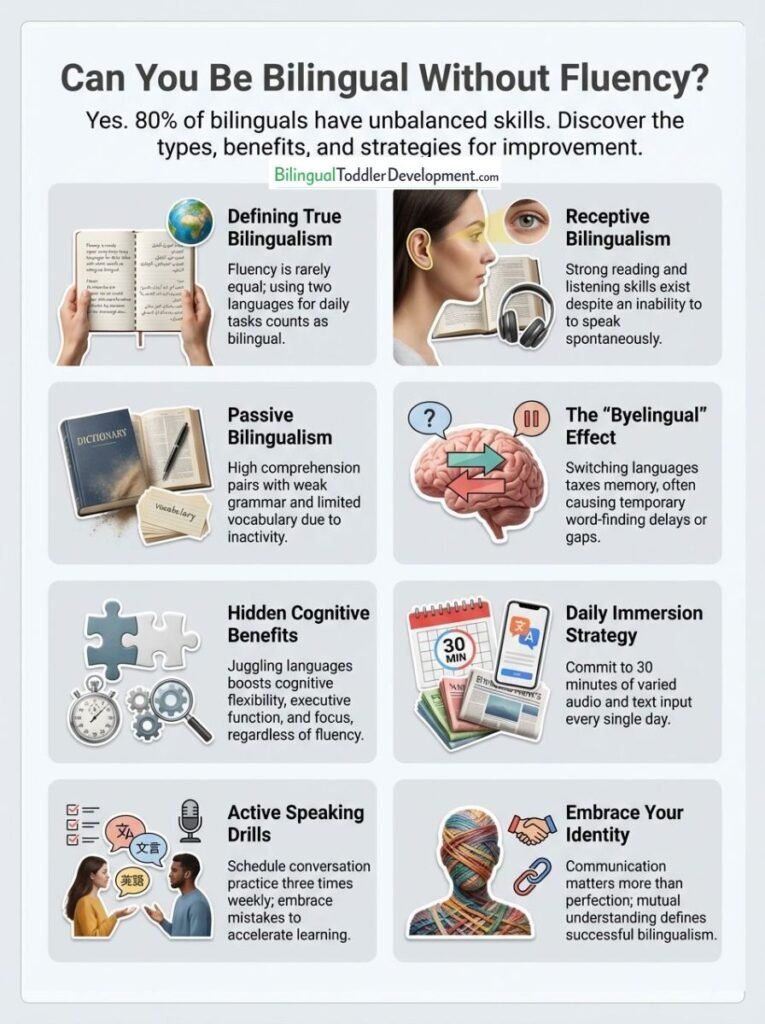
Being bilingual means using two languages in meaningful ways. It does not mean speaking, reading, writing, and understanding both languages equally well.
If you’re wondering exactly how bilingualism is defined and how experts think about bilingual language development, see our guide on What Does It Mean to Be Bilingual?
Many parents picture a bilingual child as someone who can switch effortlessly between two languages in every situation. In reality, bilingual development is often much more uneven.
For example, a child may understand a home language well but prefer speaking English. Another child may be comfortable chatting with family in one language but have a much larger school vocabulary in another. Both children can still be bilingual.
What matters is not whether a child has identical skills in both languages. What matters is whether they are developing the ability to understand and communicate using more than one language.
This is why bilingual children often have different strengths in different languages. Their skills reflect the language experiences they have each day.
Bilingual Does Not Mean Equal Fluency
One of the biggest misconceptions about bilingualism is that children should be equally fluent in both languages.
In reality, most bilingual children have a stronger language and a weaker language. They may hear one language more often, use it with more people, or need it more frequently for school, play, and everyday activities.
A child who speaks English confidently at school but uses only simple phrases in a home language is still bilingual. Likewise, a child who understands a heritage language but speaks it less often can still be developing bilingual skills.
Bilingualism exists on a spectrum. Children develop different levels of proficiency in each language based on how much exposure and practice they receive over time.
Why Most Bilingual People Have a Stronger Language
Languages grow through use. The language a child hears and uses most often usually develops more quickly.
School, friendships, community activities, media, and family routines all influence which language becomes dominant. As these experiences change, a child’s stronger language can change too.
This is why it is common for bilingual children to appear stronger in one language during certain stages of development. It does not mean they are losing the other language or that something is wrong.
Instead, it reflects the natural way bilingual language development responds to a child’s environment and daily experiences.
Does Being Bilingual Require Equal Fluency?
No. Equal fluency is not required for a child to be bilingual.
In fact, perfectly balanced bilingualism is relatively uncommon. Most bilingual children have different strengths in each language depending on where, when, and with whom they use those languages.
A child may be able to discuss school subjects comfortably in English but struggle to explain the same ideas in a home language. Another child may understand family conversations in a heritage language yet feel more confident speaking English with friends. Both situations are normal.
Language skills also develop at different rates. Understanding often grows before speaking, and vocabulary may expand faster in one language than the other. These differences can make a child seem more fluent in one language even when they are actively developing both.
Rather than asking whether a child is equally fluent in both languages, a better question is whether they are continuing to make progress over time.
If a child is building vocabulary, understanding more, communicating more effectively, and using both languages in meaningful ways, they are moving forward as a bilingual learner, even if one language remains stronger than the other.
Can a Child Be Bilingual but Not Fluent?
Yes. A child can be bilingual without being equally fluent in both languages.
Many bilingual children develop stronger skills in one language while still understanding and using another. This is especially common when a child hears one language at home and another at school.
Parents are often surprised when a child seems to understand a language well but rarely speaks it. In most cases, this is a normal part of bilingual development and does not mean the child is confused or falling behind.
Understanding Receptive and Expressive Language Skills
Language development involves both understanding language and using language.
Receptive language refers to what a child understands when they hear or read language. Expressive language refers to what a child can communicate through speaking or writing.
Many bilingual children develop receptive skills before expressive skills. For example, a child may understand everything a grandparent says in the home language but respond in English because speaking is harder than understanding.
For a deeper look at how receptive and expressive language develop and why they often progress at different rates, see our guide on Receptive vs Expressive Language in Bilingual Children.
This pattern is often called receptive bilingualism. Learn more in our guide, What Is Receptive Bilingualism? Why Some Children Understand More Than They Speak.
Why Understanding Often Develops Before Speaking
Understanding language is usually easier than producing it.
Before a child can speak comfortably, they must first learn vocabulary, sentence patterns, pronunciation, and how conversations work. As a result, children often understand much more than they can say.
This is true for monolingual children as well, but it is especially noticeable in bilingual children because their language exposure is divided between two languages.
A child who follows instructions, understands stories, and responds appropriately in a language is building important language skills, even if they are not yet speaking that language fluently.
What matters most is continued progress over time. As children gain more opportunities to hear and use a language, expressive skills often begin to catch up with comprehension.
Signs a Child Is Bilingual but Not Yet Fluent
A child can show strong understanding in a language and still use that language less confidently when speaking.
This is one of the most common patterns in bilingual development. Many children understand far more than they can comfortably express, especially in their less dominant language.
Seeing one or more of the signs below does not automatically mean something is wrong. In many cases, these patterns simply reflect differences in language exposure, opportunities to practice, and everyday language use.
- They follow instructions in the weaker language but answer in the stronger one.
- They use gestures, pauses, or simple words when searching for vocabulary.
- They seem fluent in one setting but less confident in another.
- They switch between languages during conversations to communicate more easily.
Understanding a Language Better Than They Speak It
This is one of the most common bilingual language patterns.
A child may understand stories, conversations, and instructions in a language but struggle to speak it with the same level of confidence. This happens because understanding language is often easier than producing it.
For example, a child may follow everything a grandparent says in a home language but answer in English because it feels easier and more automatic.
Children often build language knowledge long before they can use it comfortably in conversation. As they gain more opportunities to hear and use the language, speaking skills often begin to catch up.
Responding in One Language While Understanding Another
Many bilingual children understand one language and respond in another.
For example, a child may understand Spanish, Mandarin, or another home language perfectly well but choose to answer in English because that is the language they use most often with friends and classmates.
This behavior is usually a sign of language preference, not language confusion.
Children naturally gravitate toward the language that feels easiest and most familiar in a given situation. As long as they continue understanding and using both languages, responding in one language while understanding another is often a normal part of bilingual development.
Having Different Vocabulary Strengths in Each Language
Bilingual children often learn different types of vocabulary in different languages.
A child may know family-related words, household routines, and cultural expressions in a home language, while learning school subjects, classroom instructions, and academic vocabulary in English.
Because of this, a child may appear highly fluent when talking about certain topics but struggle to find words when discussing others.
This uneven vocabulary development is common in bilingual children. Rather than expecting identical vocabulary in both languages, it is more helpful to look at overall communication skills and growth across both languages combined.
Why Some Bilingual Children Are More Fluent in One Language
It is very common for bilingual children to be stronger in one language than the other.
In most cases, this happens because children use their languages in different places, with different people, and for different purposes. A stronger and weaker language is a normal part of bilingual development and does not mean a child is losing a language or falling behind.
Unequal Exposure to Each Language
Children learn language through exposure and use. The more often a child hears and uses a language, the stronger that language typically becomes.
For example, a child who hears English throughout the school day but only hears a home language during meals and family gatherings will naturally receive more practice in English.
Even in families that actively support bilingualism, exposure is rarely divided equally. As a result, it is common for one language to develop faster than the other.
The Impact of School and Social Environments
School and friendships play a major role in language development.
Many bilingual children spend a large portion of their day learning, playing, and communicating in the majority language used at school. Over time, this language often becomes the one they use most comfortably with peers.
This does not mean the home language is disappearing. It simply reflects the fact that children tend to become more fluent in the language they use most often in their daily lives.
As children grow and their environments change, language dominance can change as well.
Limited Opportunities to Use the Weaker Language
Understanding a language and speaking a language are not the same skill.
Some children hear a language regularly but have few opportunities to actively use it. They may understand conversations, stories, and instructions in that language while still feeling less confident speaking it themselves.
For example, a child may hear a heritage language from parents and grandparents but respond mostly in English because that is the language they use most often with friends and classmates.
When children have fewer opportunities to speak a language, expressive skills often develop more slowly than comprehension. This is one reason why a child may understand a language well but not yet speak it fluently.
The good news is that language skills can continue to grow as children receive more opportunities to hear, use, and interact in both languages.
If you’re looking for practical ways to support a child’s weaker language, see our guide on How to Help a Child Become More Fluent in Their Weaker Language.
Is It Normal for a Bilingual Toddler to Prefer One Language?
Yes. It is completely normal for bilingual children to prefer one language over another at different stages of development.
Many parents worry when a child understands both languages but consistently chooses to speak only one. While this can be frustrating, language preference is usually a reflection of comfort, habit, and opportunity rather than a sign that something is wrong.
In most cases, a preferred language simply becomes the easiest language to use in everyday situations.
Why Children Develop a Dominant Language
Children naturally become more comfortable in the language they use most often.
For many bilingual children, that language is influenced by school, friendships, community activities, and daily routines. If a child spends most of the day interacting in English, English may become their preferred language even if they regularly hear another language at home.
This does not mean the home language is unimportant or that bilingual development has stopped. It simply reflects the language that currently receives the most practice.
Language dominance is common in bilingual children and does not make them any less bilingual.
Learn more about why one language often becomes stronger and how language dominance changes over time in our guide on Language Dominance in Bilingual Toddlers.
Preference Does Not Mean Rejection
Some parents worry that a child who prefers one language is rejecting the family’s home language or culture.
In most cases, this is not what is happening.
Children often choose the language that feels fastest and easiest in a particular setting. A child may understand a home language perfectly well while choosing to respond in English because that is the language they use most often with friends, teachers, or siblings.
Choosing one language more frequently does not mean a child has lost interest in the other language. The ability to understand and use that language often remains intact, even when it is used less often.
How Language Dominance Can Change Over Time
Language dominance is not permanent.
A child’s stronger language can change as their environment changes. Starting school, spending more time with relatives, joining community activities, or moving to a new area can all influence which language feels most natural.
Many bilingual children experience shifts in language dominance throughout childhood. A language that seems weaker today may become much stronger later as opportunities for use increase.
Many parents wonder whether these changes eventually lead to fluency in both languages. Learn more in Will My Child Eventually Become Fluent in Both Languages?
For this reason, it is often more helpful to focus on overall progress in both languages rather than worrying about which language is currently strongest.
When Should Parents Be Concerned?
Most bilingual children who have a stronger and weaker language do not have a language disorder.
In many cases, uneven language skills simply reflect differences in exposure, opportunities to practice, and everyday language use. The most important question is not whether a child is equally strong in both languages. It is whether they are continuing to make progress in their overall ability to understand and communicate.
A child who struggles only in a less-used language may simply need more exposure and practice. A child who struggles to understand or communicate in both languages deserves a closer look.
Normal Uneven Language Development
Uneven language development is a normal part of bilingualism.
Many bilingual children understand one language better than they speak it, prefer one language over another, or develop different vocabulary strengths in each language. These differences often become more noticeable during school transitions or changes in family routines.
In most cases, bilingual children continue making progress over time, even when one language develops faster than the other.
Signs of normal bilingual development may include:
- A stronger and weaker language
- Understanding a language better than speaking it
- Responding in one language while understanding another
- Different vocabulary strengths across languages
- Temporary shifts in language preference
These patterns alone do not suggest a language disorder.
Signs of a Possible Language Delay
Concerns become more significant when communication difficulties appear across both languages, not just in the less-used language.
A bilingual child should not be expected to perform equally in both languages. However, they should continue making progress in their overall communication skills.
Consider speaking with a professional if your child:
- Has difficulty understanding language in both languages
- Struggles to communicate wants, needs, or ideas in both languages
- Shows little progress in vocabulary or sentence development over an extended period
- Has difficulty interacting with family members, caregivers, or peers because of communication challenges
- Appears significantly behind expected language milestones across both languages
You can also compare your child’s progress with typical expectations in our guide to Bilingual Toddler Language Milestones.
The key is to look for patterns that affect communication overall, rather than focusing on one language in isolation.
If you’re unsure whether your child’s language patterns reflect normal bilingual development or a possible delay, see our guide on Language Delay vs Bilingual Development.
When to Seek a Bilingual Speech Evaluation
If you are concerned about your child’s communication skills in both languages, a bilingual speech evaluation can help determine whether their development is following a typical bilingual pattern or whether additional support may be beneficial.
An evaluation is especially helpful when concerns extend beyond one language and affect your child’s ability to understand, express themselves, or participate in everyday interactions.
The goal of an evaluation is not to determine whether a child is equally fluent in both languages. Instead, it is to understand how the child communicates across all the languages they use.
If you are unsure whether your concerns are related to bilingual development or a possible language delay, seeking a professional evaluation can provide clarity and peace of mind.
Final Thoughts: Bilingual Does Not Mean Perfectly Balanced
If your child is stronger in one language than the other, they are not alone.
Most bilingual children develop uneven language skills at some point. They may understand one language better than they speak it, prefer one language in certain situations, or have different vocabulary strengths across their languages. These patterns are a normal part of bilingual development.
Being bilingual does not require equal fluency in both languages. What matters most is that your child continues to grow in their ability to understand, communicate, and connect with others using the languages in their life.
Rather than focusing on perfect balance, focus on progress. A child who is building skills, gaining confidence, and communicating more effectively over time is moving in the right direction.
And remember, a stronger and weaker language today does not mean things will stay that way forever. Language skills change as children grow, learn, and experience new environments.
The goal is not perfect bilingualism. The goal is meaningful communication and a lifelong connection to the languages that matter most to your family.
Frequently Asked Questions
Can you be bilingual if you are only fluent in one language?
Yes. Many bilingual people are much stronger in one language than the other. A child can understand and use two languages while still being more fluent in one of them. Bilingualism does not require equal fluency.
Does being bilingual mean speaking two languages equally well?
No. Most bilingual children have a stronger language and a weaker language. The language they hear and use most often usually develops faster, especially during the preschool and school years.
Does understanding a language count as being bilingual?
Yes. Some bilingual children understand a language much better than they speak it. This is a common bilingual language pattern and does not mean the child is not bilingual.
Why does my child understand our home language but answer in English?
This often happens when English is the language a child uses most often at school, with friends, or in the community. Many bilingual children continue to understand their home language well while preferring to respond in the language that feels easiest and most familiar.
Is it normal for a bilingual child to be stronger in one language?
Yes. Uneven language development is common among bilingual children. Differences in exposure, opportunities to practice, and daily language use often lead to one language becoming stronger than the other.
Should I worry if my child mixes two languages?
Usually not. Mixing languages is a normal part of bilingual development. Children often use words from both languages to communicate effectively, especially when they are still building vocabulary. Language mixing by itself is not a sign of confusion or a language disorder.
Can a child lose fluency in a language they do not use?
Yes. Language skills can become weaker when they are not used regularly. Speaking and vocabulary are often affected first, while understanding may remain stronger for longer. Continued exposure and opportunities to use the language can help maintain and strengthen those skills.
When should I seek a speech evaluation for my bilingual child?
Consider seeking an evaluation if your child has difficulty understanding or communicating in both languages, shows limited progress over time, or struggles to interact effectively with family members, caregivers, or peers. Concerns that appear across both languages are generally more significant than difficulties in only one language.