
You hear your toddler say something like, “I want leche” or “¿Dónde is my toy?” and suddenly your brain starts racing.
Are they getting confused? Are they mixing up both languages? Did hearing two languages somehow make things harder?
Many parents worry the first time they hear their child blend languages together. It can sound unusual, especially if family members, teachers, or friends suggest that children should keep languages completely separate.
Here’s the reassuring news: bilingual toddlers mixing languages is incredibly common, and in most cases, it is not a sign of confusion at all. In fact, language mixing often tells us something surprisingly positive about how children learn and use language.
In this guide, you’ll learn why bilingual toddlers mix languages, what researchers say about it, when it’s considered completely normal, and the few situations where it may make sense to look more closely.
Quick Answer: Yes, Language Mixing Is Usually a Normal Part of Bilingual Development
Yes. It is normal for bilingual toddlers to mix languages. Children learning two languages often combine words from both because they are using the words that come most easily in the moment. This behavior, often called code-switching or code-mixing, is a common part of bilingual development and usually does not mean a child is confused.
You might hear your toddler say things like:
• “I want leche.”
• “Where’s el perro?”
• One language with grandparents and another at daycare
These moments can sound surprising at first, but they are often signs that both languages are active and growing.
Research also supports this. Studies of bilingual families have found that children regularly hear and use mixed language naturally, and researchers have found no evidence that this slows vocabulary development.
Why parents often worry when languages get mixed
Hearing your toddler switch between languages can feel surprising at first. Many parents immediately wonder if their child is getting confused or falling behind.
You may hear concerns like:
- “Shouldn’t they keep the languages separate?”
- “Are they mixing because they don’t know either language well?”
- “Will hearing two languages delay speech?”
These worries are extremely common. Language mixing often sounds unusual simply because many adults assume bilingual children should use one language at a time. In reality, bilingual development rarely works that way.
Why language mixing is common and expected
Children learning two languages are building two vocabularies at the same time. Those vocabularies do not always grow evenly.
A toddler may know food words in one language, playground words in another, and family phrases in both. When they need a word quickly, they often use whichever one comes first.
Research suggests that language exposure and everyday experiences strongly influence these patterns.
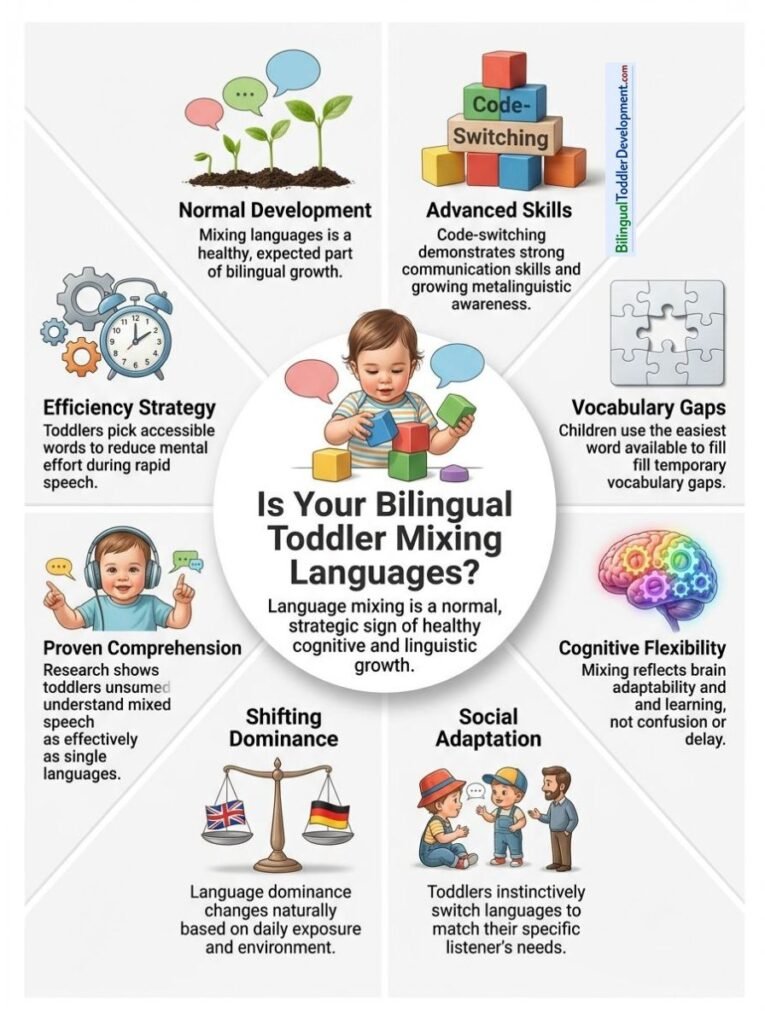
What Does “Mixing Languages” Actually Mean?
Language mixing can look different from family to family. Some toddlers combine words from both languages in the same sentence. Others switch languages depending on who they are speaking with. Some simply use the first word that comes to mind.
You might hear things like:
• “I want leche.”
• “Where’s el perro?”
• English with daycare teachers and another language with grandparents
If these examples sound familiar, you are not alone. Mixing languages is a very common part of bilingual development and usually reflects how children naturally learn and use language.
You may sometimes hear experts use terms like:
- Code mixing: using words from both languages within the same sentence or phrase
- Code switching: changing languages based on the conversation, listener, or situation
You do not need to memorize these labels. What matters most is understanding that language mixing can happen in several different ways, and most of the time it is a normal part of learning more than one language.
Using words from both languages in one sentence
This is one of the most common types of language mixing parents notice. You may hear something like, “I want leche” or “¿Dónde is my toy?” Your toddler is not trying to mix things up. They are trying to communicate in the fastest and easiest way possible.
The American Academy of Pediatrics offers a helpful way to think about vocabulary growth in bilingual children: total vocabulary matters more than how many words exist in each language separately. A child may know some words in English and others in Spanish while still developing language skills normally.
If you want to respond in a way that supports language development, try a simple “connect and model” approach:
- Step 1: Confirm meaning: “Yes, you want milk.”
- Step 2: Model one short sentence in the language you are targeting: “Milk, please.”
- Step 3: Give the item and repeat it naturally later: “Here’s your milk.”
This keeps communication positive and successful while still giving your child clear language input.
Switching languages depending on the listener
Many bilingual toddlers quickly learn that different people use different languages. They may speak English at daycare and use a heritage language with grandparents. Some children understand one language well but answer in another because it feels easier to speak.
Children are often paying close attention to who understands what. This kind of language choice can reflect social awareness, not confusion.
If you want to strengthen a particular language at home, it can help to create a family language plan that feels realistic and sustainable.
Family language plan
Best for
Common challenge
One person, one language
Families with two consistent language models
Can become difficult to maintain over time
Heritage language at home
Families wanting stronger home language exposure
English may become dominant outside the home
Time and place
Families who prefer structure
Too many rules can make communication feel stressful
Many experts emphasize that consistency matters more than choosing the “perfect” approach.
Kids often match the language to the person, not the place.
Filling in missing words from another language
Bilingual toddlers often have uneven vocabularies. They may know food words in one language and playground words in another.
When a child cannot quickly find a word, they usually choose the one they already know. This is sometimes called a vocabulary gap, but it does not mean something is wrong. It simply reflects where language exposure has happened most often.
To support new words naturally:
- Pick a small group of words your child uses often
- Use them during everyday routines
- Repeat them across different situations
- Keep practice playful and low pressure
Over time, repeated exposure helps children build vocabulary in both languages naturally.
Why Bilingual Toddlers Mix Languages
Bilingual toddlers mix languages for the same reason adults often do. They use the words that feel easiest, most familiar, or most useful in the moment. Mixing languages is usually not random, and it rarely means a child is confused.
If you pay attention over time, you may begin noticing patterns. Children often switch languages because of four simple factors:
- Access: one word comes faster in one language
- Exposure: the language heard more often becomes easier to use
- Listener: children often choose what they think others understand
- Topic: some experiences become connected to one language more than another
For example, your child may use English words for school topics but use heritage language words for food, family routines, or traditions. They may speak one way with grandparents and another with daycare teachers.
These patterns reflect how bilingual children organize and use language in everyday life.
They know one word better in one language
Some words become stronger in one language before the other. That usually reflects repetition and experience, not a problem with learning.
For example, a toddler who hears “juice,” “shoes,” and “backpack” every day at daycare may naturally use those words more quickly in English. At home, they may know family phrases, foods, and routines more easily in another language.
This is why many experts suggest paying attention to total vocabulary across both languages rather than counting words in just one language.
If you want to track growth at home:
- Keep one running list for English
- Keep one running list for the heritage language
- Circle concepts your child knows in both languages
- Watch for growth over time rather than perfect balance
Vocabulary develops unevenly across languages
Bilingual vocabulary growth is rarely perfectly balanced. Children often learn words where they use them most.
A toddler may know playground words in one language and bedtime words in another. They may know emotions in one language and food words in another.
This uneven growth is very common, especially during periods of rapid language development.
If you want to strengthen the weaker language, variety often matters more than simply hearing more words. Exposure to everyday actions, feelings, places, and routines creates more opportunities for learning.
They use the easiest word available
Toddlers often choose the word that takes the least effort to retrieve. This becomes especially noticeable during exciting moments, fast play, frustration, or strong emotions.
If your child suddenly says one language word inside a sentence from another language, they are often trying to communicate quickly, not trying to sort out which language belongs where.
To make learning easier:
- Use one idea per sentence
- Keep new phrases short
- Repeat important words naturally throughout the day
Simple repetition often works better than frequent correction.
They are adapting to who they are speaking with
Language is social. Children quickly learn that different people use different languages.
If English dominates your child’s daily environment, they may naturally answer you in English even if you speak another language at home.
This does not mean they are rejecting the heritage language. It often means one language currently feels easier or more automatic.
To support the weaker language naturally:
- Create routines your child enjoys in that language
- Use predictable phrases during daily activities
- Give your child opportunities to interact with people who use that language regularly
Small, meaningful experiences often help more than constant reminders or corrections.
Does Mixing Languages Mean My Child Is Confused?
No. Mixing languages does not usually mean your child is confused. In most cases, it reflects how bilingual children naturally learn, organize, and use language.
When toddlers are learning two languages at the same time, both language systems remain active. Instead of turning one language “off” and another “on,” children often pull words from whichever language feels easiest in the moment.
That may sound unusual to adults, but researchers and speech experts consistently describe language mixing as a normal part of bilingual development.
The more useful question is not:
“Do they mix languages?”
The better question is:
“Are they continuing to make progress in communication over time?”
Children who are learning normally continue building vocabulary, understanding more language, using gestures, combining words, and interacting socially, even if they sometimes mix languages.
Research says no
Parents often worry that mixing languages means a child cannot separate the two languages. Research does not support that concern.
Studies looking at bilingual children and caregiver language patterns have found no evidence that hearing or using mixed language slows vocabulary development.
Speech and language experts also emphasize an important point: bilingualism itself does not cause speech or language disorders. If a child has a genuine speech or language difficulty, signs usually appear across all languages the child uses.
Mixing languages can actually show flexibility and learning
Surprisingly, language mixing can sometimes reflect a strength rather than a problem.
When children switch between languages, they may be showing that they understand who they are speaking with, which words work best in different situations, and how communication changes across settings.
For example, your child may:
- Use one language with grandparents and another at daycare
- Choose certain words based on routines or topics
- Adjust language depending on who understands them best
These behaviors can reflect growing social awareness and flexible communication skills.
Instead of focusing on whether languages stay perfectly separate, focus on the bigger picture:
Is your child communicating, connecting, and continuing to learn?
That question often tells parents much more than language mixing itself.
Examples of Normal Language Mixing in Toddlers
By this point you may be wondering:
“Okay, but what does normal language mixing actually sound like?”
Here are some examples many bilingual families hear every day:
| What your toddler says | What it may mean | Helpful response |
|---|---|---|
| “Quiero more crackers.” | They used the fastest word available | “You want more crackers.” |
| “Where’s el perro?” | One word comes more easily in one language | “There’s the dog.” |
| Answers Grandma differently than daycare teachers | They connect different languages with different people | Respond naturally and model language |
You may also notice patterns like:
- School words appearing mostly in English
- Family routines using more heritage language words
- More language mixing during excitement or fast play
- Temporary changes after preschool, travel, or routine shifts
These patterns usually reflect language exposure and everyday experiences, not confusion.
The goal is not perfect separation between languages. The goal is communication, connection, and continued growth.
When parents begin looking at the bigger picture instead of listening for perfectly separated languages, language mixing often becomes much less worrying.
How Language Dominance Can Affect Mixing
Language dominance simply means one language feels easier or faster for your child to use at a particular moment in time. It is not permanent, and it can change as your child’s environment changes.
When one language becomes temporarily stronger, children often mix languages more frequently because the stronger language is easier to access quickly.
This is very common in bilingual development.
One language often becomes temporarily stronger
In many bilingual families, English becomes temporarily stronger once daycare, preschool, or regular social activities begin. Children naturally use the language they hear and practice most often.
That does not mean the heritage language is disappearing. It often means your child is spending more time using one language during daily routines.
You may notice things like:
- More English words after starting preschool
- More heritage language words after visiting relatives
- Sudden changes after travel or schedule changes
- Certain topics becoming linked to one language
These shifts are normal and often reflect changes in exposure rather than a problem with language learning.
If you want to support the weaker language, small daily routines usually help more than constant correction.
You can try:
- Reading bedtime stories in the weaker language
- Using the language during meals, cooking, or bath time
- Creating simple weekly traditions connected to that language
- Giving your child opportunities to hear and use the language naturally with other people
Consistency matters more than perfection.
Dominance can shift over time
Language dominance is not fixed. A language that feels weaker today may become much stronger a few months later after more exposure and practice.
Many bilingual children move back and forth between stronger and weaker languages throughout early childhood.
Instead of expecting equal skills in both languages at all times, it is often more helpful to watch for overall communication growth.
Ask yourself questions like:
- Is my child learning new words over time?
- Are they communicating more easily?
- Are they understanding more in both languages?
- Are they continuing to engage socially and respond to others?
Those patterns usually tell parents much more than temporary language mixing or temporary dominance shifts.
If progress seems limited in both languages over time, that may be a good point to speak with a pediatrician or speech-language pathologist for additional guidance.
Conclusion: What to Take Away About Language Mixing
Hearing your bilingual toddler mix languages can feel surprising at first, especially if you expected both languages to stay completely separate.
In reality, language mixing is a very normal part of bilingual development. Most children learning two languages combine words, switch between languages, and show temporary dominance patterns as they grow.
In most cases, mixing languages is not a sign of confusion. It is a sign that your child is actively learning how to communicate using all the language tools available to them.
Instead of focusing on perfectly separated languages, focus on the bigger picture:
Is your child communicating, connecting, learning new words, and continuing to grow over time?
That is what matters most.
And if you ever feel uncertain, you do not have to figure it out alone. A pediatrician or speech-language pathologist can help you better understand what is typical and whether additional support may be useful.
FAQs
Is it normal for bilingual toddlers to mix languages?
Yes. Most bilingual toddlers mix languages at some point while learning to communicate. Children often use the words that come most easily in the moment, especially during fast play, excitement, or emotional situations.
Does mixing languages mean my child is confused?
Usually no. Mixing languages is considered a normal part of bilingual development and does not typically mean a child is confused. Most bilingual children naturally learn how to adjust language use over time.
At what age do bilingual children stop mixing languages?
There is no exact age. Many children continue mixing languages occasionally even after they become fluent in both languages. Mixing often decreases as vocabulary, exposure, and social awareness grow.
Should I correct my child when they mix languages?
Constant correction is usually not necessary. A calmer and more effective approach is to respond naturally and model the phrase you want your child to hear.
When should I worry about language mixing?
Language mixing alone is usually not a concern. It may help to speak with a pediatrician or speech-language pathologist if your child struggles to communicate in both languages, stops using skills they previously had, or shows limited progress over time.