
You hear other toddlers talking in short sentences… and your child is still using a handful of words.
At first, you tell yourself not to worry.
Then someone says it.
“Maybe it’s because they’re learning two languages.”
Now you are stuck between two very different possibilities.
Is this completely normal for a bilingual child?
Or is this a language delay that needs attention?
This is one of the most confusing situations parents face, because bilingual development can look like a delay on the surface, even when everything is progressing exactly as it should.
At the same time, real language delays can be missed when everything is explained away as “just bilingual.”
That uncertainty is what makes this so stressful.
The truth is, the difference is not about how your child sounds in one language.
It is about how they are developing across both languages.
Once you know what to look for, the picture becomes much clearer.
This guide will show you how to tell the difference step by step, using simple signs you can observe at home and the same principles speech professionals use during a bilingual evaluation.
Here is the simplest way to understand the difference.
Quick Answer: Language Delay vs Bilingual Development
The difference comes down to this:
Bilingual development shows progress across both languages.
A language delay shows up in both languages.
If your child seems behind in one language but is understanding and learning well in the other, that is usually a normal bilingual pattern.
If your child is struggling to learn words, understand language, or communicate in both languages over time, that is more concerning for a language delay.
Here is a simple way to tell the difference:
More consistent with bilingual development
- Vocabulary may look small in one language, but total words across both languages are growing
- Mistakes show up more in the newer or less-used language
- Understanding is strong in at least one language
More concerning for language delay
- Total vocabulary is small across both languages and does not grow over time
- Similar grammar difficulties appear in both languages
- Difficulty understanding everyday directions in either language
Speech professionals look at total language across both languages, not English alone.
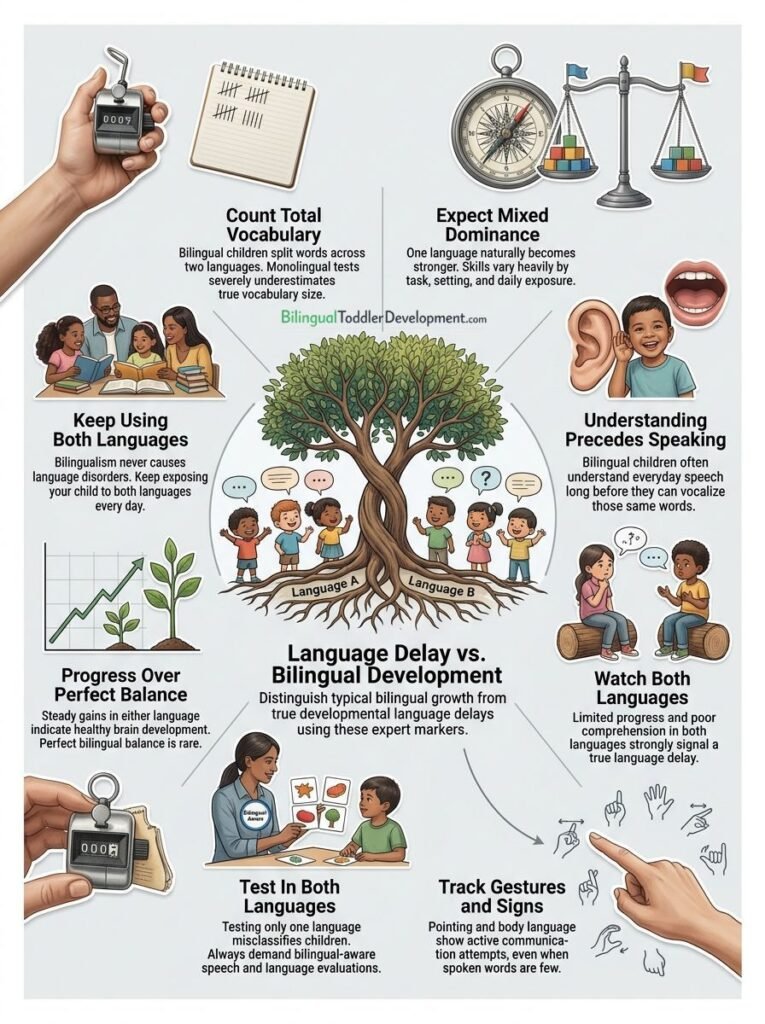
Why Bilingual Toddlers Can Seem Behind at First
If your bilingual toddler seems “behind,” there is a good chance you are seeing something completely normal.
In most cases, it comes down to three predictable patterns that show up in bilingual development.
Once you understand these patterns, it becomes much easier to tell the difference between a normal bilingual profile and a true language delay.
Vocabulary Is Split Across Two Languages
When a child is learning two languages, their vocabulary is divided between them.
That means a word count in just one language can make it look like your child knows fewer words than they actually do.
For example, a child might say “dog” in English and “leche” in Spanish. If you only count one language, you miss part of the picture.
A better way to look at progress is to count total vocabulary across both languages.
Some professionals also use total conceptual vocabulary, which counts a concept once even if the child knows it in both languages (like “dog” and “perro”).
The key idea is simple:
A smaller vocabulary in one language does not mean your child knows fewer words overall.
One Language Is Often Stronger Than the Other
Most bilingual children are not evenly balanced between their two languages.
One language usually becomes stronger based on where the child spends more time and where they need language to communicate.
For example:
- A child may hear one language mostly at home
- And another language at daycare or preschool
Because of this, it is normal for one language to develop faster at certain stages.
This can create the impression that a child is “behind,” when in reality they are progressing normally in the language they use most.
Language dominance can also shift over time as routines, caregivers, and environments change.
Understanding Develops Before Speaking
In early language development, children typically understand more than they can say.
This is called receptive language (understanding) developing before expressive language (speaking).
In bilingual children, this gap can be even more noticeable because they are processing two languages at once.
So while your child may not be saying many words yet, they may:
- Follow directions
- Respond to familiar questions
- Understand routines and daily language
These are all important signs that language development is moving in the right direction.
Because of this, it is important to track what your child understands, not just what they say.
These patterns can make a child look behind at first, even when development is completely on track.
What Normal Bilingual Development Looks Like
Normal bilingual development does not mean equal skills in both languages.
Instead, it shows up as steady progress, strong understanding, and active communication, even if vocabulary is split across two languages.
Here are the key signs to look for:
Progress in At Least One Language
One of the clearest signs of healthy development is progress in at least one language.
Your child does not need to grow evenly in both languages. What matters is that they are:
- Learning new words
- Starting to combine words
- Finding new ways to communicate
Growth in either language shows that the underlying language system is developing.
Strong Understanding of Everyday Speech
Understanding is often a stronger and earlier skill than speaking.
Even if your child is not saying many words yet, they may still:
- Follow simple directions
- Respond to familiar questions
- Understand routines and everyday language
Strong comprehension is a reassuring sign that language development is on track.
Use of Gestures and Communication Attempts
Communication is not just about words.
Healthy language development includes a wide range of communication attempts, especially in toddlers.
Look for:
- Pointing, showing, and giving
- Sound effects like “vroom” or “uh-oh”
- Consistent attempts to get your attention
These behaviors show that your child is actively trying to communicate, which is a key step toward spoken language.
Differences Across Environments
It is normal for bilingual children to sound different depending on where they are.
A child may:
- Speak more in one language at home
- Use a different language at daycare or school
- Be more talkative in familiar settings and quieter in new ones
These differences reflect how language is used in real life, not a problem with development.
What matters most is not balance, but steady progress and meaningful communication.
Signs That May Indicate a Language Delay
Some differences in language are normal in bilingual children.
What matters is where you see consistent difficulty over time.
A language delay is more likely when challenges show up across both languages, not just in one.
Here are the key signs to watch for:
Limited Progress in Both Languages
A bilingual child can be weaker in one language and still be developing normally.
What is more concerning is limited progress in both languages over time.
Look for patterns like:
- New words are slow to appear or do not stick in either language
- The child is not starting to combine words as expected
- Communication does not improve, even with increased exposure
When growth is limited across both languages, it may point to an underlying language delay.
Difficulty Understanding Simple Directions
Understanding language is one of the most important signals to watch.
If your child struggles to follow simple directions in the language they hear most, it may be a sign of a deeper issue.
For example:
- Difficulty following one-step directions
- Not responding to familiar questions
- Trouble understanding everyday routines
If understanding is weak in both languages, this is a stronger concern than mixing languages or having a smaller vocabulary in one language.
Minimal Use of Words or Gestures
Communication includes both words and nonverbal attempts.
If your child is not using many words, and also shows limited gestures or attempts to communicate, this can be a red flag.
Look for:
- Little pointing, showing, or bringing objects to you
- Few attempts to get attention or express needs
- Limited use of sounds, approximations, or simple words
A lack of communication attempts often matters more than pronunciation errors.
Little Improvement Over Time
Progress is one of the clearest indicators of healthy development.
It is normal for growth to come in bursts. However, if weeks turn into months without meaningful change, it is worth taking a closer look.
You may want to seek an evaluation if:
- Vocabulary does not grow over time
- Communication stays at the same level
- Skills seem stalled or are not building
If you notice several of these signs together, it is a good idea to talk with your pediatrician or a speech language professional.
Why Looking at One Language Alone Can Be Misleading
Focusing on just one language is one of the most common mistakes parents and professionals make.
But this is where many parents and even professionals get it wrong.
A bilingual child’s abilities are spread across both languages. Looking at only one can make a child seem behind when they are actually developing normally.
What matters is:
- Total vocabulary across both languages
- Understanding in at least one language
- Progress over time
When you look at the full picture, the difference between a delay and normal bilingual development becomes much clearer.
When to Seek a Speech Evaluation
If you are asking yourself whether you should get help, that is often a sign it is worth checking.
If you are unsure whether your child’s development is typical, you do not need to wait and wonder.
A speech and language evaluation can give you a clear answer and help you decide what to do next.
You may want to seek an evaluation if you notice:
- Limited progress in both languages over time
- Difficulty understanding simple directions in either language
- Few words, gestures, or attempts to communicate
- Skills that seem stalled or are not improving
If several of these signs are present together, it is a good idea to take the next step.
Why Acting Early Matters
Early support is not about labeling your child. It is about giving them the best chance to build strong communication skills.
Many children who receive early support make significant progress, especially when challenges are identified sooner rather than later.
Even if everything turns out to be typical, an evaluation can give you peace of mind and clear guidance.
What to Expect From an Evaluation
A good evaluation looks at your child’s communication across both languages, not just one.
It may include:
- A discussion of your child’s language exposure and daily routines
- Play-based observation and interaction
- A language sample to see how your child communicates naturally
- Simple activities to see how your child understands and learns
In some cases, testing may be done in both languages or with the help of an interpreter.
The goal is not to “pass or fail,” but to understand how your child is developing and what support, if any, would help.
How to Take the Next Step
If you are concerned, start by talking with your pediatrician.
You can also ask about:
- Early intervention services in your area
- A speech language pathologist with experience in bilingual development
- A hearing check, if there are any concerns about listening or responsiveness
You do not need to have all the answers before reaching out.
Taking the first step is often the hardest part, and it is also the most important.
What You Can Do Right Now to Support Your Child
If you are monitoring your child’s development, there are simple things you can do every day to support their language growth.
You do not need special tools or training. What matters most is consistent, meaningful interaction.
Focus on three key areas:
1. Create Regular Opportunities for Both Languages
Children learn language through real interaction, not passive exposure.
Give your child regular chances to hear and use both languages during everyday activities.
For example:
- Read the same favorite book in each language
- Talk through routines like meals, bath time, and getting dressed
- Spend time with family or peers who use the less-heard language
Consistency matters more than perfection.
2. Focus on Communication, Not Perfection
Your goal is not perfect grammar. It is meaningful communication.
Encourage your child to express needs, ideas, and feelings in any way they can.
You can support this by:
- Praising attempts, even if words are incomplete
- Expanding what they say (“dog” → “big dog running”)
- Offering simple choices (“juice or milk?”)
Communication builds before accuracy.
3. Use Daily Routines to Build Language Naturally
Routines are one of the easiest ways to build language because they repeat every day.
Use these moments to model simple, consistent language.
For example:
- At meals: name foods and repeat short phrases
- During play: describe actions like “go,” “stop,” and “open”
- At bedtime: repeat the same book or phrases
Repetition helps language stick.
Key Takeaways
- Bilingual children may seem behind in one language, but that can be completely normal.
- What matters is total development across both languages, not English alone.
- Normal bilingual development shows progress, strong understanding, and active communication.
- A language delay is more likely when difficulties appear in both languages over time.
- If you are unsure, a bilingual-aware speech evaluation can give you clear answers.
Frequently Asked Questions About Language Delay and Bilingual Development
Do bilingual toddlers talk later than monolingual children?
Bilingual toddlers may seem quieter in one language because their vocabulary is split across two languages. However, when total vocabulary is considered, most develop language at a typical pace.
Can learning two languages cause a language delay?
No, learning two languages does not cause a language delay. If a child has a language disorder, it will usually affect both languages, not just one.
How can I tell if my child has a language delay?
Look for progress across both languages. A language delay is more likely if your child has limited vocabulary, weak understanding, or little communication in both languages over time.
Should I stop using one language if my child is behind?
No, it is usually best to continue using both languages, especially the one you speak most naturally. Reducing a language can limit your child’s overall exposure and slow development.
When should I seek professional help?
You should consider an evaluation if your child shows limited progress in both languages, struggles to understand simple directions, or uses few words or gestures over time.
If you still feel unsure, trust your instincts. Getting a clear answer early can make a meaningful difference.