
Code Switching in Bilingual Toddlers: Why Kids Mix Languages and What It Really Means
Your toddler starts a sentence in one language and finishes it in another.
“Quiero juice.”
“Open le book.”
If you’re raising a bilingual child, moments like this happen all the time. And they often leave parents wondering the same thing:
Is my child mixing languages because they’re confused?
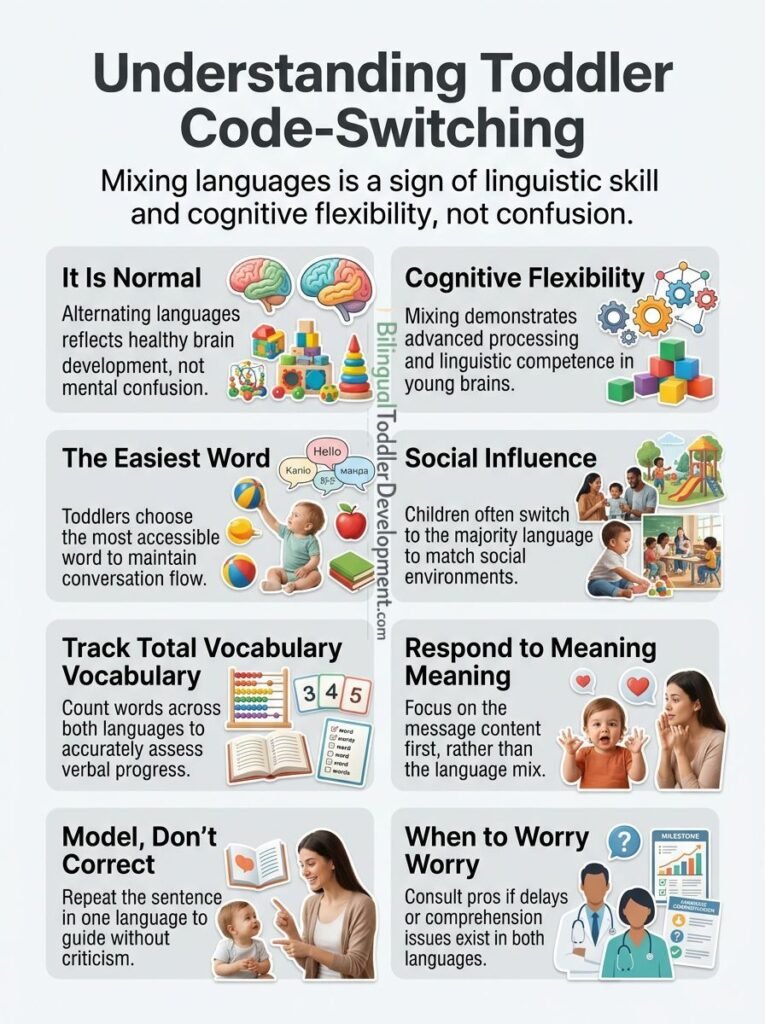
In most cases, the answer is no. Language switching is one of the most common and natural patterns in bilingual development. What sounds like “mixing” is often your child using the fastest word available to keep the conversation moving.
Understanding why toddlers switch languages can help you see what’s actually happening inside their developing language system—and how to support both languages without turning everyday conversation into a lesson.
What Is Code Switching in Bilingual Toddlers?
Code switching means your child alternates languages during a conversation. The switch can happen from one sentence to the next (inter-sentential code-switching) or inside a sentence (intra-sentential code-switching, also called intrasentential code-switching).
In a 2019 longitudinal study of Spanish-English toddlers in San Diego and French-English toddlers in Montréal, children switched languages more often between utterances than within them, which lines up with how short toddler sentences are at this stage. The same paper also reported that in the Spanish-English group, 77% of children switched from Spanish to English at least some of the time, and exposure patterns helped predict when those code-switches showed up.
Here’s the key takeaway: code-switching is usually a sign your child is using both language systems actively, not a sign they are “getting mixed up.”
- Inter-sentential code-switching: “Quiero jugar. I’m done.”
- Intra-sentential switching: “Quiero that one.”
- Code-switched fragments: short inserts that fill a gap fast
- Language dominance: which language comes out more easily in a given setting
Simple Examples of Code Switching in Toddlers
Toddlers pick words from both languages to finish a thought, especially the word that arrives fastest.
You might hear: “Mama, quiero juice.” Or: “No, no, all done.” Then they jump back to the other language five minutes later.
Those switches can show up in any word class: a noun (“juice”), a verb (“want”), an adjective, a pronoun, prepositions, or adverbs. During play, it can sound like rapid variability, but it often follows a simple pattern: your child grabs the most available label and keeps going.
- Lexical gap fill: they know the concept but only have the word in one language right now
- Recent exposure effect: the last language they heard can “prime” the next word
- Efficiency: they keep the conversation moving instead of pausing
Code Switching vs Code Mixing: Are They the Same?
People use these terms in different ways, so it helps to be explicit.
| Term you’ll hear | What it usually means | What it suggests you do |
|---|---|---|
| Code switching | Switching languages in larger chunks, often whole utterances (inter-sentential code-switching). | Notice the setting: who they are talking to and what language is being used around them. |
| Code mixing | Blending languages inside a sentence, including intrasentential code-switching or code-switched fragments. | Look for a vocabulary gap, then model the missing word naturally in the language you want to strengthen. |
Both patterns are common in bilingual toddlers and multilingual families. Neither automatically signals confusion.
Why Do Bilingual Toddlers Mix Languages?
Most bilingual toddlers mix languages for the same reason adults do: it is an efficient way to communicate with the vocabulary and language processing speed they have in that moment.
In English-dominant U.S. settings, a minority language (like Spanish or French) can be strong at home, but English can quickly become the “default” language for school, media, and peers. That difference in language prestige and day-to-day language exposure can pull a child toward English in certain contexts.
- Exposure: what they hear most, and with whom
- Proficiency: what they can say easily in each language
- Social context: which language gets a faster response from the listener
- Conversation speed: fast back-and-forth makes the “nearest word” strategy more likely
If you want to be strategic, treat language mixing as a clue: “What word did they borrow, and what would I like them to have ready in the minority language next time?”
Vocabulary Is Distributed Across Two Languages
A practical reality of bilingual first language acquisition is that toddlers rarely learn every label in both languages at the same time. Word learning spreads out.
That is why measuring only one language can make a capable bilingual child look “behind.” Many clinicians and researchers use total vocabulary (counting words across both languages) or conceptual vocabulary (counting concepts, regardless of which language the child uses for them) to get a fairer picture.
Total vocabulary, not an even language split, is often the clearest growth signal you can track at home.
- Action step: keep a running list of new words in both languages for two weeks, then look at growth, not just the split.
- Action step: if you work with an SLP, ask whether they can interpret bilingual results using total and conceptual scoring where appropriate.
Toddlers Choose the Easiest Word Available
When toddlers are excited, tired, or trying to keep up with a quick conversation, they often choose the word with the lowest “effort cost.” That might be the word they heard most recently, the one they can pronounce most easily, or the one they have practiced more.
So an intra-sentential code-switching example like an English noun inside a French sentence can simply reflect which label is most accessible, not which grammar they “forgot.”
- Pro-tip: if you want the minority language word to win the race, practice it in calm moments, not only when your child is already in motion.
- Simple tracking tool: a short observational log that notes the borrowed word, the topic, and who was present.
Social Context Influences Language Choice
Toddlers are more socially tuned than we give them credit for. They notice which language gets understood fastest, which language others are using, and which language “fits” the setting.
The 2019 longitudinal research described differences by language pair and context, and it also noted that the proportion of variance accounted for by exposure and proficiency can be modest. In other words, code switching is real and statistically meaningful, but it is not controlled by one single factor.
- Action step: if you want more minority language use, create predictable “minority-language zones,” like meals with grandparents, bedtime stories, or a weekend morning routine.
- Action step: coach frequent conversation partners (siblings, caregivers) to stay responsive in the minority language instead of switching to English to speed things up.
Is Code Switching a Sign of Confusion?
No. In most cases, code switching in bilingual toddlers is a normal part of language development.
A 2024 article for pediatric clinicians in JAMA Pediatrics describes mixing words from multiple languages as a typical part of multilingual development and not a sign of confusion. The more useful question is: “Is my child communicating, learning new words, and understanding in daily life?”
- Green flag: the message stays clear, even if the language changes.
- Green flag: your child understands routines and simple directions in the languages they hear most.
- Next step if unsure: track growth for 2 to 4 weeks, then review patterns, not one-off sentences.
What Research Says About Language Separation in Young Children
Researchers often study toddler code-switches by transcribing play sessions and analyzing language variability over time. You may see methods listed like quantitative analyses, bivariate correlations, partial correlation, logistic regression, t-tests, bootstrap procedure, and inter-rater agreement. Those are ways to check whether patterns are reliable, not just anecdotal.
Two common transcription tools you’ll see named are ELAN (often used for time-aligned audio and video coding) and CLAN (used with CHILDES-style transcripts). For parents, the “so what” is simple: strong studies usually show their work clearly enough that another team could repeat it.
- Action step: when you read a research summary online, look for whether it used recorded speech samples, not just memory-based impressions.
- Action step: if a paper lists a PMCID or NIHMSID, that often signals the manuscript is archived in a public research repository, which can make it easier to access and verify details.
Why Code Switching Can Reflect Cognitive Flexibility
Even in toddlerhood, choosing a language is a form of cognitive control: your child is selecting between two active systems. That can look like “random mixing,” but it often tracks the listener, the topic, and the setting.
If you want to encourage flexible bilingual communication without pressure, build it into play.
- Listener switch game: one stuffed animal “speaks” the minority language, the other “speaks” English, and you take turns.
- Topic switch routine: keep bath time in one language and snack time in the other for a few weeks, then see whether switching becomes smoother.
- Repair practice: if you do not understand, ask for clarification once, then model the word you think they meant.
What Code Switching Looks Like at Different Ages
Code switching changes as utterances get longer and vocabulary grows. A younger toddler may mostly insert single content words. An older toddler may switch entire sentences, especially when the conversation is moving fast.
Across ages, language exposure still matters. A child who hears the minority language mainly at home may show more switching toward English outside the home, because English is doing more “work” in that setting.
- Action step: compare your child to themselves over time, not to a monolingual child’s single-language output.
- Action step: write down where you want each language to be strong (home, relatives, school readiness), then align exposure with that goal.
Code Switching in the First Words Stage (12–18 Months)
In the first words stage, mixing can be as simple as one label in one language and the next label in the other. Gestures do a lot of the communication work, so a “mixed” vocabulary is common.
Instead of correcting language choice, respond to intent and add language models.
- Do: “Yes, ball. Ball!” then also offer the other language label naturally later.
- Do: repeat key labels during shared attention (pointing at the same object).
- Avoid: turning every word into a drill or asking for a translation on the spot.
Mixing Languages During Vocabulary Expansion (18–24 Months)
Between 18 and 24 months, toddlers often feel like they are learning words daily. Mixing languages can increase, simply because they are talking more.
If you want a concrete checkpoint, the American Speech-Language-Hearing Association lists that by 19 to 24 months many children use and understand at least 50 different words and start putting two or more words together. For bilingual toddlers, clinicians often look at that growth across both languages, not only in English.
- Action step: pick 10 high-use words (food, family, favorite toys) and make sure your child hears them in the minority language every day.
- Action step: use “say it back” modeling: respond to meaning, then repeat the sentence cleanly in one language.
Code Switching During Early Sentences (2–3 Years)
As sentences get longer, you may hear more obvious inter-sentential code-switching, like one sentence in English followed by one in Spanish or French.
In the 2019 longitudinal work on toddlers (31 to 39 months), Spanish-English children who switched from Spanish to English tended to do it with whole utterances more often than embedded words. The same paper also described shifts in what types of words were switched as children aged, with content words still playing a major role.
- Action step: if your child borrows a specific word repeatedly, that is your short list for the next week’s practice in the minority language.
- Action step: keep sentence models short. A two- or three-word model is easier to copy than a long correction.
When Code Switching Is Completely Normal
Most bilingual toddlers code switch at least sometimes. It is especially normal when your child has strong comprehension, steady growth in new words, and clear social engagement.
It is also normal for the direction of switching to lean toward the majority language in U.S. environments. That pattern often reflects opportunity and habit, not a problem with language acquisition.
- Normal pattern: more mixing during exciting play, fast talk, or new settings.
- Normal pattern: more minority language use with minority-language speakers.
- Normal pattern: more English at preschool, the playground, or with English-dominant peers.
Signs Your Toddler Is Progressing Normally
You can see healthy language development even with frequent code-switches. Focus on communication success.
- Your toddler gets their point across most of the time.
- Your toddler adds new words over weeks in one or both languages.
- Your toddler understands familiar directions in the settings where each language is used.
- Your toddler uses gestures, eye contact, and shared attention during play.
Why Mixing Often Increases During Fast Conversations
Fast conversation raises pressure. Toddlers often reach for the nearest available word, which can trigger code-switched inserts.
If you want fewer mid-sentence switches, slow the pace before you “teach.” You usually get better results by creating more turns, not longer turns.
- Action step: pause for two seconds after you speak, so your toddler has time to retrieve the word in the language you are using.
- Action step: use predictable phrases (like “I want,” “Help me,” “All done”) in the minority language every day, so they become automatic.
When Language Mixing May Signal a Concern
Language mixing itself is rarely the concern. The concern is a pattern of weak progress across both languages, poor comprehension in daily routines, or loss of previously learned skills.
For U.S. families, the CDC notes that at 2 years many children say at least two words together, and the American Academy of Pediatrics recommends standardized developmental screening at 9, 18, and 30 months, with autism screening at 18 and 24 months, or whenever you or your pediatrician have concerns.
- Action step: if you are worried, ask for a hearing check and a speech-language evaluation that considers both languages.
- Action step: bring a short video or audio sample from home, plus a simple word list from each language.
- Action step: tell the clinician your child’s language exposure pattern (who speaks what, and when).
Signs That May Indicate a Language Delay
Use clear, functional signs rather than counting code-switches. In bilingual toddlers, delays tend to show up as difficulties learning language in general, not as “too much mixing.”
ASHA’s communication milestones for 19 to 24 months include understanding and using at least 50 words and combining two or more words. If your child is not building words in either language over time, that is worth a closer look.
- Possible red flag: very few words across both languages by 24 months.
- Possible red flag: limited gestures and limited attempts to communicate.
- Possible red flag: poor comprehension in familiar routines (even with gestures and context).
- Possible red flag: regression, meaning they lose skills they previously used.
Why Delays Appear Across Both Languages
Bilingualism does not “cause” a language disorder. But low total exposure to meaningful interaction in any language can slow language development for any child.
Clinicians also watch for developmental language disorder (DLD), which can affect language learning regardless of the number of languages in the home. A thorough evaluation looks at learning patterns, not just a snapshot score in English.
- Action step: if your toddler hears the minority language mostly as background speech, convert some of that time into direct conversation or shared book reading.
- Action step: if you are pursuing an evaluation, ask whether testing can sample both languages or use bilingual-appropriate measures.
How Parents Should Respond When Toddlers Mix Languages
When you respond well to code switching, you protect your child’s confidence and you strengthen the language you want them to keep.
Use these strategies as a menu. Pick two for two weeks, then reassess.
- Track the pattern: note which words get borrowed, since those are often the exact vocabulary gaps you can fill.
- Model, do not correct: restate the sentence in one language without making your child repeat it.
- Build minority-language routines: keep the minority language active with real interaction, not only songs in the background.
- Support total vocabulary: celebrate new words in either language, then add the missing label later.
- Use play for practice: pretend play makes repetition feel natural and boosts language acquisition.
Respond to the Message First
Reply to your child’s idea first. That keeps communication rewarding and supports social language development.
Then, if you want to support the minority language, offer a clean model in that language. Keep it short and friendly.
- Child: “Quiero juice.”
- You: “You want juice. Sí, quieres jugo.”
- Child: “Ouvre le book.”
- You: “Open the book. Ouvre le livre.”
Model the Sentence in One Language
After your child speaks, model the full sentence in one language. Match their meaning, keep the grammar simple, and keep the conversation moving.
If your child is sensitive to correction, skip the “repeat after me” step. You can still provide strong monolingual models without turning it into a performance.
- Make models short: 3 to 6 words is usually plenty for a toddler.
- Repeat key verbs: action words drive early sentences.
- Recycle phrases: repeated frames help language proficiency grow faster.
Keep Both Languages Active at Home
If you want the minority language to stay strong in the U.S., consistency matters more than perfection. Your child does not need equal exposure every day, but they do need regular, meaningful chances to use it.
You can use any home structure that is realistic for your family. Some families use one-parent-one-language. Others use time blocks, like minority language at breakfast and bedtime.
- Action step: choose two daily “anchors” for the minority language (bedtime story, bath time, school pickup, or dinner).
- Action step: recruit more speakers. Video chats with relatives count, as long as your child participates.
- Action step: rotate topics your child loves (vehicles, animals, cooking) and build word lists for those themes.
Does Code Switching Go Away as Children Grow?
Often, mixing changes rather than disappearing. As vocabulary and sentence length increase, some children mix less inside sentences, but still switch languages by topic, listener, or setting.
It also depends on the environment. If English becomes dominant at school and in the community, many children continue to switch toward English unless the minority language stays active and useful in daily life.
- Action step: aim for a “use case” for the minority language, like relatives, community events, religious services, or a regular activity group.
- Action step: if you notice attrition (skills fading) in the minority language, increase interaction time first, then reassess after a month.
How Vocabulary Growth Reduces Mixing
As your toddler learns more words in each language, they can rely less on borrowing. That can reduce intra-sentential switching that is driven by vocabulary gaps.
The simplest way to support that growth is to increase meaningful input and practice around your child’s favorite topics. You are trying to make the minority language words easy to retrieve, not just “known.”
- Action step: pick one weekly theme and repeat it across books, play, and daily routines.
- Action step: add translation equivalents gradually, not all at once.
Why Many Fluent Bilinguals Still Code Switch
Even adults with strong language proficiency code switch. They do it for speed, emphasis, identity, humor, or because one language fits the moment better.
So if your long-term goal is a child who can communicate comfortably across multiple languages, some code-switching is a feature, not a failure.
- Helpful mindset: separate “borrowing because of a gap” from “switching because it fits the social moment.”
- Action step: keep building depth vocabulary in the minority language so switching becomes a choice, not a necessity.
How Code Switching Fits Into Bilingual Language Development
Code switching fits into bilingual language development as a normal strategy: toddlers use both systems to communicate efficiently while their vocabularies and grammar strengthen.
In the preschool period, studies often find more inter-sentential code-switching than intrasentential code-switching, plus a tendency to switch content words more than function words. That pattern makes sense for young bilingual children whose sentences are still short and whose word learning is expanding rapidly.
- Action step: use code-switches as a map for what to teach next, especially in the minority language.
- Action step: prioritize conversation and play over drills, since real interaction builds language processing skill.
Why Total Vocabulary Matters More Than Language Separation
If you force strict separation too aggressively, you can miss the bigger goal: growing total vocabulary and confidence in both languages.
Tools that clinicians often use to track early language include parent-report inventories like the MacArthur-Bates Communicative Development Inventories (available in English and Spanish forms), which can help you quantify progress without relying on memory alone.
- Action step: if you are tracking progress, track new words and new word combinations across both languages.
- Action step: bring your tracking notes to appointments so a clinician can see growth trends, not just a single-day snapshot.
How Code Switching Relates to Language Milestones
For many toddlers, switching increases during bursts of growth, then steadies as words become easier to retrieve. Switching can also rise in new environments, like starting preschool, because social context changes language demands.
The practical milestone focus is this: is your child steadily gaining new ways to communicate, in at least one language now and ideally in both over time? If yes, code-switching usually sits inside normal language acquisition.
- Action step: watch for month-to-month change: new words, new phrases, clearer requests, and better comprehension.
- Action step: if progress stalls across both languages, consider a bilingual-informed evaluation rather than waiting for code-switching to “stop.”
Conclusion: Code Switching Is a Normal Part of Bilingual Development
Code switching is one of the most common forms of language mixing you’ll hear in bilingual toddlers, and it usually reflects normal language development, not confusion.
If you respond to meaning, model clean sentences, and keep the minority language active, you support language acquisition and language proficiency while your child learns to use both languages with confidence.
As vocabulary grows and conversations become more complex, many bilingual children continue switching languages naturally depending on the listener, setting, or topic.