
Can a 2 Year Old Be Bilingual? What’s Normal, What’s Not, and When to Worry
“Am I confusing my child?”
If your two-year-old mixes languages in the same sentence, says fewer words than another toddler at the playground, or seems to understand everything but barely speaks, that question can sit quietly in the back of your mind.
When you’re raising a child with two languages, normal development can look messy. Words might be “split” between languages. Phrases may come later than you expected. One language might seem stronger than the other. It’s easy to wonder if adding a second language is making things harder.
Take a breath.
Yes, a 2 year old can absolutely be bilingual.
In fact, toddlers are remarkably equipped to sort, absorb, and use more than one language — even if their speech doesn’t look polished yet. Mixing languages, uneven vocabulary, and slower single-word output in one language are often completely typical patterns in bilingual development.
The key is knowing what’s normal, what’s worth watching, and how to support both languages without turning your home into a classroom.
In this guide, you’ll learn:
- What bilingualism really looks like at age two
- How to interpret milestones across both languages
- When language mixing is normal (and when to seek support)
- Practical ways to strengthen exposure in everyday routines
If you’re hoping to raise a confident bilingual child — without second-guessing every word — you’re in the right place.
Key Takeaways
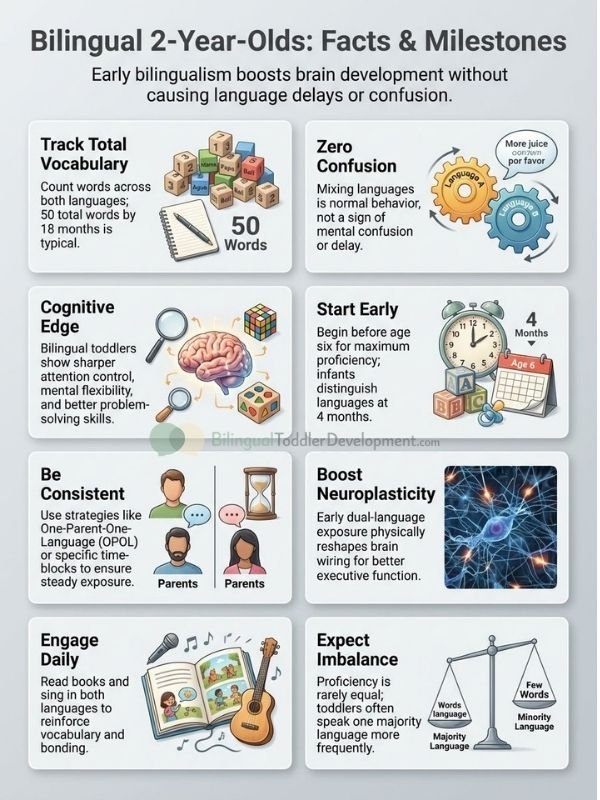
- Yes, toddlers can learn multiple languages. In a 2007 study in Science, researchers found infants as young as 4 months can discriminate languages in controlled lab tasks, which supports the idea that “sorting” languages is not too hard for the young brain.
- Late talking is fairly common. ASHA notes late language emergence in 2-year-olds often falls in the 10% to 20% range, and a widely used clinical marker is fewer than 50 words and no two-word combinations by 24 months.
- Count words across both languages. A 2024 JAMA Pediatrics article for parents emphasizes looking at total vocabulary across languages and counting translation pairs (like “dog” and “perro”) as one concept.
- Language mixing is normal. Many toddlers code-switch because they are using every tool they have to communicate. Your job is to keep input steady and make both languages useful in daily life.
What Does It Mean for a 2-Year-Old to Be Bilingual?
A 2-year-old can understand two languages and show different strengths in each.
At age two, “bilingual” usually means your child hears and uses two languages regularly, even if they talk much more in one of them right now.
It helps to think of bilingualism as a continuum. Some children are strong “listeners” in a language long before they become confident “speakers,” especially if that language shows up mostly with one caregiver, at childcare, or during certain routines.
You’ll often hear two categories:
- Simultaneous bilinguals: children exposed to two languages from birth (or very early infancy).
- Sequential bilinguals: children who start with a first language, then add a second language later (often when childcare or preschool begins).
Uneven skills are normal. A toddler might know more nouns and verbs in one language (food, toys, actions), and more “school words” in the other (colors, shapes), depending on where the language is used.
If you want a practical way to measure progress, focus on communication: can your child get needs met, share interest, follow simple directions, and use first words and early phrases in at least one of their languages?
Language Development Milestones for Bilingual 2-Year-Olds
For bilingual toddlers, milestones still matter, but you need to interpret them through the lens of language exposure. A child who hears English all day at childcare and Spanish mostly at bedtime will look different from a child who gets a true 50/50 split.
As of an April 2025 update, the CDC’s 2-year milestones include saying at least two words together (example: “More milk”). Use that as a functional checkpoint, not a competition.
If you’re unsure what “counts,” this quick guide keeps you grounded:
| What you’re watching | What it can mean in bilingual toddlers | What to do this week |
|---|---|---|
| Lots of understanding, fewer spoken words | Strong receptive language, expressive language still catching up | Narrate routines, then pause so your child can fill in one word |
| Words in both languages, but “mixed” in one sentence | Normal language mixing and efficient communication | Respond warmly, then model the phrase back in one language |
| Few words and no two-word phrases close to age 2 | Could be late language emergence (in any child, bilingual or not) | Talk with your pediatrician and consider a speech-language pathologist consult |
Vocabulary growth in two languages
Bilingual toddlers often have a “split” vocabulary, which can make them look behind if you only count one language. That’s why many clinicians use total conceptual vocabulary, meaning you count concepts across both languages, and you do not double-count translation pairs.
For example, if your child says “dog” in English and “perro” in Spanish, that is still one concept. A 2024 JAMA Pediatrics piece for parents highlights this exact point because it changes how you interpret “word counts.”
To track vocabulary in a way that actually helps you make decisions, use a simple method:
- Keep a running list of new words in each language (separate columns).
- Mark translation pairs with a single star so you count them once.
- Note whether the word is used spontaneously or only repeated.
- Track a few “function words” too, like early adjectives (“big,” “hot”) and early prepositions (“in,” “on”), since these often come later than nouns.
If vocabulary is growing but uneven, that usually points to an exposure problem, not a learning problem. You can fix exposure.
Use of two-word phrases
Two-word phrases are a major checkpoint because they show your child can combine meaning, not just label objects. You may hear these as “more milk,” “mama up,” or “no shoes.”
Two-word phrases are less about perfect grammar and more about your child learning to combine ideas.
CDC’s 2-year milestone includes saying at least two words together, and ASHA’s commonly used late language emergence marker includes no two-word combinations by 24 months. If your child is close to age two and phrases are not showing up in either language, it’s worth getting eyes on the full picture.
If your child is using single words, you can often nudge phrases without turning your home into a classroom:
- Expand, don’t quiz: if your child says “milk,” you say “more milk” and hand it over.
- Use power phrases: “help me,” “all done,” “my turn,” “go car,” “bye bye.”
- Build verbs into daily life: “wash hands,” “open door,” “sit down,” “pick up.”
- Repeat the same phrase in the same moment: toddlers learn through predictable repetition.
Code-switching behaviors
Code-switching means switching languages within a conversation. At age two, it often looks like using the easiest word available from either language, especially for high-emotion moments like snacks, bedtime, or big feelings.
A 2025 update from Nationwide Children’s Hospital notes that mixing two languages can be a natural form of communication in multilingual families. In day-to-day life, it usually signals flexibility and problem-solving, not confusion.
If you want to support balanced bilingualism without making your child feel corrected all day, try these low-friction moves:
- Follow their message first: answer what they meant, right away.
- Model a clean version: repeat the phrase back in the language you want to strengthen.
- Keep the conversation going: more back-and-forth builds communication skills faster than flashcards alone.
- Protect the minority language moments: meals, bath time, or the ride home can be “target language” routines.
Common Questions About Bilingualism in Toddlers
Most worries fall into two buckets: “Will my child be confused?” and “Am I causing a language delay?” Both are understandable questions.
Here are clear answers, plus the practical next steps that actually help.
- Confusion: language mixing is expected and usually temporary.
- Delays: bilingualism does not create a delay, but delays can happen in any child and should be evaluated when red flags show up.
Are bilingual children confused?
In controlled research settings, infants can discriminate languages very early. A well-known 2007 paper in Science found infants could visually distinguish languages at 4 months in lab tasks, which supports what many clinicians see in practice: children’s brains are built to sort patterns.
What looks like “confusion” is usually one of these normal scenarios:
- Your child knows the word in one language but not the other yet.
- Your child is using the language that feels easiest in that setting (childcare, playground, grandparents).
- Your child is borrowing a word because it is the one they hear most often.
If you want to reduce mixing without shutting your child down, keep your response simple: acknowledge, then restate in the language you are targeting.
Does bilingualism cause language delays?
Bilingualism does not cause language delays by itself. Family physicians and pediatric guidance commonly note that children raised with two languages may mix them early on, but they tend to reach similar milestone windows as monolinguals.
The key is to separate “bilingual pattern” from “red flags.” ASHA notes late language emergence estimates in 2-year-olds often range from 10% to 20%, and one widely used marker is fewer than 50 words and no two-word combinations by 24 months.
If you are deciding whether to seek help, this checklist is a good starting point:
- Your child has very few words across both languages close to age two.
- Your child is not combining words in either language.
- Your child seems to have limited understanding of simple, familiar directions in any language.
- You notice hearing concerns, frequent ear infections, or inconsistent response to sound.
- Your child has lost words or social communication skills they used before.
A speech-language pathologist can evaluate bilingual children appropriately by looking at skills across languages and contexts, not by treating one language as “extra.”
Is it better to start earlier?
Earlier is usually easier, mostly because it gives you more time to stack up meaningful hours of input. ASHA’s parent guidance is straightforward: start early, and aim for lots of practice through talking, singing, playing, and reading.
The important nuance is this: starting earlier does not mean drilling. For two-year-olds, the fastest path to language learning is still play-based learning plus real conversation.
If you are starting a second language at age two, pick one or two routines and make them reliable:
- Morning routine: dressing, breakfast, and the walk to the car in the target language.
- Bath routine: the same 10 to 15 words and phrases every night.
- Books: reread the same favorites so your child can predict and participate.
Benefits of Bilingualism at an Early Age
For most families, the biggest benefits are practical: your child can connect deeply with grandparents, caregivers, and community, and you do not have to “choose” a first language over family identity.
On the skills side, multilingual children often get extra practice noticing patterns, switching between speakers, and learning that one idea can have multiple labels.
Cognitive advantages
You will hear big claims about bilingualism and cognitive development. The honest version is more useful: some studies find task-specific advantages in attention and flexibility, while other large studies find little difference once you control for factors like socioeconomic status and language exposure quality.
What is not debated is that bilingualism gives your child a real-world cognitive skill: the ability to communicate with more people, in more places, across more experiences.
In a 2025 Bayesian meta-analysis of dementia research, bilinguals were estimated to show dementia symptom onset about 3.45 years later on average than monolinguals, though the authors did not find robust evidence that bilingualism prevents dementia.
That long-term research is interesting, but for a two-year-old, your best “cognitive advantage” is simpler: build strong language routines that keep both languages useful and joyful.
Enhanced cultural understanding
Culture is where language sticks. When a toddler associates a language with people, food, songs, and family jokes, they are more likely to keep using it.
Try making culture part of your weekly rhythm:
- Cook one family recipe while naming ingredients and actions (stir, pour, cut).
- Do a weekly video call with relatives, and prep three “easy wins” your child can say.
- Find bilingual story times or community playgroups where your child hears the language from other kids.
- Use simple traditions (holiday crafts, songs, greetings) in the dual language you want to protect.
Better problem-solving skills
Two-year-olds problem-solve all day, mostly through trial and error. Multiple languages add more chances to practice sorting, matching, and switching, which are real-world thinking skills.
Keep it toddler-simple. Build language learning into games you already play:
- Sorting game: “big/small,” “soft/hard,” and color words in both languages.
- Treasure hunt: hide three objects and give clues using prepositions like “in,” “on,” and “under.”
- Repair moments: when your child points, model the phrase they needed, like “help me” or “I want that.”
Challenges of Raising a Bilingual 2-Year-Old
Raising a bilingual toddler can feel uneven because language exposure is rarely even. English often dominates outside the home in the U.S., so the minority language can fade unless you build real reasons to use it.
The good news is that most challenges are predictable, which means you can plan for them.
Potential slower vocabulary development in one language
It is common for a child to have fewer words in the language they hear less. That does not automatically signal a language delay.
Instead of asking “How many words does my child have in English?” ask a better question: “How is my child communicating across both languages?” A 2024 JAMA Pediatrics article aimed at parents stresses that vocabulary should be considered across languages, using total vocabulary and avoiding double-counting translation pairs.
If you want to strengthen the less-used language, focus on high-frequency needs first:
- Food and drink words
- Comfort phrases (help, hurt, tired, all done)
- Play verbs (open, push, jump, throw)
- People and routines (grandma, daycare, bedtime)
Balancing language exposure
Balancing languages is less about perfection and more about building consistent “language jobs,” meaning each language has places where it is needed.
Dual language immersion programs in the U.S. often use structured schedules like 50/50 or 90/10, and descriptions of these models typically emphasize that the partner language should be used for at least half the school day in true immersion settings (as outlined by Goethe-Institut USA). That same logic helps at home: small, occasional exposure is rarely enough for confident speaking.
If you want a simple home plan, try one of these:
- OPOL: one parent mainly uses one language, the other parent mainly uses the other.
- Minority language at home: home is mostly the target language, English happens outside.
- Time and place: mornings are Spanish, bedtime is English, childcare is English, weekend playdates are the target language.
Pick one approach for 6 to 8 weeks before you judge results. Toddlers need repetition and time.
Tips for Supporting a Bilingual 2-Year-Old
The best plan is the one you can actually sustain. For two-year-olds, consistency wins because it creates predictable opportunities to talk.
Use the tips below to build communication skills, support language acquisition, and reduce stress around “doing it right.”
Consistency in language use
Consistency does not mean never switching. It means your child can predict which language is likely in which moments, and they get enough practice to use it.
If you are using OPOL or a time-and-place method, these habits make it easier:
- Anchor routines: meals, bath, bedtime, and the drive are your best language exposure blocks.
- Use stable phrases: keep 10 to 20 “daily life” phrases you repeat often.
- Keep correction gentle: respond to meaning first, then model your preferred wording.
- Recruit childcare support: ask caregivers which words they hear most, then reinforce those words at home in both languages.
If you are considering American Sign Language, treat it like any other language: your child needs consistent models and daily opportunities to sign for real reasons.
Engaging in language-rich activities
Two-year-olds learn language through back-and-forth, not through passive listening. That’s why shared reading, songs, and play work so well.
Public health messaging and early literacy campaigns often push a simple habit. Read aloud daily, and keep it doable. The Read Aloud 15 Minutes campaign promotes 15 minutes a day, and it points to the American Academy of Pediatrics recommendation (first issued in 2014) to begin reading aloud at birth.
To make books work for bilingual language learning, use “dialogic reading,” which is just a fancy name for interactive reading. Many educators use the PEER pattern:
- Prompt: “What’s that?”
- Evaluate: “Yes, a truck.”
- Expand: “A big, red truck.”
- Repeat: “Big red truck.”
You can do this in either language, and you can switch languages by day, by parent, or by routine.
Encouraging both languages equally
Equal love for both languages does not require equal hours every day. It requires two things: steady input and real reasons to use each language.
Try building “reasons to speak” into your week:
- One playdate or family call where the target language is expected and supported.
- A small set of toys that “live” in one language (kitchen play, dolls, cars).
- A short daily routine where you pause and let your child fill in the last word.
- A simple music playlist in the less-used language that you sing together.
If your child answers you in the majority language, do not panic. Keep responding, keep modeling, and keep the target language moments warm and predictable.
Myths About Bilingualism in Toddlers
Many myths sound persuasive because they match what you see day-to-day, like language mixing or uneven vocabulary. The research and clinical guidance are clearer: bilingualism does not “break” language development.
Bilingualism leads to confusion
Mixing words is common in early bilingual development. It usually means your child is using every tool they have to communicate in that moment.
If you want to reduce mixing, do it through better input and better routines, not pressure. Model the phrase you want, then keep the conversation moving.
Parents must stick to one language each
OPOL can work well, but it is not the only effective strategy. Many families succeed with time-and-place routines, minority language at home, or childcare plus home language combinations.
The bigger predictor is whether your child gets enough high-quality conversations in each language, including opportunities with other native speakers when possible.
Mixing languages is harmful
Language mixing is not harmful by default. In many multilingual communities, code mixing is a normal communication style across ages.
What can be harmful is making a child feel corrected or embarrassed for trying. If you want to tighten up language use, keep it positive: respond, model, and repeat.
Scientific Insights on Early Bilingualism
Science gives parents a helpful reframe: children are prepared to learn multiple languages, and the brain adapts to the input it receives.
Your toddler does not need perfect separation. Your toddler needs steady opportunities to hear language, use language, and feel understood.
Brain development in bilingual toddlers
Early language acquisition overlaps with rapid brain growth in infancy and toddlerhood. That timing is one reason bilingual learning can feel natural when exposure is consistent.
A practical takeaway from the research is simple: if you want a child to speak a language fluently later, you need to protect daily speaking opportunities now, even if the speech is messy at first.
Research on language acquisition in young children
Modern guidance for parents and clinicians emphasizes better measurement. You need to account for vocabulary across languages, look at comprehension and gestures, and interpret milestones in context.
If you are worried, do not wait for “school to fix it.” In the U.S., children under three can often access evaluation through early intervention services, and a speech-language pathologist can help you sort out whether you are seeing a normal bilingual pattern, late talkers, or signs of a broader language delay.
Conclusion
Yes, a 2 year old can be bilingual, and that can support long-term language development.
The patterns that worry parents most, like language mixing and uneven vocabulary, are often normal in children learning multiple languages.
Your best leverage is steady language exposure that fits your real life: predictable routines, books, songs, play, and frequent back-and-forth conversations.
If your child has very few words across both languages or is not combining words close to age two, a speech-language pathologist can help you get clear answers and a plan.
With the right support, many multilingual children grow into confident communicators in their first language and their second language.